

A continent of ecologies
Wildlife on a Wanderer’s Back
In this section
A Wanderer carries biomes, migrations, husbandry, predators, wonders, and local variation at continental scale.
On this page 19 topics
#11. Wildlife on a Wanderer's back
A Wanderer is the size of a continent and carries the variety of one. Its back holds mountain ranges and moss-forests, plains, deserts, warm coasts, lakes, farmland, and frontier that nobody has walked twice. There is no single roster of animals for a thing that large, and any list claiming to be one would be describing a valley and calling it a world.
First, what you are standing on. For nearly everybody, nearly always, it is soil — millennia of accumulated sediment lying over the titan, deep enough to plow, to sink a well into, to root a forest in, and to bury four hundred years of ancestors without ever once reaching anything that is alive. Farmland is farmland. A forest floor is a forest floor. Nobody is walking on a Wanderer's skin.
The living body is underneath it, and it surfaces. Bone-rock — the titan's skeleton — breaks through wherever the soil runs thin: ridges, spines, scoured flank, high country. The hide itself shows at creases, at breath-vents, along warm runoff channels, and at the mouths of the Depths. Those exposures are a small fraction of a Wanderer's back, and they are where the strangest life on the Tread lives — which is why this chapter spends so much of its length on ground that most people cross twice in a lifetime and many never cross at all.
The Handbook says it better than a bestiary can: you do not forget that you are standing on something alive, but you can go years without being shown it — Player's Handbook, Introduction — The Tread, “What is under your feet.”
Past that, a division runs underneath everything in this chapter: some of the life up here arrived, and some of it was always here. A settlement's dogs and a settlement's hidemites are not two kinds of animal. They are two kinds of history, and knowing which is which tells you more about a region than any amount of describing the animal.
Everything past that division is local, and local means the place answers for it. A Chronicle that needs an animal should build one belonging to its own region, and should not mistake having built it for having established it everywhere.
For the craft of that — what to ask before inventing one, and how to bring it to a table — see Tread Master's Guide, §28.1 — Creating a Chronicle-local living entry.
#11.1 Ordinary life, and how it got here
There are wolves. There are deer, squirrels, rabbits, foxes, goats, songbirds, crows, turtles in the slow water, fish in the watersheds, beetles in the grain and moths in the wool. Most of what a company meets in a season is an ordinary animal doing an ordinary thing, and it is worth saying so plainly rather than dressing it up.
But almost none of it is native. A Wanderer's back is a living surface that people arrived on. Every ordinary animal up here is descended from something that was carried — livestock driven aboard, working animals, pets, hunting stock, fish deliberately put into a watershed, bees in a hive, vermin in a grain sack, seeds in the mud on somebody's boot. Then it got loose, and then it had a very long time.
That single fact is the most useful generative tool in this chapter, because it turns a question about animals into a question about people. Ask what was brought here, and what got out.
Four things follow.
Two Wanderers do not have the same ordinary animals. Different peoples brought different things. A traveler from a titan with no wolves may reach one where wolves are the reason nobody walks the ridge at night, and find the whole idea of them foreign rather than frightening.
A Convergence is an ecological event, not only a trade one. Things cross. Some of what crosses was not invited, and a settlement may still be arguing three generations later about which titan a pest arrived from.
Absence is lawful and interesting. "There are no wolves here; nobody ever brought any" is a complete and correct answer. So is a Wanderer with no honeybees, whose orchards are pollinated by something else entirely.
Names drift. The same animal carries different names on different Wanderers, and a Fleethollow route-keeper who knows both is a more useful traveling companion than a hunter.
Every ordinary animal up here is a piece of somebody's history that got loose. The wolves on a ridge came aboard once, in a crate or on a lead or trailing a wagon nobody was watching, and nobody now remembers whose they were.
#11.2 Life of the hide
The animals above came aboard. This life did not.
A Wanderer is a living body, and living bodies carry passengers. What follows evolved here, on a titan, and lives on and in the living surface itself rather than in the sediment above it — so almost all of it is found where that surface is exposed: creases, breath-vents, warm runoff, bare bone-rock, and the thin ground of the flanks and the high country.
A farmer can work the same field for fifty years and meet none of it. That is the ordinary case, and it is worth stating plainly before a chapter that is about the extraordinary one. This is the strangest ecology in the setting and the one most worth reaching for when a Chronicle wants something that could not exist anywhere else — and it is also, for most people, somewhere else.
None of it is a required roster. Each entry carries what it asks of the people who meet it and where on the body it is found, because on a Wanderer those are usually the same fact.
#Hidemites · Nuisance. · The warm folds.
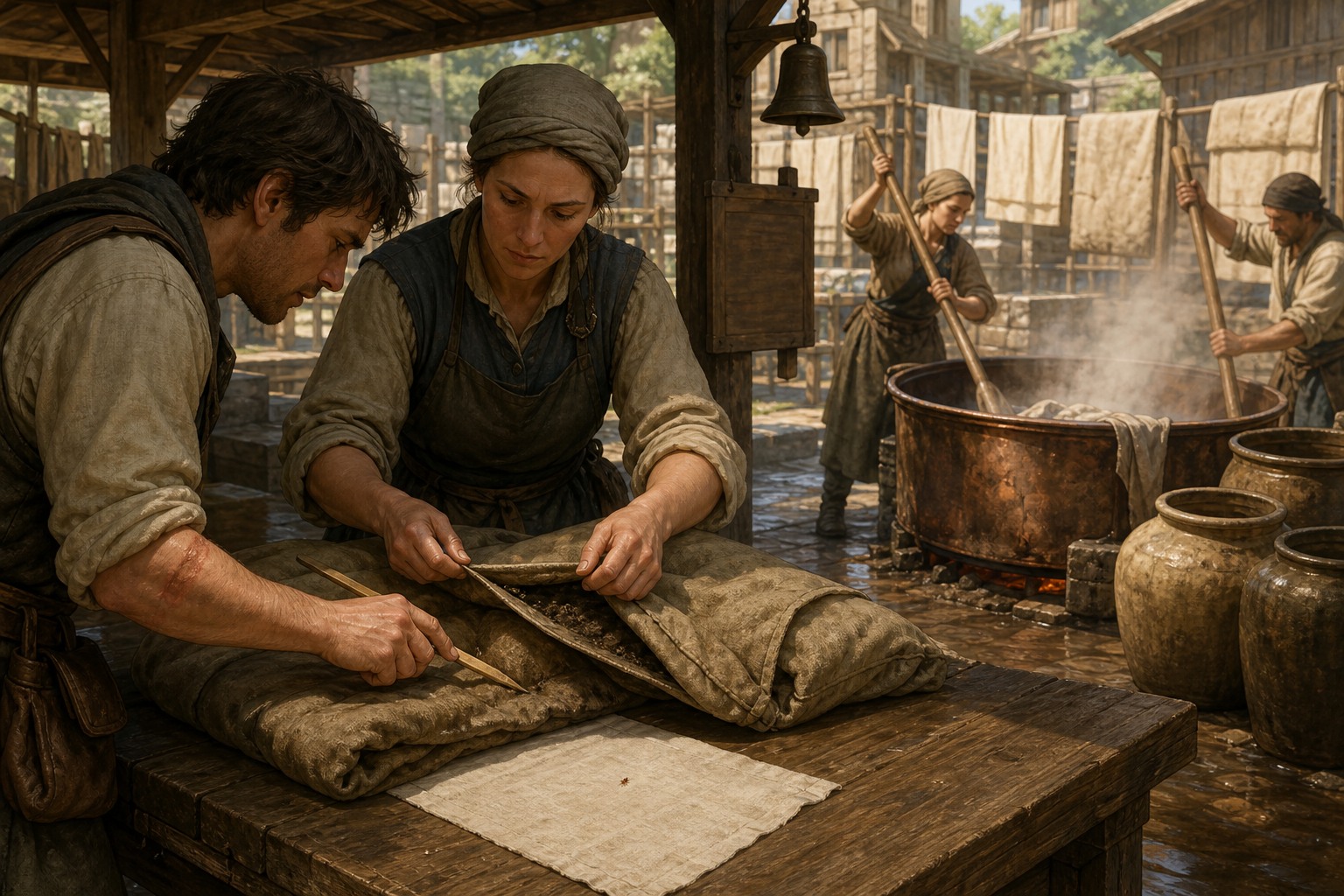
The ordinance is older than the charter. We do not know who wrote it and we boil on the day it names. — a settlement clerk of the middle back, asked why
What you see: almost nothing. A hidemite is a pale reddish speck the size of a pinhead — a moving dot against clean linen and invisible against anything else. What people actually see is the evidence: a fine gritty dust in the seams of a bedroll, and a rash in a band exactly where cloth pressed on skin.
They live where the hide creases: warm, damp, sheltered, and almost exactly like the inside of a bedroll. They have no interest in people at all. They have an enormous interest in cloth, and people are the only thing on the Tread that has any.
So laundry is a civic matter. Nearly every settlement of any size keeps a boiling day, a boil-house, and a body of ordinance about both that frequently predates the settlement's own founding papers. Caravans arriving between boiling days camp outside the line. Caravans that skip two do not get a third invitation. There is an entire trade in lye, scrapers and cheap bedding that everybody depends on and nobody has ever thought of as a trade.
What outsiders get wrong is that it is about cleanliness. It is about cloth. A meticulous traveler with the wrong bedroll is carrying thousands of them. A filthy one who sleeps on bare rock is carrying none, and will say so at length, to anyone.
The insult follows the misunderstanding, as insults do. Accusing somebody of carrying mites is a specific and cutting thing to say, and settlements that would never admit to disliking road people say it about Fleethollow carters and Roadwise families with great regularity and perfect deniability.
Where they are not. The cold high country and the dry flanks have almost none. Tuskborn visitors to the warm back find the whole apparatus of boiling day — the bell, the queue, the ordinance read aloud — hysterical, and say so, and are not thanked for it.
#Gleaners · Nuisance. · Wherever people are.
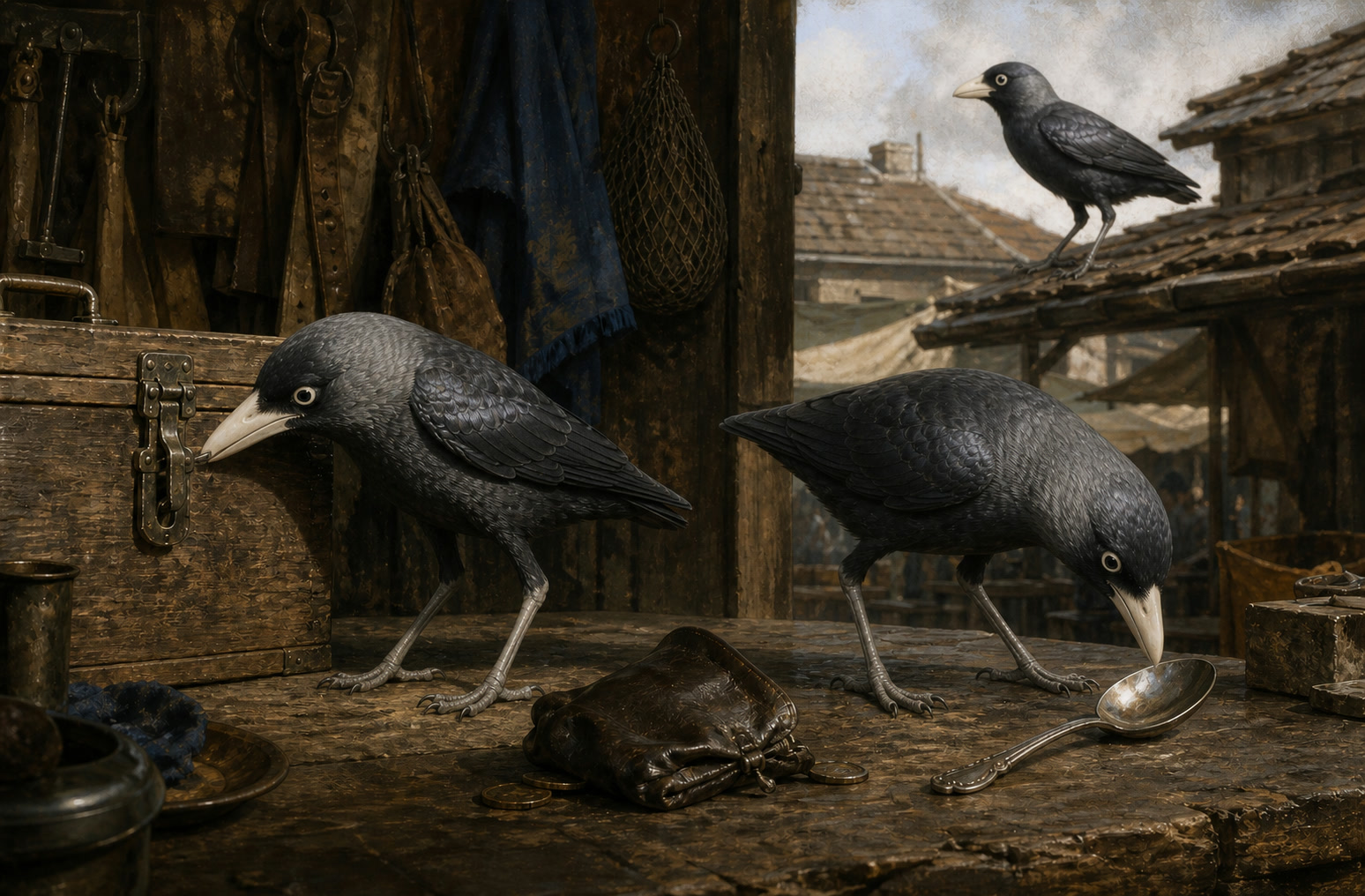
What you see: a crow-sized bird, gray-black and glossy, with a heavy pale bill and a bright ring around the eye. The tail is short and square and the legs are long for a bird that size, because a gleaner spends more of its life walking on tables than flying.
Native to the hide, though they behave so much like something that grew up alongside settlement that naturalists have argued the point for a century. They did not grow up alongside settlement. They found it, and found it good.
They take what is bright and unlatched. They do not take what is valuable, which is the distinction everyone learns a little late: a Gleaner will step over a purse to reach a spoon. Sagebound latch their reagent cases because of Gleaners. Guild halls keep rules about what may be left open on a bench. In market towns there is a child paid to sit with the goods and do nothing else, and that job has a name in every dialect that has ever needed one.
They test. A Gleaner will work at a catch, fail, leave, and come back the following week having evidently thought about it — and the people who have watched this happen are unanimous, and are not believed.
Every settlement has one story. The best documented belongs to a boundary crew at Kelt Rethin who lost a license-seal off a table in the open air, could not lawfully open a face for a season, and cost four families a winter. It is still cited in arguments about where paperwork ought to be kept.
They are also useful. A flock working the air ahead means people ahead, and Fleethollow route-keepers read them without ever quite conceding that a bird is part of the method.
#Stitchbirds · Hazard. · Anywhere woven.
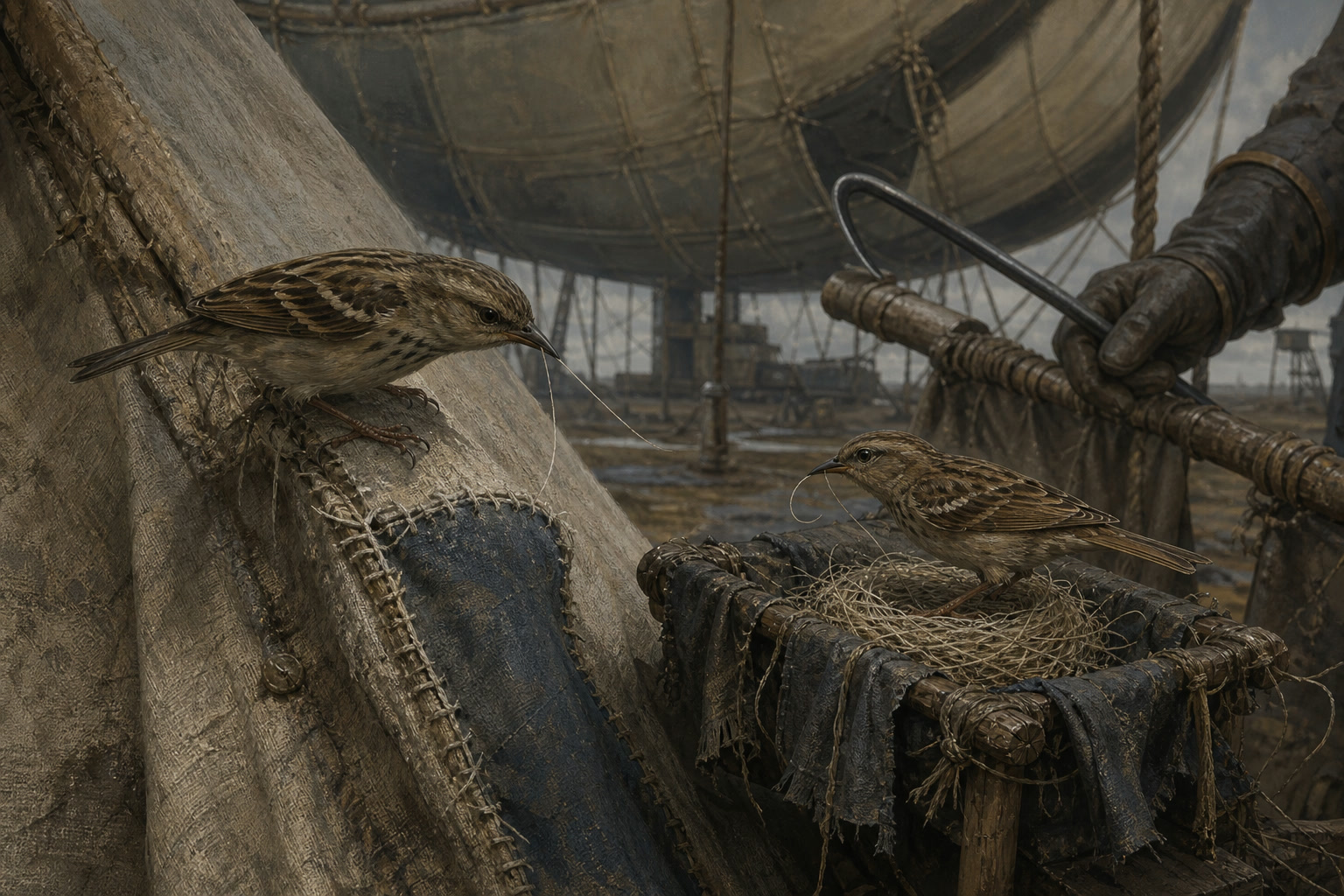
What you see: a small drab bird, sparrow-sized, streaked brown and buff, and entirely unremarkable until it is working. The bill is the tell — long, fine, and hooked at the very tip, built to draw one thread out of a weave without taking the weave with it.
They nest in the fibrous growth that mats the older hide, and they build well. Then people arrived carrying the finest nesting material that has ever existed on this titan, and the fortunes of the stitchbird improved immeasurably through no effort of its own.
They pull thread. Tents, nets, sacking, sail, rope lashings — and, the reason anyone outside a farm has heard of them, the envelope of a moored airship. A colony establishing beside a mooring field is not a nuisance. It is an economic emergency, and the standard answer to it is a person.
Line-walkers are that person. They walk the moorings and they look up, all day, in a particular way that other line-walkers recognize from across a field. It is a real profession with real apprentices and a real body of lore about knots, and a retired line-walker still looks up.
The argument is what to do about a colony. Settlements that burn one out say so proudly at council. Settlements that hang offering-frames — racks of waste cloth set out at the field's edge, deliberately, as better nesting than the envelope — are quieter about it, because it sounds uncomfortably like feeding the problem. It works considerably better, and it is very hard to defend to anybody who has just lost an envelope.
A Wildcaller with standing can move a colony. It is expensive, and the colony returns if the mooring field is still the best cloth on the ridge, which it is.
What people get wrong is that they are destructive. They are builders. They are superb at it, and what they are superb at is taking your tent apart in good order and putting it somewhere better.
#Tallow-moths · Hazard. · At dusk, at any worked light.
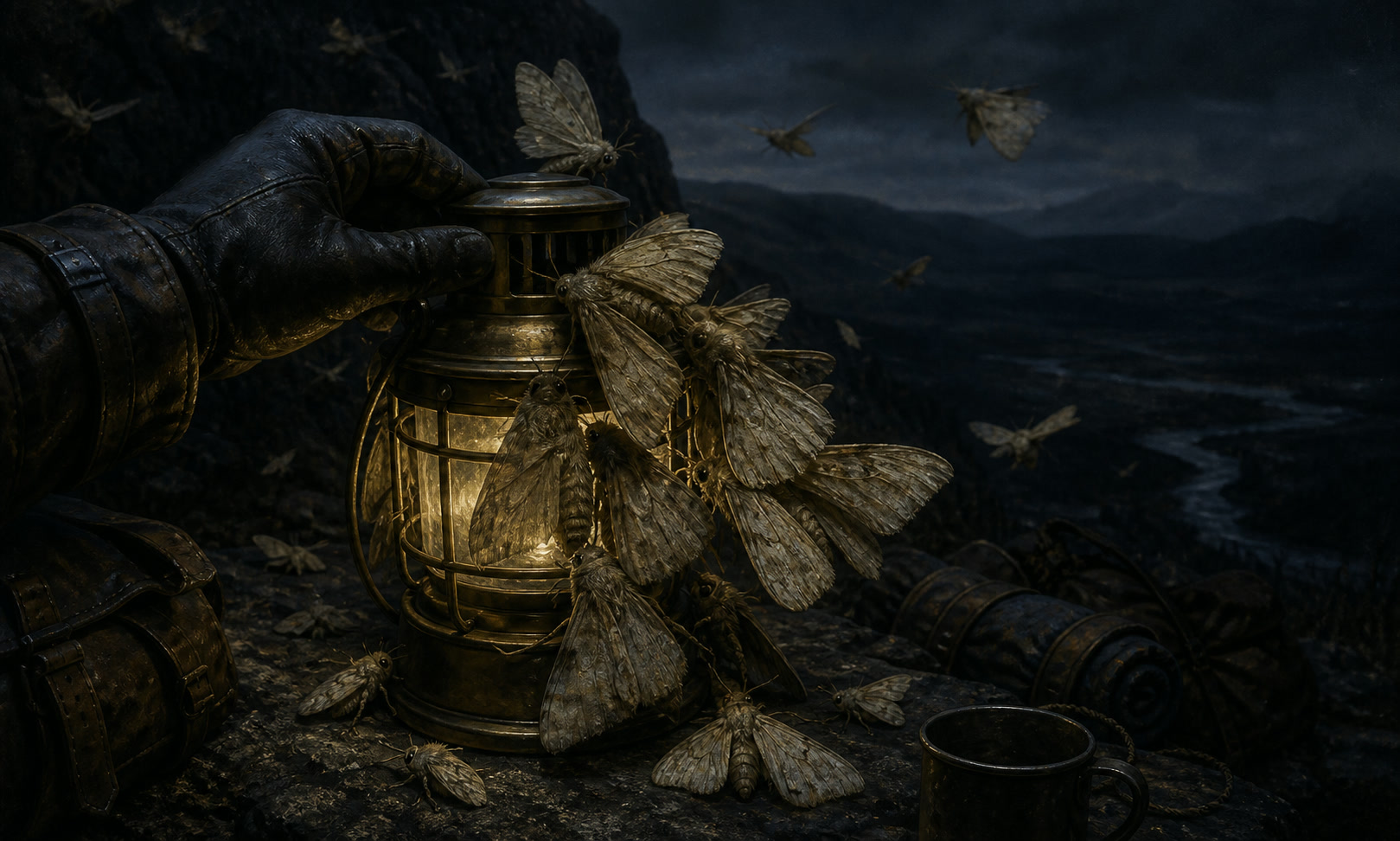
What you see: a moth the size of a spread hand, thick-bodied and soft, its wings the dull cream of rendered fat with a faint darker marbling. They fly heavily and badly. Close to, the wing surface is powdery and comes away on the fingers, and the body is startlingly warm.
Drawn to made light in a way nobody has explained. A burning tree draws none of them. A struck campfire draws a few. A lantern draws thousands, and a lantern in a housing draws more than a lantern in the open — the detail that has kept the Sagebound arguing for two hundred years without producing anything a Wardpriest will put a name to.
They arrive in numbers and they put the flame out with their own bodies. They are not burning; they are dying against it in sufficient mass to smother it, and the difference matters a great deal to anyone who has tried to answer them with more fire.
The moths are not the danger. Losing the light is. In a settlement a swarm is a ruined evening. On a ridge in the cold, four days from anywhere, at a Depths mouth with one lamp between six people, it is how a company dies. Same animal, same night. This is the plainest demonstration in the book of what §1 means, and nothing about the moth changed.
Every lantern on the Tread shuts in one motion. Every one of them. It is so universal a feature of the design that almost nobody who owns a lamp has ever wondered why a lamp would need to, and the answer is three weeks a year, at dusk.
Wildcaller standing works on them. Shouting does not, and the swarm does not care, and people try it anyway, which tells you most of what it is like to stand in one.
#Rill-eels · Hazard. · The warm runoff channels.
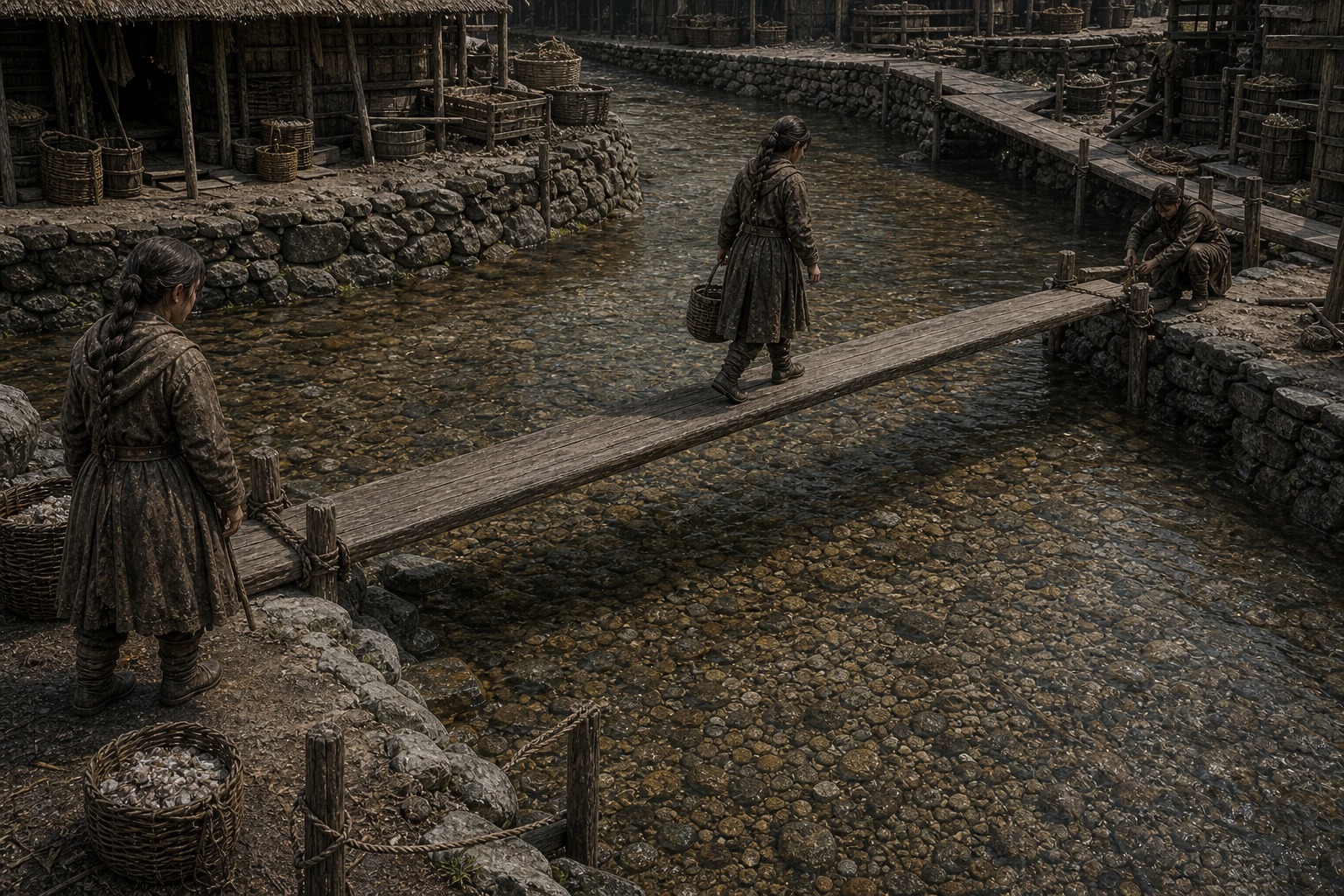
What you see: ideally nothing. A rill-eel is finger-thick and arm-long, the exact mottled brown of the channel bed, blunt-headed with no obvious fin. In clear shallow water a still one is invisible until it moves, and it does not move until it is stepped on.
The rills are the titan's own water, running warm through the hide, and the eels in them are small, unaggressive, and nearly invisible against the bed. Almost nobody is attacked by one. Almost everybody who is bitten stepped on it.
Their bite carries what keeps the hide's own blood moving, borrowed wholesale from the body they live inside, and so the wound does not close. Three streets from a Wardpriest, that is a bad afternoon. Four days out it is the start of something serious, and the serious part is not usually blood loss. It is that the wound stays open, and the water is warm, and everything else in the water can tell.
There is a packing method. It is taught to children in rill country, it is performed badly by adults under pressure, and it works about as well as that suggests.
Every regular crossing has a plank, maintained by whoever uses it under one of the oldest unwritten obligations on the Tread. Leaving a rill-plank rotten is a particular kind of disgrace — illegal nowhere, and forgotten nowhere either.
Hearthborn field hands are bitten routinely and think nothing of it. Delvers are bitten once, a long way from help, and describe it for the rest of their lives.
#Vent-crabs · Hazard. · The ground around breath-vents.
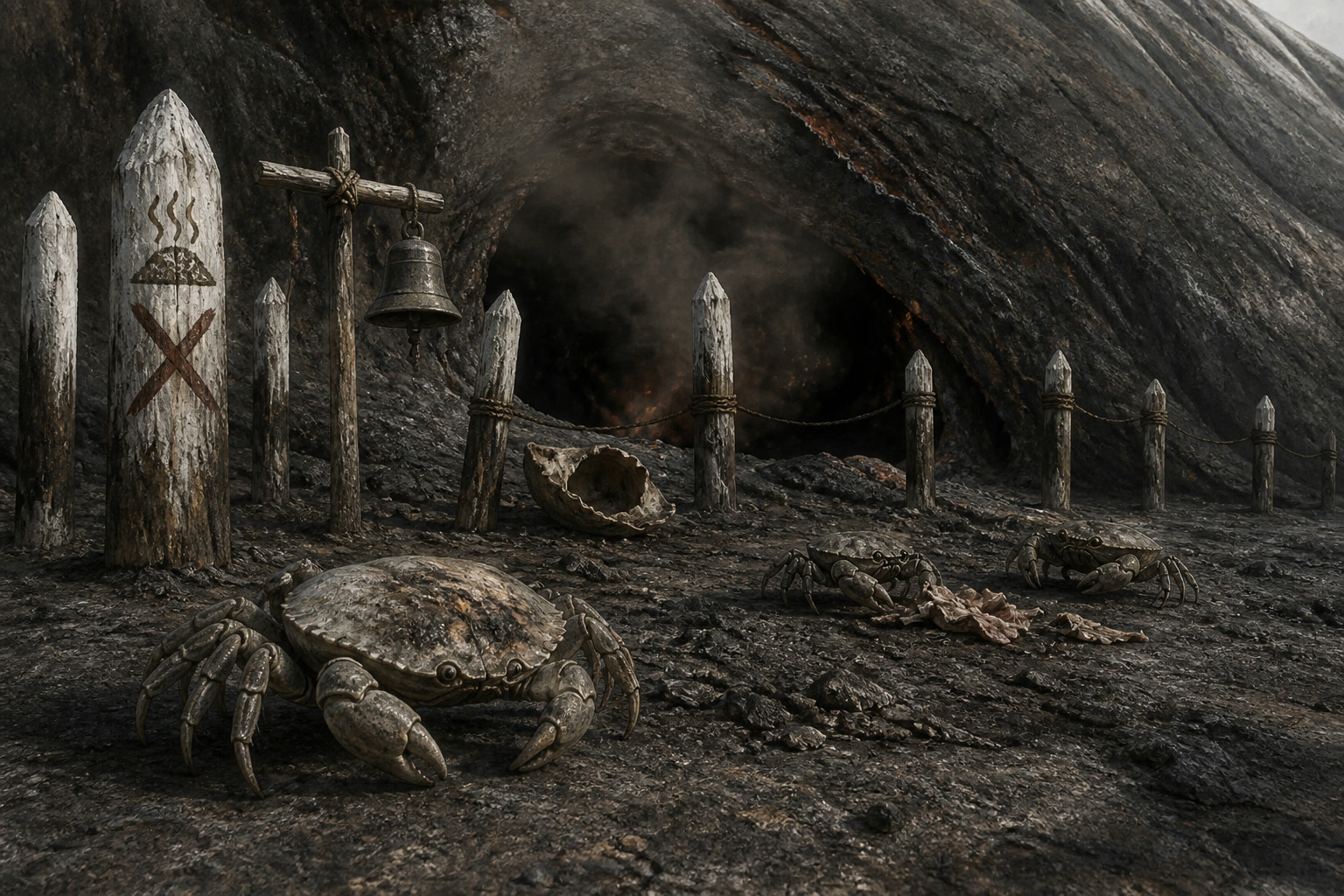
What you see: a broad flat-shelled crab the size of a dinner plate, plated in something closer to bone than shell, ash-gray with old scorch patterning across the back. It walks slowly and deliberately on eight thick legs and does not startle. The claws are heavy and blunt — built for breaking, not for cutting.
Indifferent, and very difficult to hurt. They eat what the venting kills — which means that a healthy population of them is evidence that a vent kills things often enough, and reliably enough, to feed one.
They are not the danger. Being close enough to meet one is the danger. A company that finds itself among vent-crabs should stop asking about the crabs.
Their density is a schedule, and vent-wardens read it. A warden who mentions that a vent has been busy is not making conversation. Around any vent worth watching there is a run of stakes, or a bell, or a line of whitewash, and a local convention about crossing it that is enforced with more violence than the crossing alone would seem to deserve.
People try to kill them, which fails. People try to eat them, which succeeds and is unpleasant. People take the shells, which are bone-hard and worth money. All three require standing precisely where the stakes say not to, and the shell trade in particular carries a mortality rate that everyone in it knows and no one in it discusses.
A vent-crab has never killed anybody. It has been present at a great many deaths, and it will be present at yours, and it will not hurry.
#Fold-lurkers · Contest. · The deep creases.
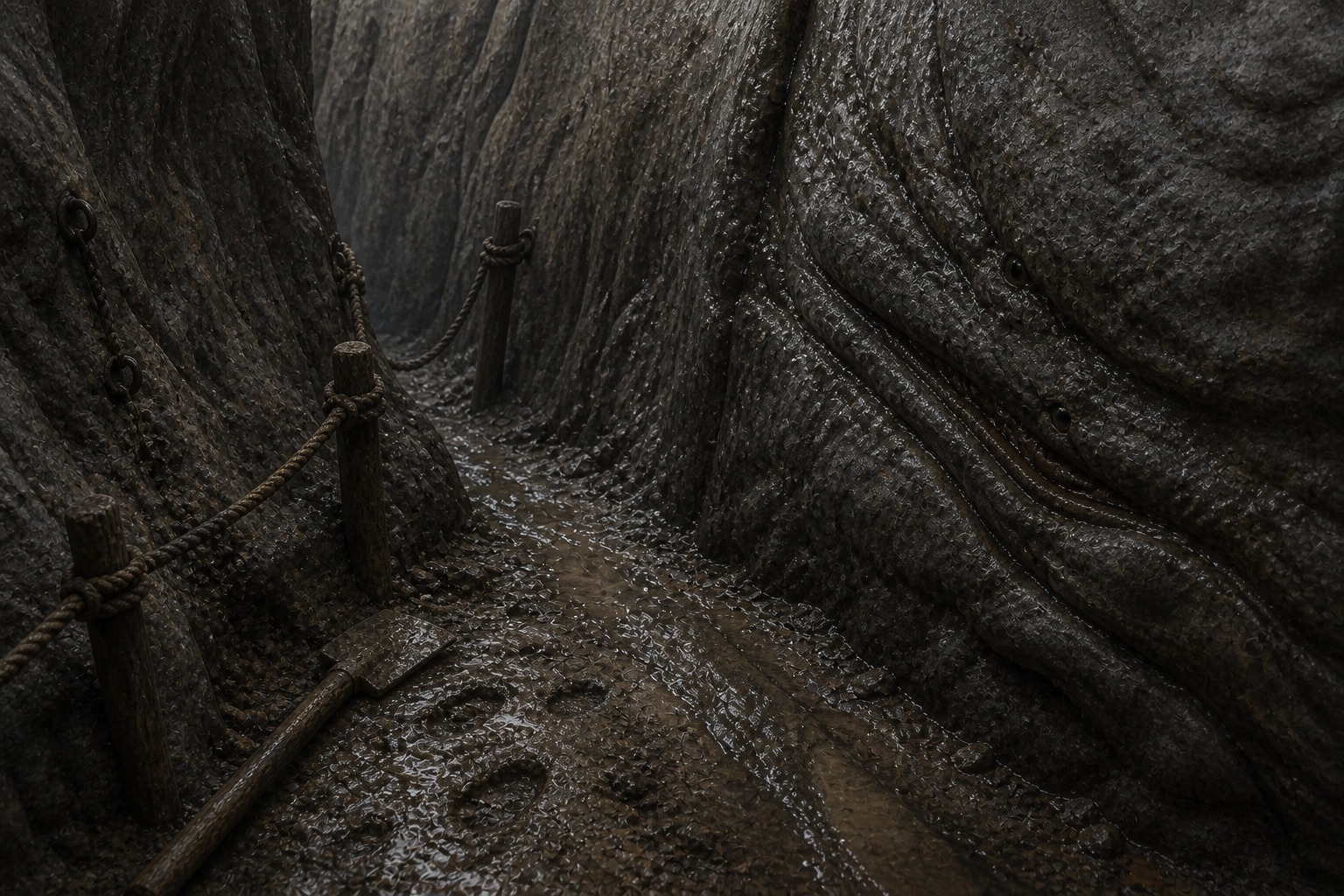
What you see, when you finally see it: a long flat-bodied animal pressed into the crease wall, the length of a person and with almost no depth at all, its skin the exact wet gray of the hide it lies against and folded into the same wrinkles. The limbs are held tight along the body until they are not. There is no face to speak of — a wide seam of a mouth and two small unlidded eyes set far apart, and both are usually the last thing anybody notices.
An ambush measured in days.
A fold-lurker takes a position in a deep crease and holds it without moving for as long as that takes. Whatever comes down the crease comes because the crease funnels it — runoff, forage, a comber calf separated from the herd, a company that took the low route because the low route looked easier. It does not hunt. It waits in the one place where waiting works.
And it strikes on the Wanderer's rhythm. Not on its own. Everything alive up here sits inside the titan's beat; the fold-lurker is the only thing anyone has found that uses it. Its timing is therefore not random, not tense, and not readable by ordinary attention. There is no gather and no tell, nothing a good eye can catch and nothing a veteran can teach. There is a beat, and on the beat, the crease moves.
A Pulsewalker reads the strike before it comes. Everyone else learns about it afterwards. If a table has never quite understood what Pulsewalking buys, one fold-lurker will explain it in a way no chapter can.
The consequence is a labor market. Crease-work pays better than ridge-work for one reason, and companies taking crease contracts either carry a Pulsewalker or lie about carrying one. Crease-hands with thirty years and no Practice at all insist they feel it too, and Pulsewalker traditions are split, testy and unresolved on whether that is Pulsewalking under a different name or simply what becomes of a person who has survived the same thing four hundred times. It is the Fleethollow argument about direction, conducted by people with more to lose.
Where they are not. A young or smooth-backed Wanderer has no creases worth the name. On those titans crease-work is not a trade, nobody hires a Pulsewalker for it, and the whole profession sounds like a story somebody made up about somewhere else.
#Combers · Contest. · Moss-forest, along the migration lines.
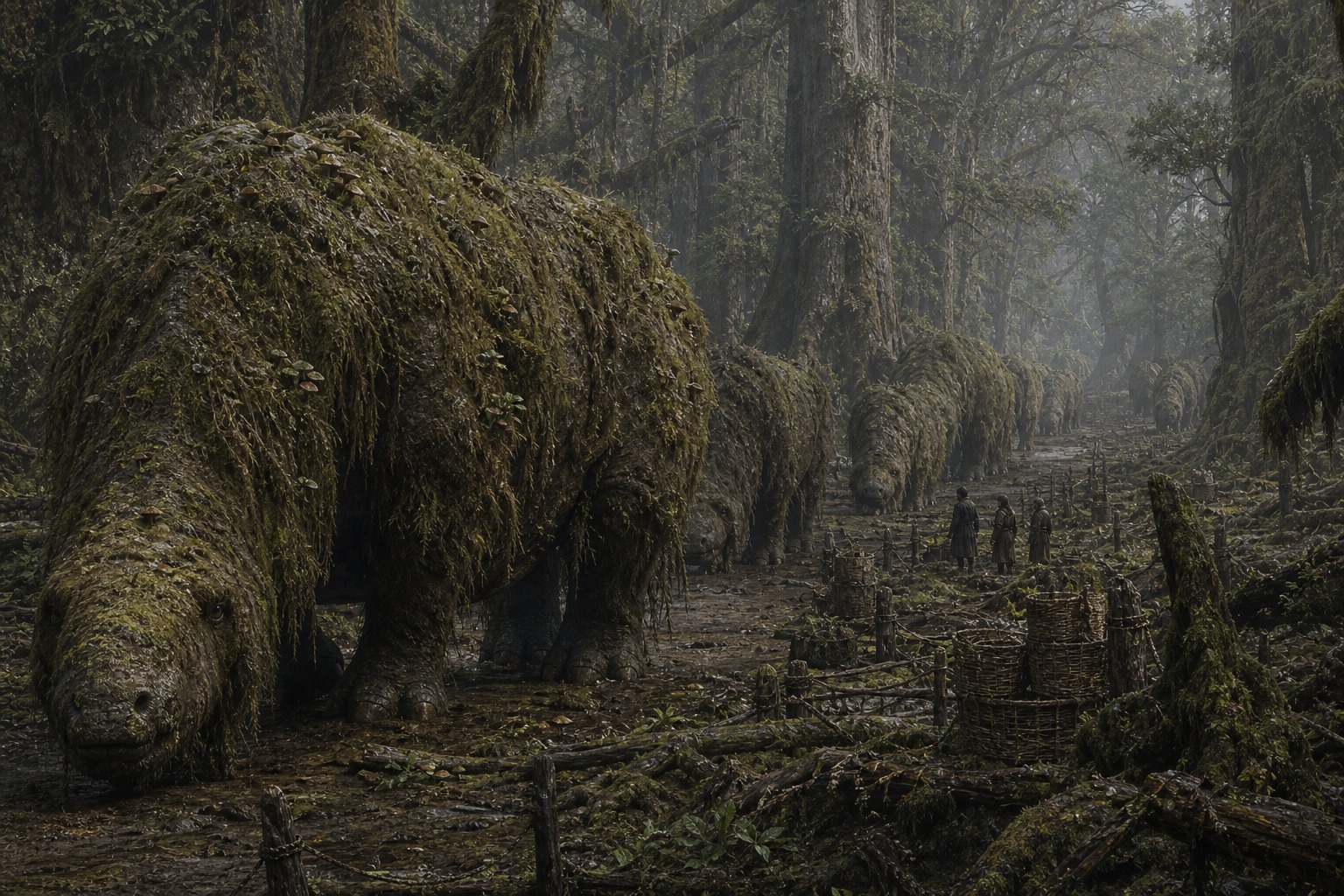
What you see: a bulk. A comber stands twice the height of a person at the shoulder, long-bodied and heavy-legged, under a dense matted coat the color of wet moss with real moss growing in it. The head is small for the body, carried low, with a broad grinding mouth and no visible neck. In a herd you do not see individuals at all. You see a moving edge of the forest.
Placid, and the reason the moss-forest exists in the shape anyone recognizes. Grazing is maintenance. A moss-forest left ungrazed closes over itself inside a generation and becomes something dank and poor that supports far less of everything, people included. Settlements that drove the combers off a range have then paid, slowly and at length, to learn this.
They move on lines older than any settlement standing on them. A town built across a comber line has three options and has generally tried all three: move, fence, or make an occasion of it. Fencing has never worked twice in the same place. Making an occasion of it works — so there are settlements where the crossing is a holiday, roads shut and nobody working, for no better reason than that the alternative was pretending it was not going to happen.
Most people killed by combers were not attacked. They were in the way of something that does not stop and did not notice.
A Wildcaller can turn a herd. Slightly, briefly, and at cost. Turning a herd is also how a herd ends up going through somebody else's town, and there is law about this on several Wanderers, most of it written immediately after an incident that everybody involved described differently.
What they leave behind manures a season's fields better than anything else available, and Hearthborn communities on a comber line run an entire cheerful economy of collection that visitors find difficult to be solemn about. It is one of the few places on the Tread where a dangerous animal is straightforwardly good news.
Bloomkin communities in a grazed moss-forest have arrangements with the herds that nobody outside the forest has satisfactorily described, and Bloomkin invited to describe them do not.
#Ridgeback wolves · Contest. · The bone-rock spines.
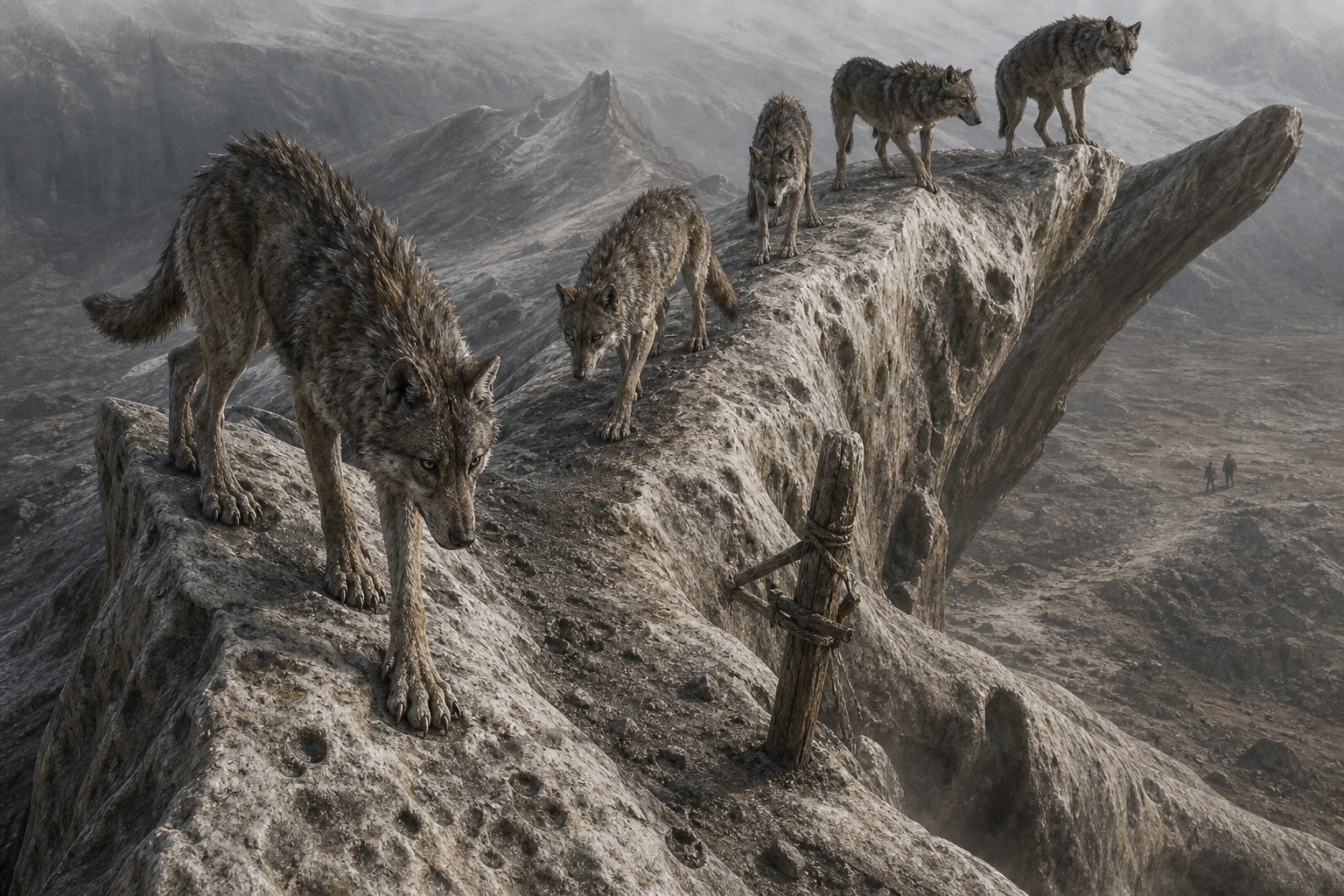
What you see: a wolf, and then not. Leaner than carried stock, longer in the leg, coated the broken gray-brown of bone-rock, with a ridge of coarser hair standing along the spine. The tell is the feet — broad and splayed, hard-padded, with blunt nails that grip stone — and a hunter who has seen both can tell you at a glance which one is standing on the ridge.
Almost certainly descended from carried stock. The Fleethollow route-records argue about which crossing brought them and have argued for two centuries, with the good-natured ferocity of a dispute nobody expects to settle.
They are the proof of what §11.1 means by a very long time. Two hundred generations on bone-rock have given them a foot that grips it. A hunter can tell you so from across a ridge; a naturalist can demonstrate it on a table; neither can tell you when it happened, and there is no titan anywhere still carrying the animal that arrived.
They hunt the ridgelines because the footing up there rewards a pack and punishes anything shod for farmland — so a company crossing a spine in ordinary boots is being hunted on ground chosen for the purpose. Fleethollow route-keepers schedule around packs exactly as they schedule around weather, which is a quiet admission that a pack is a feature of the route rather than an event on it.
Tuskborn hold the flanks, the ridges run through the flanks, and several centuries of proximity have produced arrangements between particular holdings and particular packs that outsiders read as either taming or superstition. It is neither. Nobody involved will explain it to a visitor, and it works.
What people get wrong is the word. A traveler from a titan with ordinary wolves hears wolves, prices the risk accordingly, and is wrong in a way the ridge does not allow much time to reconsider.
Where they are not. Flat-backed Wanderers have no spines and no ridgebacks, and generally carry something else instead that ridge country would find just as unreasonable.
#Scarwyrms · Peril. · Old wounds, and made mouths.
We did not find it. We built it a house forty years ago, it moved in, and now we are asked why we will not go back. — an Underfolk crew-master, refusing a face
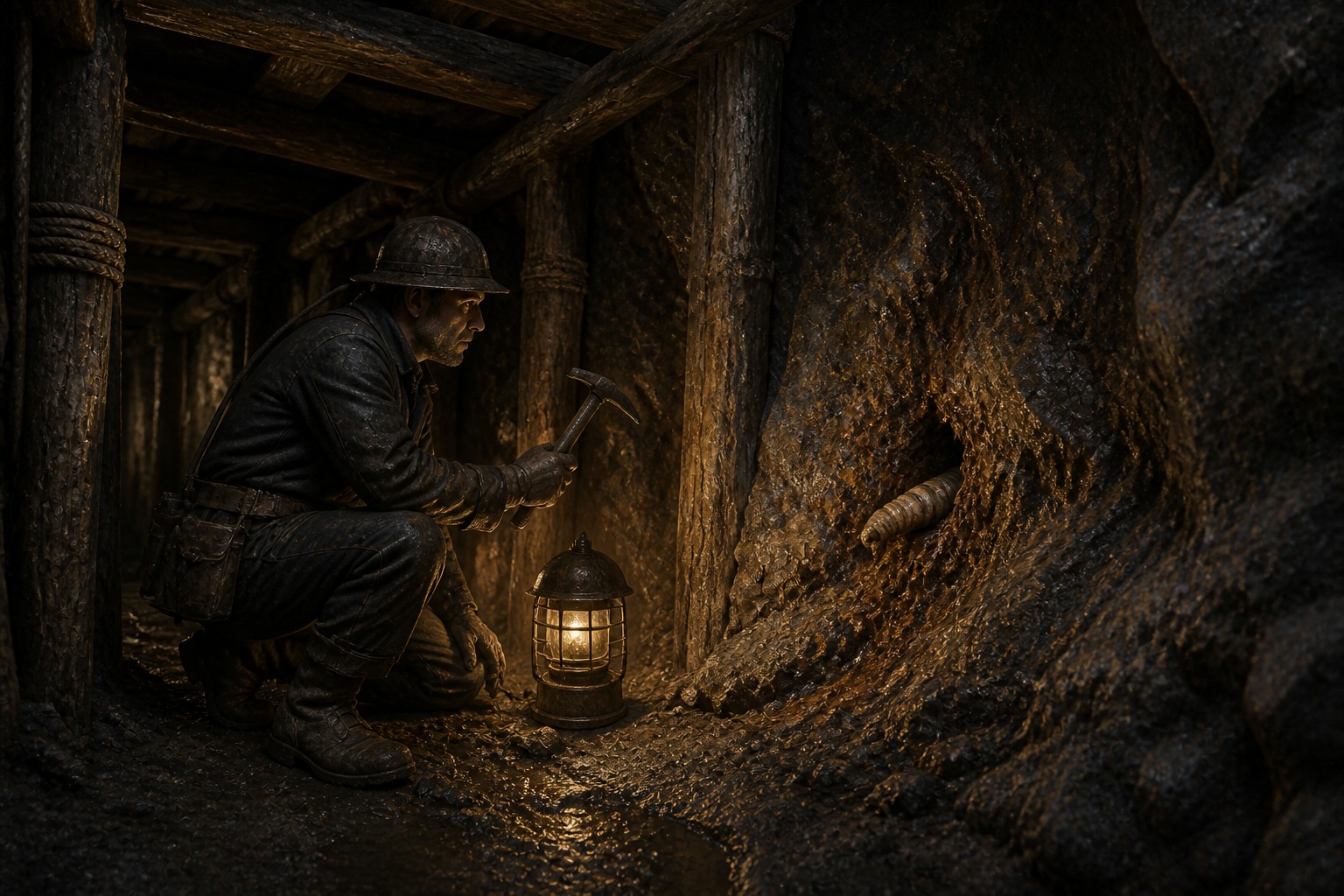
What you see: rarely the whole animal. A scarwyrm is about the length of an arm and the thickness of a wrist, pale and segmented and glistening, eyeless, ending in a ring of small hooked mouthparts. It moves fast in a space it knows and it is almost never in the open. What people see is a section of it passing a lamp, and then no more of it.
They live in wounds. Where the hide was breached long ago and closed badly, what remains is a cavity — warm, sheltered, out of the weather, and fed by the body's own traffic. That is a habitat. Habitats fill.
A Depths mouth that was cut rather than found is a wound, and delvers who open their own entrance have, on a timescale nobody plans in, built somewhere for a scarwyrm to live. This is the most uncomfortable fact in boundary work, and it is why old crews prefer a mouth that somebody else made a very long time ago.
It is not large. People expect large and price the danger accordingly. It is entirely at home in a space you have never seen, it knows every turn of it, it can be elsewhere and back while a company is still deciding, and it does not leave. Peril is not a size.
A fight is not really on offer. What works is closing — making the cavity uninhabitable, which in practice means surrendering the mouth, the workings behind it, and whatever those were worth. Boundary crews will refuse a face on scarwyrm sign, and refusal is a licensed act with paperwork attached, which tells you both how often it happens and what it costs.
Reading that sign is Underfolk knowledge. It is a substantial part of why Underfolk boundary work is worth what it is worth, it is not written down, and the crews are entirely aware of what would happen to their position if it were.
The Depths close their own wounds — see §12.1 — and what happens where a Mender and a scarwyrm want the same cavity is recorded nowhere. Both are attested. The meeting is not.
#Rootmothers · Peril, and not a fight. · Beneath the old moss-forests.
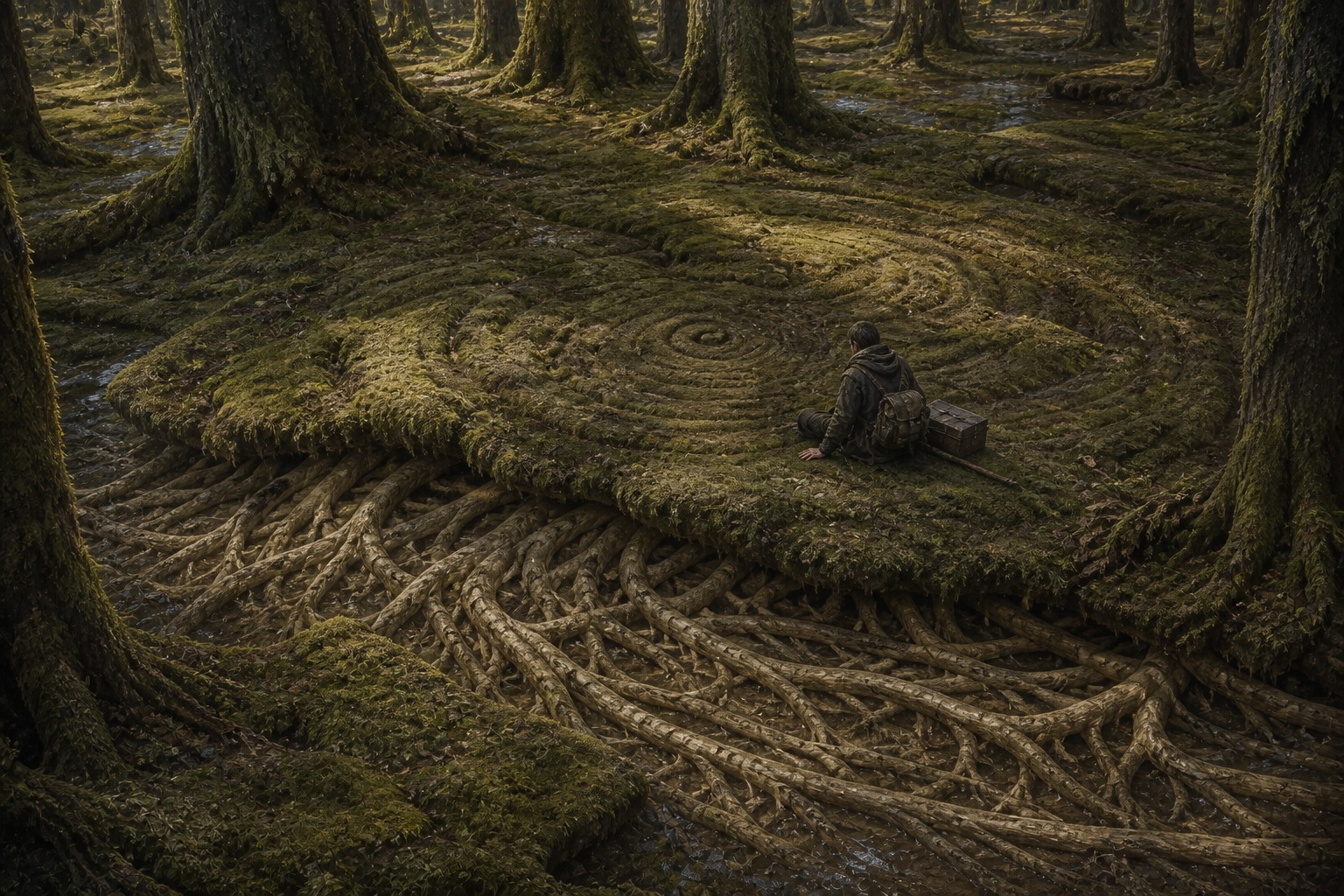
What you see: a forest floor. There is no body. A Rootmother is the root system of an old moss-forest, and standing on one you are standing on all of it — a dense mat of pale interlaced roots beneath the moss, thicker and warmer than it has any reason to be. Where one is present the moss grows in slow concentric patterns visible from a height and meaningless to anyone standing in them.
Under an old moss-forest the root systems are not many things. They are one thing. In some places that one thing has become slow, and attentive, and there is no reliable way to tell from outside which forests have one. The people living above always know.
It has no interest in anything happening at human speed. That is not hostility, obstruction, or indifference in any sense a person would recognize. It is a different clock. A conversation is a season.
A Wildcaller with standing can ask a question and receive an answer, and the asking is one of the few genuinely strange things in this book that is also entirely safe. The danger is in what follows. Every answer creates an obligation of care that outlives the asking — and obligations are inherited. A Wildcaller who asked something at twenty-five has committed her order for as long as the order exists, and the older orders keep a register of askings precisely because nobody's memory is long enough and the forest's is.
Orders have failed to keep one. What follows is not retribution, which would require a timescale the Rootmother does not use. What follows is that a forest stops answering — and stops answering the next order too, and the one after that, long after anyone alive can say what was promised or by whom.
Cutting one is possible. Nobody who has done it recommends it, the communities above one will not discuss the subject with outsiders, and a settlement that cut a Rootmother is known for it long afterwards and does not know that it is known.
A Bloomkin asked who her mother is may answer with a place (§10). Asked that in a forest with a Rootmother beneath it, she may mean something a good deal more literal, and this book has no intention of finding out.
#The Lamps · Wonder. · A whole region, for three or four nights.
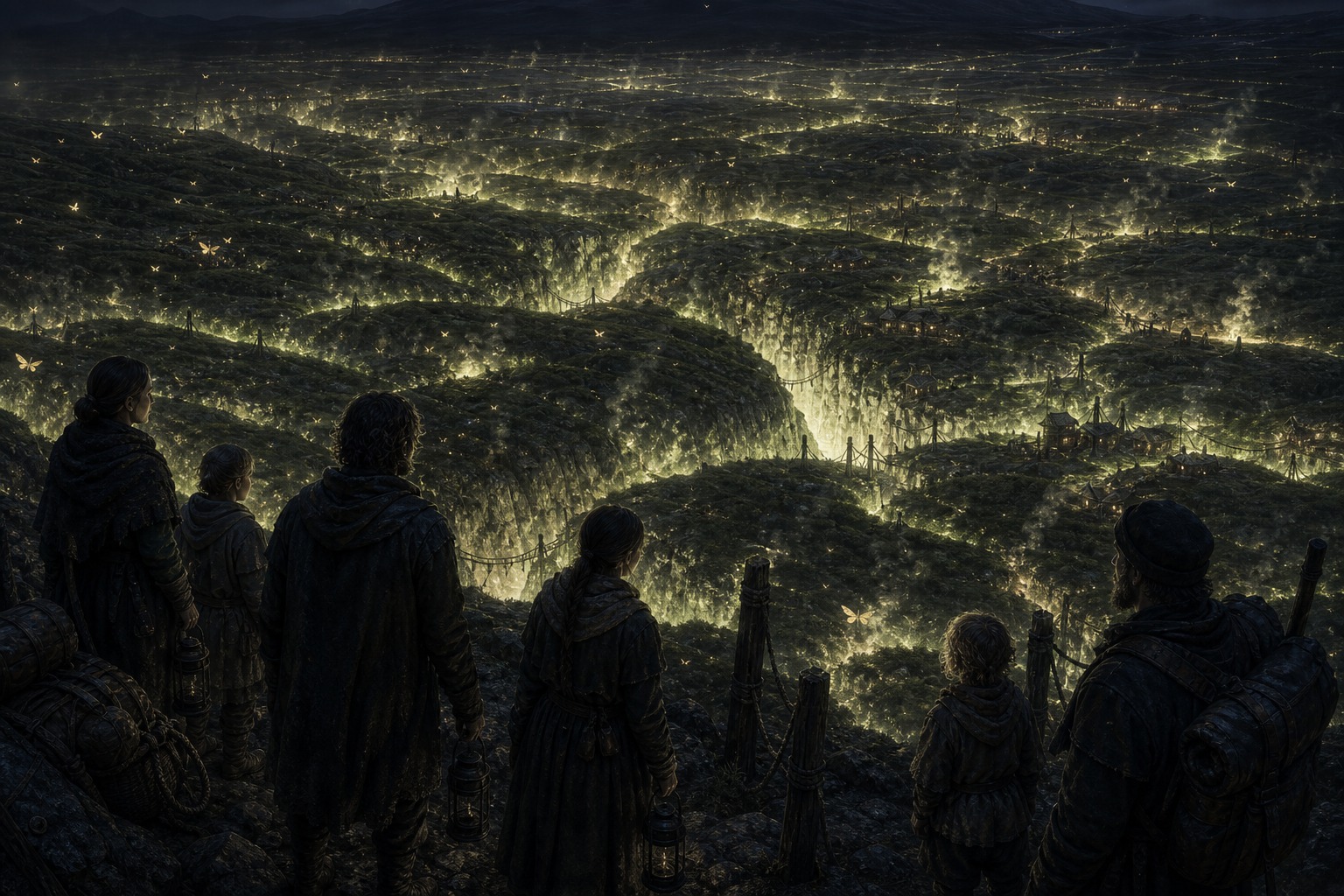
What you see: the ground lit from underneath. Every crease, vent and moss-forest running a pale green-gold, not flickering but moving slowly, the way something breathes. The light is cold. Faces underlit by it look wrong in a way people remember for the rest of their lives.
Once in a long while — no two regions agree how long, and the Fleethollow cannot predict it, which is the only thing route-keepers will publicly concede they cannot do — everything on the hide that carries light lets go of it at once.
The creases go first, then the vents, then the moss-forests. For three or four nights a region is lit from underneath by the body it is standing on. Spark-sprites come up in numbers nobody sees otherwise. The tallow-moths come and ignore the lanterns entirely. Growths that have been dull for a decade run pale green along every fold, and all of it moves, slowly, and none of it is warm.
Nobody has ever been harmed by it. There is no record anywhere of anything to fight, flee or survive, and the entry stands at Wonder for exactly that reason: being present is the whole of the event.
Something comes up with it. Every account agrees that far and no two agree on anything after — the size, the number, whether it stayed above the moss or under it, whether it noticed anyone at all. No two regions use the same name for it and no name has ever traveled, which is the best evidence anybody has that nobody has properly seen it. This book does not name it either.
Settlements date themselves by these. The year of the lamps means something exact in any town that has had one, and goes on meaning it for a century, and people who were children for one will tell you about it at length, badly, and with complete accuracy about how it felt and none whatever about what happened.
The naturalists have a longer name for it. Nobody uses it.
#11.3 The regions and what hunts in them
A Wanderer's back carries cold high country, dry flank, deep forest, plain, lake and warm coast, and each of them has something at the top of it. These are the entries a company is most likely to have to fight, and they are here for that reason.
They are still not evil. They are predators, they are hungry, and a hungry predator that has decided about you is not less dangerous for having an ordinary reason. Nothing below can be reasoned with, none of it can be out-run, and the two that can be walked away from are the two that people most often try to fight instead.
#Hoarbacks · Peril. · Cold high country, at the warm seams.
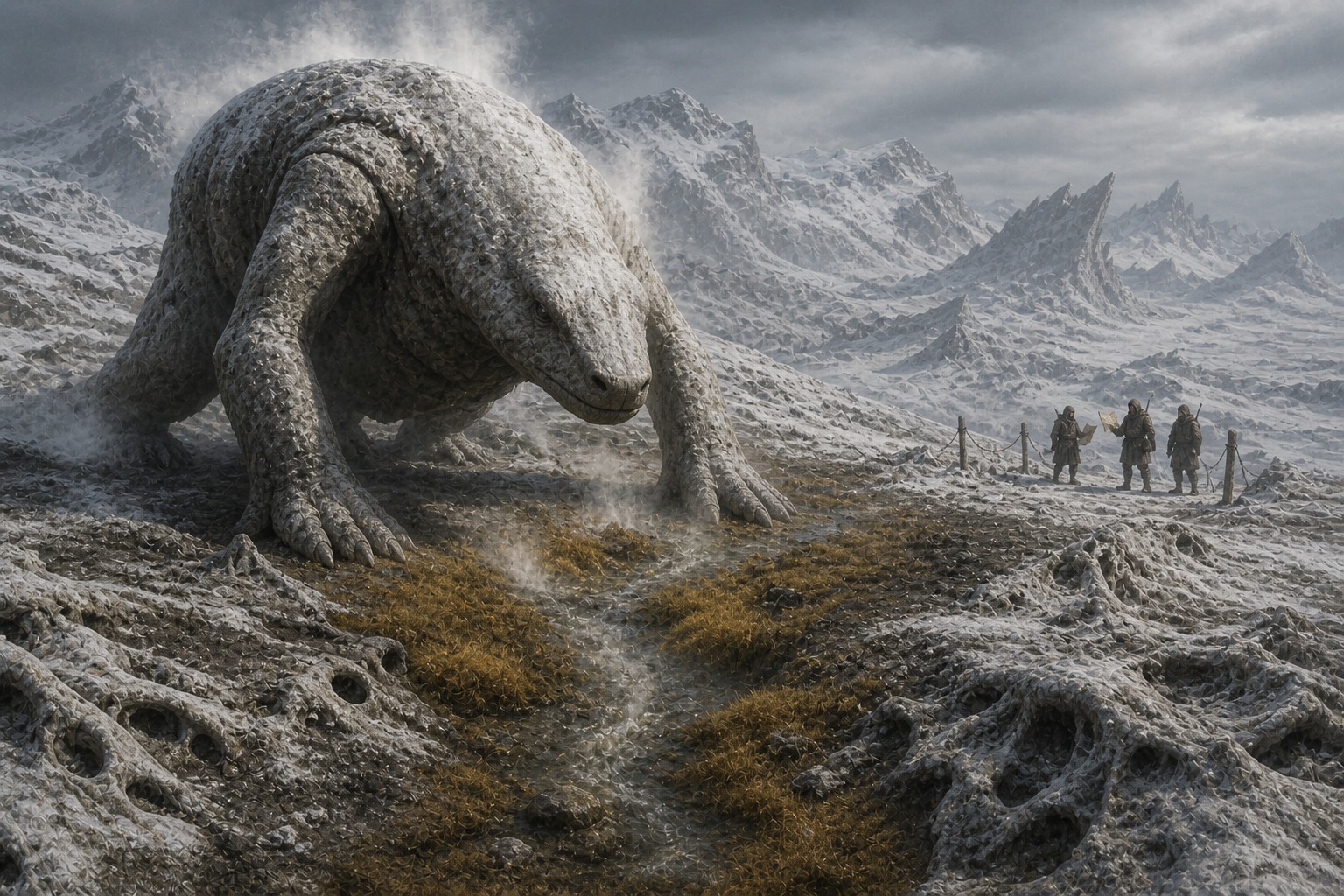
What you see: a slab-shouldered thing the height of two people at the shoulder, hauling itself over bone-rock on long forelimbs, its hide the wet gray-white of old ice with darker stone showing through where it has worn. The head is broad and flat, the eyes small and set deep under a heavy ridge, the jaw wide and lipless. It steams. In cold air a hoarback trails vapor off its back and shoulders constantly, and on a still night you see the steam before you see the animal.
What it is doing: the high country is cold, and the titan beneath it is not. Warmth leaks up through seams in the bone-rock in a few scattered places, and those places are the only survivable ground for a hundred miles in any direction. A hoarback holds one. That is its entire ecology — it does not roam, does not migrate, and does not hunt in any sense a wolf would recognize. It owns the warm place and waits for the cold to deliver.
The problem for people is exactly the same problem. A crew crossing the high country plans its route seam to seam, because the alternative is a night in the open that nobody survives. So the route and the predator are the same list of locations, and everybody involved knows it. High-country crews carry a second and third seam on the chart for that reason, and a crew that has had to use the third one is in serious trouble already.
They do not chase far. Driving one off its seam is possible, expensive, and buys a night. It will be back before you are, and it will remember.
#Rendworms · Peril. · Dry country where the soil runs thin.
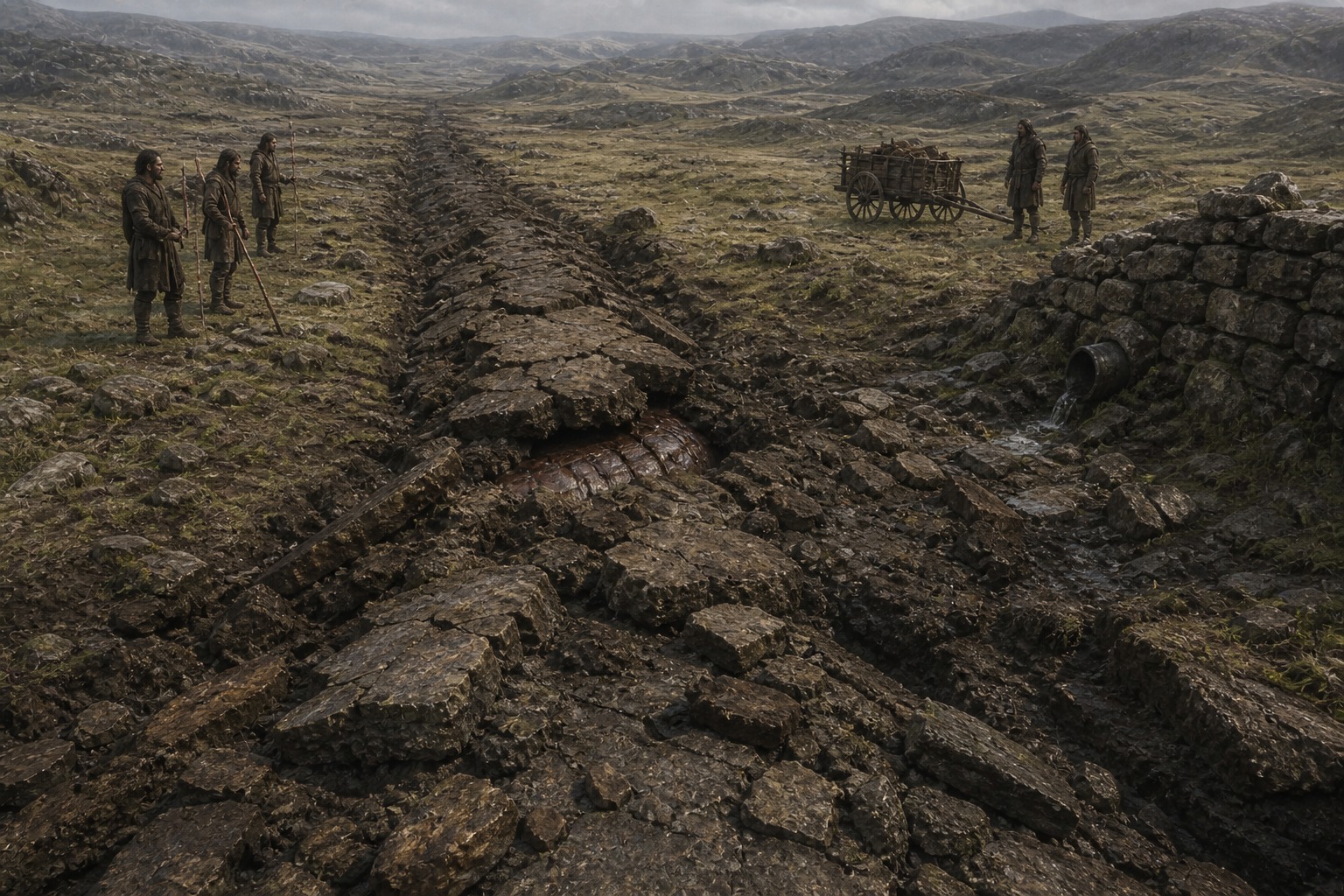
What you see, usually, is not the animal. It is a furrow: a raised ridge of broken ground a pace across, running straight for a hundred yards and then stopping. Where the soil is thin enough to have been pushed aside you can see what is underneath it, and what is underneath it is not rock.
The animal itself is the length of a cart and the color of wet liver, ringed in overlapping plates that grip as it moves, blind, and ending in a ring of inward-facing hooks rather than a jaw. It comes up rarely and briefly and most people who have seen the furrows have never seen one.
It burrows through sediment, which is what everywhere else on a Wanderer's back is made of, and in deep-soil country a rendworm is a serious agricultural nuisance and nothing more. It wrecks field drainage, undermines walls, and empties a warren in a night. Whole regions treat them the way a farmer treats any large burrowing pest, which is to say furiously and without alarm.
Dry country is where that stops being true. Where the soil runs to a few feet and the living surface is close underneath, a rendworm reaches it — and then the furrow is not damage to a field. It is a wound in something alive, which will eventually respond to having been wounded. That is rare, it is regional, and the people who live in those regions are the only ones on the Tread who regard rendworms as anything other than vermin.
Downstream it is worse than the animal. A furrow that reaches the living layer and closes badly leaves a cavity, and a cavity is a house — see the scarwyrms below. Thin-soil country overrun long enough stops having a rendworm problem and starts having a permanent one.
Meeting one is a matter of the ground under you giving way, which it does without warning because the thing is blind and does not know you are there. Nobody has ever been stalked by a rendworm. A great many people have been swallowed by one that had no idea.
#Kilnbacks · Contest. · Hot flank, in the open.
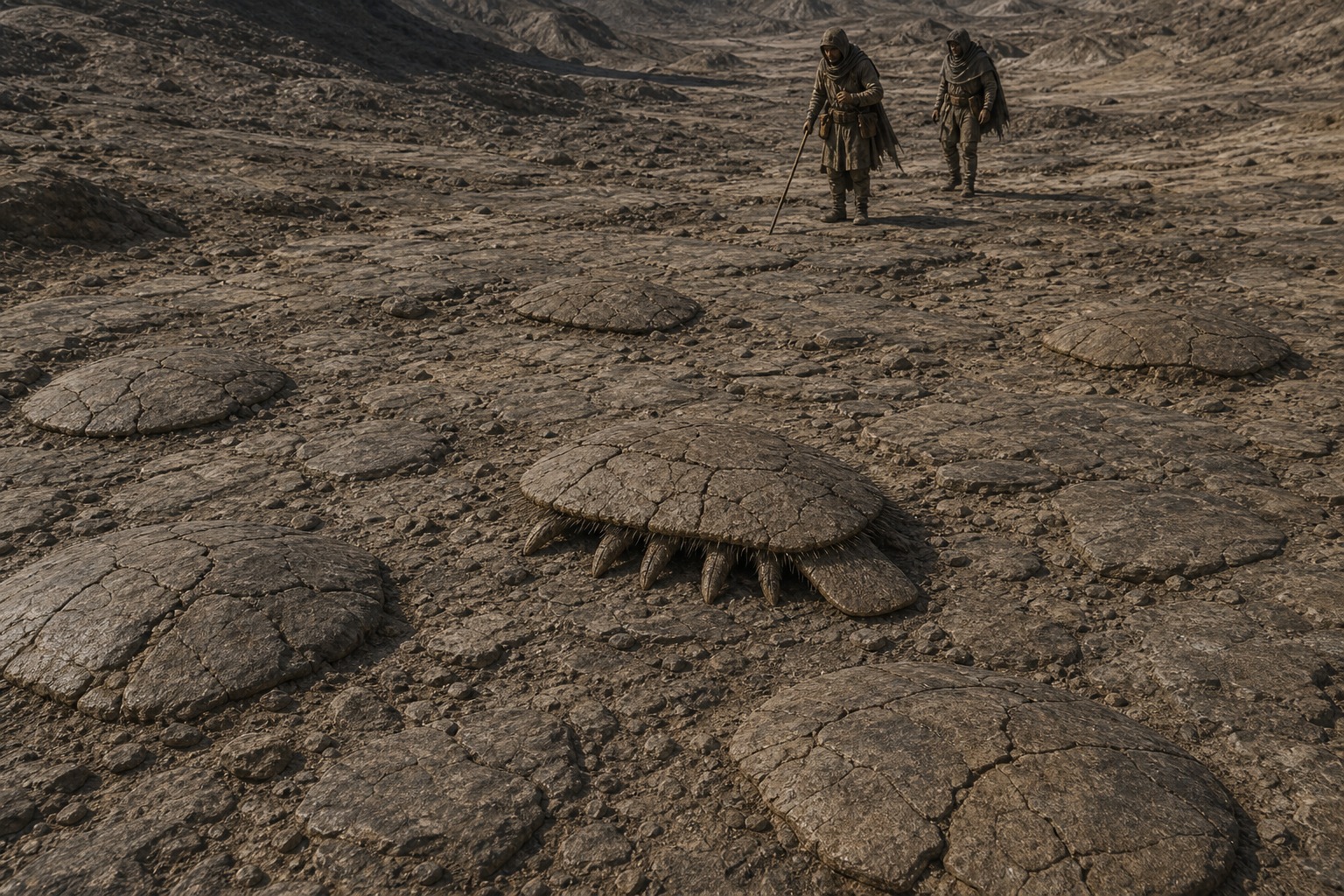
What you see: a low armored thing the size of a large dog, six-legged, its shell baked to the color and finish of fired clay and cracked across in a pattern that is different on every animal. It lies half-buried with only the dorsal plate showing, and the dorsal plate looks exactly like the scorched flat stone it is lying among. The forelimbs end in flat crushing plates rather than claws. It has no visible eyes. It has a great many short sensory bristles along the shell margin, and those are what it hunts with.
What it is doing: waiting for something to walk over it. The hot flank has almost no cover, so the kilnback became the cover. It feeds on whatever crosses the open ground in the heat of the day, which is mostly small, occasionally a goat, and once in a while a person who was going too fast.
They are the reason flank routes are walked and not ridden. A mount that steps on one panics; a person who steps on one gets a broken foot and a bad afternoon. Neither of those is the danger. The danger is that kilnbacks are gregarious in a way ambush predators usually are not — where there is one there are six, and a company that has just dealt with a broken foot is standing in the middle of five more.
Flank crews read the ground for the cracking pattern, which does not match real stone once you know it, and cannot be unseen afterwards.
#Drownjaws · Contest. · Lakes, slow rivers, warm coast.
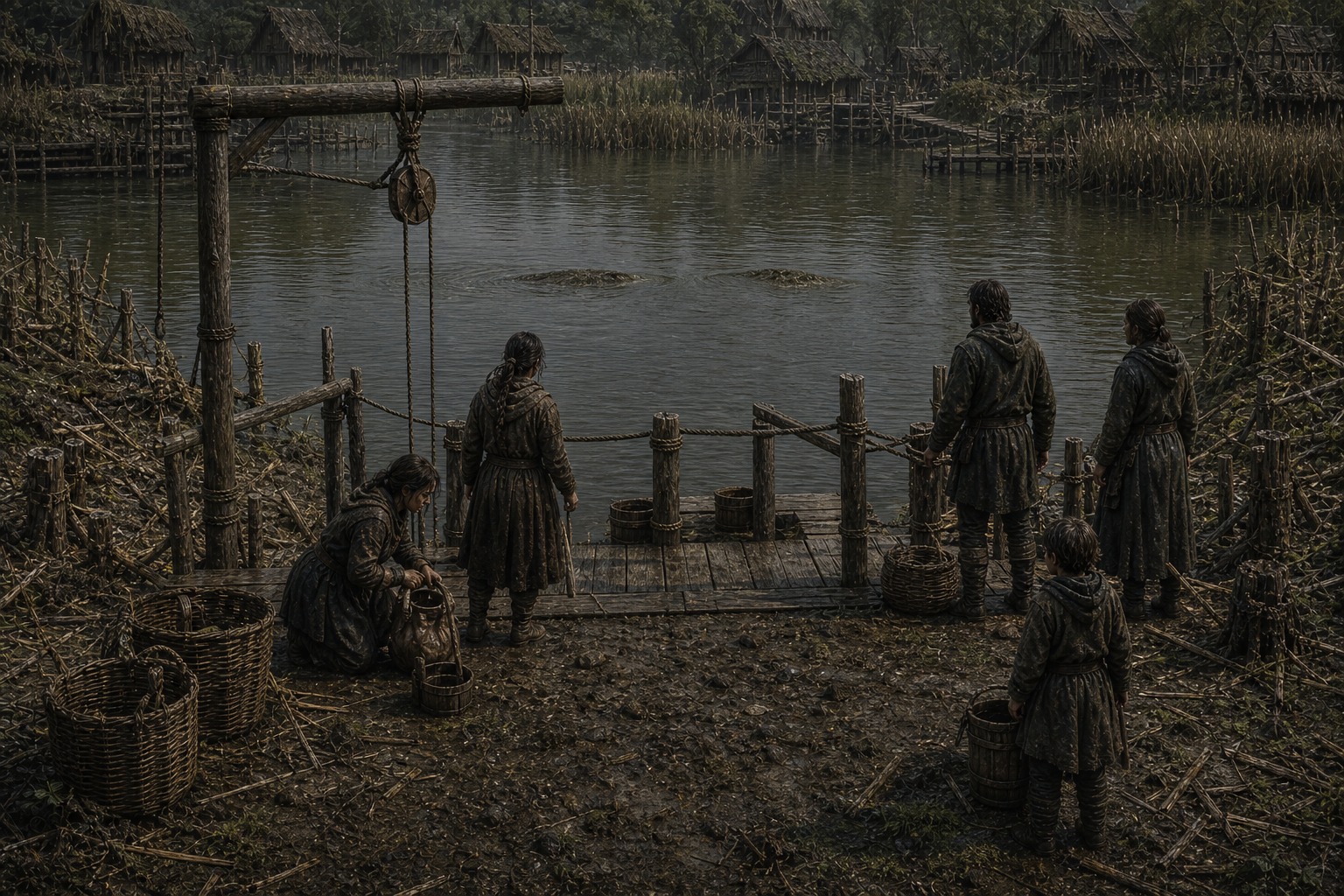
What you see, if you see anything: two ridges breaking the surface a body's length apart, moving
with the current rather than against it. Out of the water it is a long flat-bodied animal with a broad shovel head, dull olive above and pale beneath, its jaw hinged far back so the whole front of the skull opens. It has small good eyes set high, which is the tell — everything else about it is built to be underneath.
What it is doing: waiting at the places where things come to water. Not hunting in the water at all. A drownjaw takes from the bank, and takes downward, and the whole animal is arranged around that one motion.
It is a Contest and not a Peril for one reason: it commits. A drownjaw makes a single enormous effort and then has to be somewhere else. A company that survives the first three seconds has usually survived the encounter entirely, and a company that is watching the water when it happens survives the first three seconds. Everything that is dangerous about them is concentrated in the moment before anybody knew they were there.
Every settlement on a lake handles this the same way: cleared banks, cut reeds, a fixed place to draw water and a rule about drawing alone. The rules are old and unglamorous and they work, and travelers who fill a skin from a quiet reach because it was closer are a recurring and entirely avoidable kind of funeral.
#Longarms · Peril. · Deep forest and moss-forest edge.
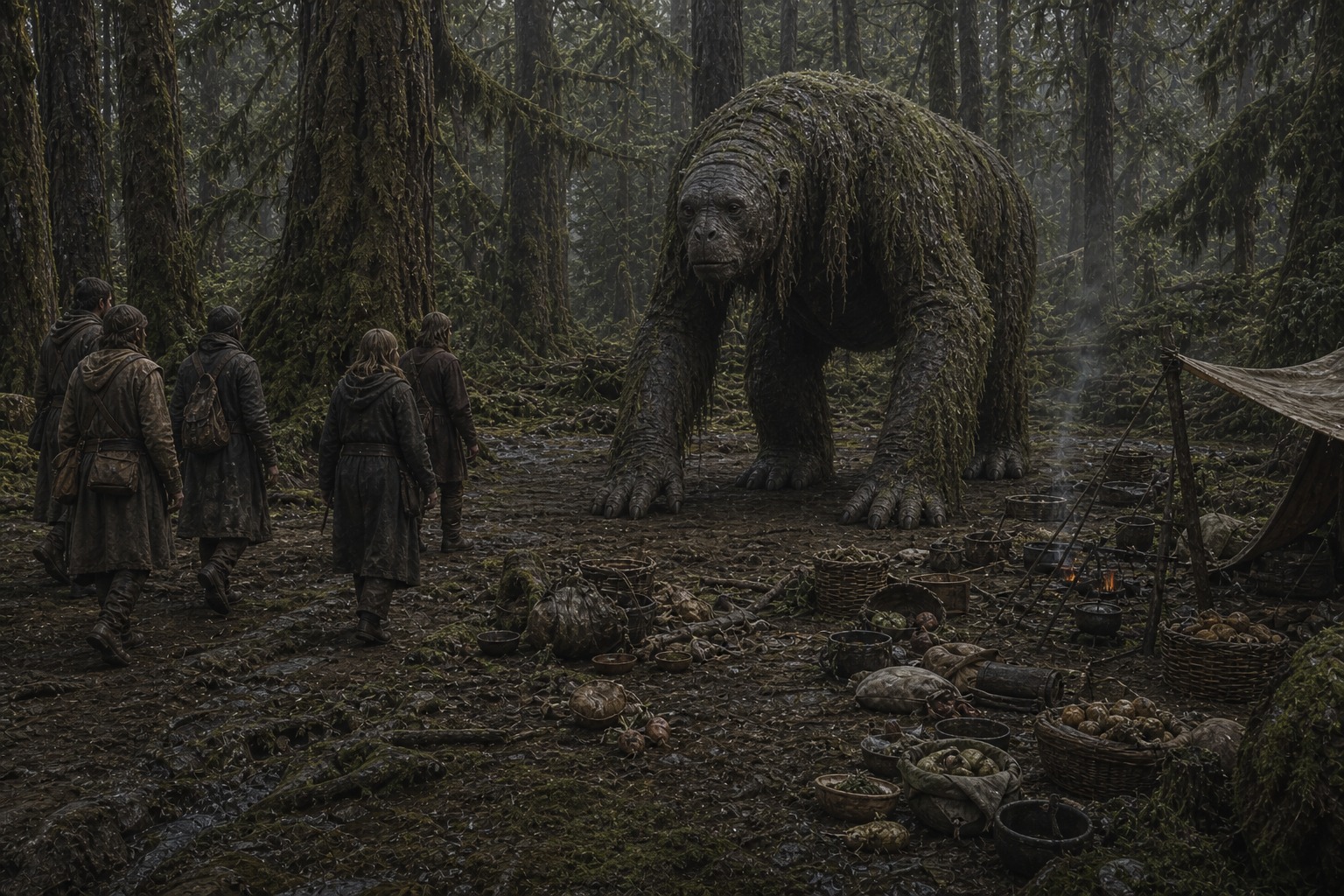
What you see: on all fours it is the size of a large bull and easy to mistake for one at distance. Then it stands, and it is a head taller than a tall person, and nothing about it is a bull. The arms are longer than the legs and thicker through than a person's thigh, ending in broad flat hands with short black nails. The coat is dense and dark green-black with real moss caught in it, the way a comber's is. The face is flat and wide and almost hairless, gray-skinned, with small deep eyes set close and a heavy underslung jaw. It is the only thing in this book that will look back at you and hold the look.
What it is doing: eating, mostly. Forest mast, roots, standing water plants, and — in the season when the herds are moving — comber calves, which is the only time it is a predator of anything. A longarm spends most of its life doing nothing quickly.
It is territorial, and territory to a longarm means larder. It holds a range around whatever is worth eating and defends it against other longarms with enormous violence and against everything else with an approach that reads, to people, as unbearable confidence. It does not ambush and it does not stalk. It walks up. Nothing in this world has given it a reason to do otherwise, and a company that has spent a season learning to watch for things hiding is badly prepared for something that simply arrives.
A company's camp is a larder, which is the whole of the problem. Food hung, food buried, food in a pack — a longarm has decided about all three long before anyone notices it, and the decision is not really about the company at all.
Foresters know the answer and travelers do not believe it. You leave. You leave slowly, you leave the food, and you do not run, because running is the one thing that turns an animal that was going to take your supper into one that is coming after you. Companies that fight a longarm generally win and generally lose somebody doing it, and the ones who have paid that price are the loudest voices for leaving the supper.
Where they are not. Thin forest cannot feed one. They are absent from the flanks, the high country, and any range where the moss-forest has been cleared to farmland — which is a fact Hearthborn communities cite whenever anybody suggests the clearing was a mistake.
#Lopers · Contest alone. A family is a Peril. · Open plain and dry grassland.
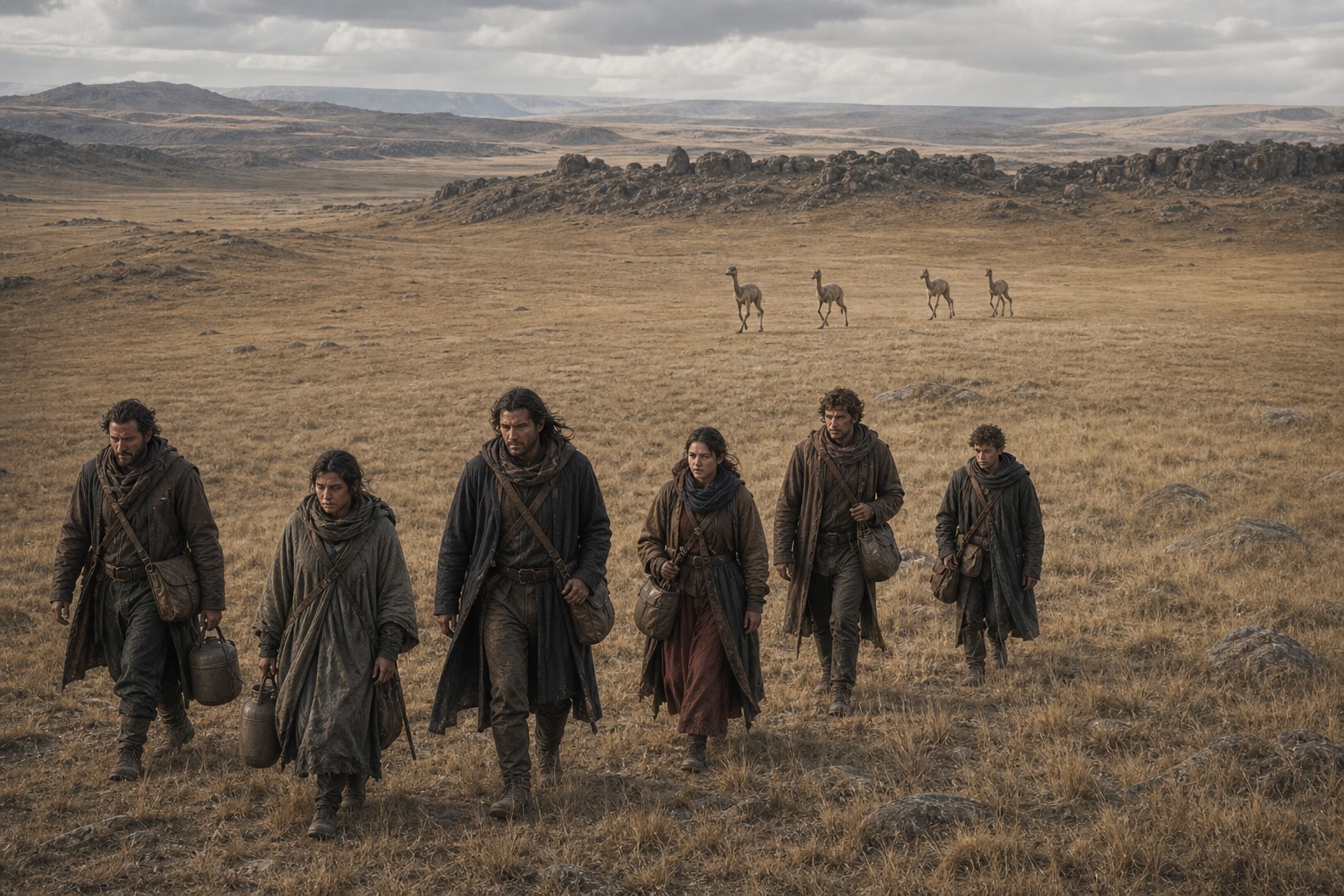
What you see: an upright animal that stands about as tall as a person and is built entirely wrong for it. The legs are long, back-jointed and heavily muscled at the top; the body is short and deep; the arms are small, held folded against the chest, and end in two hooked digits. The head is narrow, carried forward on a long neck, with forward-facing eyes and a jaw that opens further than it should. The hair is short, coarse and dust-colored, and there is a stiff dark crest along the skull that goes up when the animal is interested in something.
They are persistence hunters, and that is the entire horror of them. A loper family does not ambush, charge, or contest ground. It picks something, follows it, and keeps following. They move at a trot they can hold from dawn to dark and their prey cannot, and they close at the end when it has stopped being a chase.
So you know. You know for most of a day. They stay in sight, at four or five hundred paces, neither hurrying nor hiding, and every hour you have not lost them is an hour of information about how this is going to end. More people have died of what that does to a company than of the animal, and every plains guide has a story about the company that split up, or emptied its water too fast, or turned and charged at noon because somebody could not stand another hour.
What works is unheroic. Get to broken ground, a wall, a watercourse, anywhere a family cannot work as a family. Kill one early if the chance is clean, because a family that has lost a member will sometimes break off, and sometimes is the best odds on offer. Do not run in the open. Running is what they are for.
They avoid settlements and take stock only at the edges, which is why plains towns regard them as a traveler's problem and price guiding accordingly. Fleethollow route-keepers plot open crossings around known families the way they plot around weather.
Where they are not. Forest, ridge, and anywhere broken. A loper on bad ground is an awkward, unhappy animal, and it knows it.