

How the world answers
Competency and Action
In this section
Describe the intention and the method. The world resolves only uncertainty that matters.
On this page 8 topics
#What the character has learned to do
Lineage gives you a body. Origin and Culture give you a past. History gives you evidence. Practice gives you a path. Competency records how far you have demonstrably learned to walk it.
TREADBOUND uses no six-score build array and gives out no character levels. The world still has to answer when a lock may open, a blade may land, a room may listen, or a working of the Pulse may hold. It answers through the same grammar in every kind of scene.
Three ideas keep that grammar honest:
- Capability is an enduring primitive faculty: perception, coordination, endurance, reason, composure, empathy, and the other basic capacities through which people act.
- Competency is durable, learned, and scoped. It records something the character's history actually supports, such as reading structural failure in worked bone-rock or holding a defended doorway with spear and shield.
- Performance is what the character can express here and now, with this method, equipment, help, injury, footing, relationship, time, and opposition.
Capability is not a point-buy choice. Competency is not a profession or Practice title. Performance is not written back onto the character as a permanent trait after every attempt.
The boy said he could set a shoring frame. I have heard that before. So I put him under the west cut with two others and a bad ceiling, and I watched him work a full shift. He is not fast. He talks himself through it, which the others find funny. But he checked the same joint three times, and the third time he shifted it, and I asked him why, and he told me — not the rule. The reason. I do not care what a man says he knows. I care what he does when the ceiling is bad. — a shoring boss, on why she signed the certificate
#Method comes first
Tell the Tread Master what the character wants and what they do to pursue it. When the method matters, describe the method.
I convince the steward is an intention, not yet an action.
The character might present evidence, appeal to family, invoke an office, trade a secret, threaten the steward's position, or lie about what somebody said. Those methods call on different learning, meet different resistance, and expose different consequences.
Do not search the character record for the highest word and press it like a button. Establish what the character is doing first. The Tread Master then identifies the relevant Competency, if one applies, and the world answers that attempt.
Techniques work the same way. A Technique establishes a learned method and the possibility it can create. It never guarantees the desired result or prevents another physically possible method from being attempted.
#When the world simply answers
Most actions need no uncertain resolution.
- It happens when established competence and circumstances leave no meaningful doubt.
- It cannot happen when the established world makes the proposed result impossible.
- The Tread Master asks when the intended method is too incomplete to judge.
- The moment holds when necessary authority, world truth, or a governing rule is genuinely missing.
- The world resolves uncertainty only when success and failure are both plausible and the difference would matter.
Chance does not make an impossible method possible. It is not introduced merely to make a routine moment dramatic. When a missing fact belongs to the character's choice, the Tread Master returns the question to the player instead of inventing the answer.
#What the moment asks
A durable Competency is never the whole Performance.
A practiced climber may be exhausted. A new rope may change which route is possible. A familiar guard may hesitate where a stranger would not. Darkness may obstruct sight but protect movement. An injury, trusted assistant, fine tool, bad surface, short deadline, or active opponent matters through the causal role it actually plays.
The Tread Master weighs the character's complete acting configuration as Effective Competence. The resisting person, object, environment, access, and established state form the resistance. The Handbook may call the comparative placement of that resistance Difficulty, but Difficulty is not a universal number permanently attached to a door or a mountain.
Unfamiliarity changes what this moment demands; it does not rewrite the character's history. A Shadowhand facing an unknown lock has not become less skilled at infiltration. This lock is a harder thing for their present method to open.
#What the character sheet shows
Players see a descriptive reading of durable Competency:
- Unestablished — no durable competence has yet been shown;
- Forming — learning, with reliability still developing;
- Reliable — a dependable working hand;
- Seasoned — practiced and trusted with difficult work;
- Exceptional — known for the Competency and sought out for it; and
- Order's Edge — at the frontier of the present Capability Order.
Capability Orders continue without a fixed ceiling. Exact placement, comparison, and private calibration remain outside the player-facing record. A visible band describes a demonstrated history; it is not a percentage promise about the next attempt.
#Help and company action
Cooperation begins in the fiction. One character may create access, carry weight, draw attention, lend authority, provide a tool, protect the worker, or perform a separate necessary part of the undertaking.
The Tread Master resolves those contributions through the same action grammar. Help counts where it causally changes the acting or resisting configuration. Standing nearby does not create a bonus, and several people naming the same outcome do not merge their Competencies into one.
#Consequences belong to the attempt
Before consequential uncertainty resolves, the player should understand what the character is risking and what resistance is apparent. The outcome may change:
- state or position;
- access or time;
- injury or exhaustion;
- equipment or supplies;
- relationship, reputation, or authority;
- knowledge or belief; and
- the resistance future attempts will meet.
The result cannot invent a punishment unrelated to the method and established stakes. Success may still carry an exposed cost. Failure changes the world rather than erasing the attempt. Material changes persist in the Chronicle.
#One action, end to end
Orra needs to reach a gate lever across a watched mill floor before the guards close it.
The player does not say, I roll stealth. They describe Orra moving beneath the drive machinery when the hammer stroke masks her steps, then climbing the maintenance brace above the guards' ordinary sightline.
That establishes the method. Orra's experience in worked tunnels and her Shadowhand training are relevant. So are the unfamiliar machinery, the moving brace, the guards, and the short time before the gate closes. The Tread Master makes the exposed consequences clear: a failed crossing may reveal the maintenance line and cut off that route; hurrying may leave Orra's tool roll behind.
The attempt resolves as a narrow achievement. Orra reaches the lever and opens the gate, but her tool roll falls where a guard can recover it. The route is now known, the tools are no longer in her possession, and the guild marks on them may tell the guards who came through.
The Chronicle keeps all three truths. The next scene begins from them.
#When it comes to a fight
Fighting is not a separate game with its own rules. It is the same grammar as everything above — a stated intent, a declared method, an established resistance, a consequence that lands — applied to a moment where everyone is trying to make their difference happen at once and somebody is actively trying to stop you.
What changes is the pressure, not the procedure.
#Your Practice brings Techniques
Each Practice establishes three opening Techniques (Chapter IV). A Technique is not a spell and it is not a button. It is a trained way of doing one particular thing, written down because your character has done it often enough that it has become reliable.
Every Technique states four things, and all four matter in play:
- what must be true before it can be used at all;
- what it lets you do when it works;
- what it commits — the part of your body, attention, or position that it spends; and
- when it ends.
The commitment is the interesting half. A Pulsewalker's Resonant Counter answers an attack and leaves them off cadence. A Warblade's Brace and Turn holds a line, and holds it in one place. Nothing here is free, and none of the costs are a number you subtract from anything.
#Declare a method, not an outcome
"I attack" is not a method, and the Tread Master will ask for one. How you intend to end this — drive them off the crossing, get between them and the door, take the weapon instead of the person, make them believe you have already won — decides what your Competency and your Techniques can actually do about it.
A good many fights are won by a method that is not fighting. Footing, light, a closed door, a debt called in, a name spoken in front of the right person, or simply leaving are all real methods, and they resolve on the same terms as a blade.
#A fight is company action
Nothing in Help and company action pauses because weapons are out. That section is what company action is for. One character makes the opening, one takes the attention, one carries the weight, one does the thing that ends it. A company fighting as four people doing four unrelated things has already given away an advantage it never had to lose.
#Losing
Winning is not the assumption.
A fight can go against you, and when it does the consequence belongs to the attempt exactly as any other consequence does. An injury changes what your methods can reach — not by subtracting from who you are, but by altering what this body can presently be asked to do. A position is surrendered. Something you were carrying is now somebody else's. A relationship does not recover.
Death is possible, and it is neither the only bad outcome nor usually the most interesting one. The Bestiary's demand bands say plainly which encounters assume a company can win and which do not, and Peril means what it says: a company can lose someone, and winning is not the assumption.
#There is no combat round to learn
You will not be asked to track an initiative order, an action economy, or a grid. The Tread Master sequences the moment out of what is actually happening and comes back to you with a decision that matters. Your part is unchanged from every other section of this chapter: say what you are trying to do, and how.
#Evidence and growth
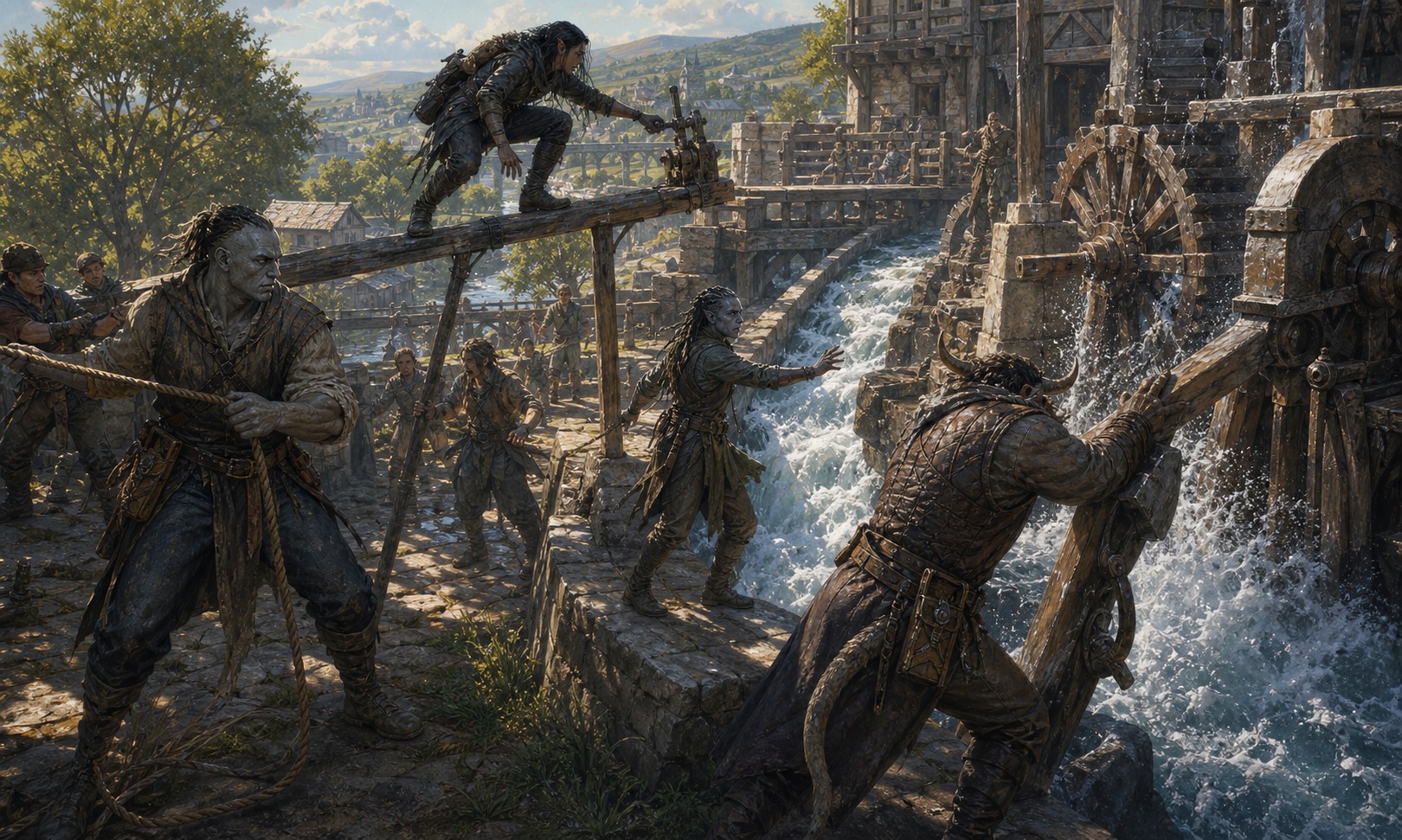
Characters grow through what they live, not through points awarded for successful rolls.
Sabra came back off the winter road different and none of us could say how. Same hands. Same short answers. But she stopped asking me which rope to trust. I went out with her in the spring and watched her turn down a coil I would have used, and she was right. Twenty-one years I have been doing this, and she was right. Nobody gave her that. The road did, and it charged her for it. — a road-crew's winter book, entry unsigned
Evidence may come from sustained work, consequential tests, hardship, discovery, responsibility, teaching, failure, repair, or a defining deed. It is directional and non-numeric. Repeatedly doing the same safe thing does not manufacture mastery, and one extraordinary moment does not always prove a durable change.
At meaningful settlements, the Tread Master reviews newly accepted evidence and asks whether the character's sustainable competence has changed. Competency may become established, refine within its present Order, cross an Order boundary, remain unchanged, or be reconsidered when lasting harm or contrary evidence requires it.
There are no levels to gain and no universal advancement tree. The three opening Techniques belong to the character's chosen Practice. Their Performances become more dependable as relevant Competencies develop. Later Techniques must be learned and supported by play; this chapter promises no hidden automatic unlock schedule.