
Coin, craft, and what you carry
Equipment and the Economy
In this section
The Tread runs on bone-iron coin, but a price is a conversation rather than a universal number.
On this page 11 topics
#Coin, craft, and what you carry
The Tread runs on bone-iron coin—but a price is a conversation, not a number on a page.
TREADBOUND has stores, tools, weapons, debt, barter, scarcity, and things worth saving toward. It does not have one fixed price for every shield, because there is no fixed shield, seller, road, or season.
A price depends on who holds the thing, who wants it, what the district has survived, where the nearest caravan is, what the buyer is known for, and what else the seller needs. The transaction happens in the world.
#Bone-iron money
Bone-iron coin is counted in three common denominations:
| coin | relationship | ordinary scale |
|---|---|---|
| Chit | base unit | small daily exchange and simple supplies |
| Shard | 10 Chits | a meaningful everyday purchase or service |
| Crownmark | 10 Shards / 100 Chits | fine work, costly passage, or something saved toward |
There is no central bank. Guild counting-houses hold deposits and issue credit-marks honored within their networks. One house may redeem another's paper for a fee. Cross-Wanderer exchange happens at Convergence and may be harsh.
Coin is not the only currency. Favor, debt, barter, access, protection, ritual exchange, and reputation may matter more than metal. In a hard season, food, water, masks, rope, or trust may be the thing that actually has value.
#Worth is local
The merchant has stock, needs, obligations, expectations about the road, a disposition toward the buyer, and sometimes goods shown only to people they trust.
In a hungry district, grain rises while heirlooms are sold for bread. After a dangerous delve, masks, boots, lamp oil, and sound rope grow dear. At a Convergence, foreign coin may be useful for a week and difficult to redeem the next.
Two men asked the price of the same lamp within an hour of each other, and I charged them differently, and I will say why. The first is going down to the fourth level with a crew who need him to come back up. The second wants it for a shelf. A price is not a number I have decided in advance. It is what the thing is worth, here, this week, to the hand held out for it. — a chandler at the ridge market, to an apprentice
The denomination table gives scale. It is not a universal price list. To learn what something costs, ask the person who holds it.
#Reference magnitudes
These are not prices. Worth is local, and a price is a conversation. What follows is a set of rough orders of magnitude so that a table can improvise consistently — so that two settlements a season apart do not accidentally differ by a factor of a hundred on the same rope.
| Roughly | Is the order of |
|---|---|
| A few Chits | a meal, a bed in a common room, a day of unskilled hire, rope, lamp oil, a boiling-day fee |
| Tens of Chits | a working tool, a week's plain lodging, a short caravan passage, a season's ordinary clothes |
| A Shard or two | a good tool built to last, boots that survive a season, passage across a titan |
| Tens of Shards | a working animal, a plain blade, one crew's contract on one face for a season |
| A Crownmark | a year of a skilled hand's wage, a bone-iron instrument, a small boat |
| Tens of Crownmarks | a Pulse-worked blade, a generator for a small holding, a share in a caravan |
| Past that | airship passage rights, a licensed Depths mouth, a counting-house credit line — things argued over rather than bought |
Read the table sideways, not down. It says a Pulse-worked blade and a year of skilled wages are in the same conversation, and that a good tool and a night's lodging are not. That is the whole of what it says. It is not a claim that any of these has a settled price anywhere.
#What actually moves the number
Scarcity. Who is asking, and what they are known for. What happened here last season. Whether the seller needs coin or needs the relationship. Whether anybody else within a week's travel is selling the same thing. Whether the buyer can carry it away, and whether the seller wants them to.
A settlement in a bad season will not honor any line in that table, and should not. A delving concern that needs a crew before the thaw will pay past the top of it without blinking. Those are not exceptions to the economy. They are the economy.
#Starting possessions are discovered
Starting equipment belongs to the Final Character Read. The player does not browse a catalog, choose a Practice package, spend a point allowance, or declare ownership because an object would be useful.
After the character's life is coherent, the Tread Master asks:
Given this person's history, what would they reasonably possess today?
Two Warblades may share martial learning and carry entirely different lives. A frontier militia veteran may own a repaired spear, weathered harness, cooking pot, and obligations to people who still call them captain. A former city duelist may have a practice blade, tailored jacket, letters of recommendation, and a creditor who knows where every piece came from.
Neither chose a loadout. Their histories established possessions, relationships, and pressure.
During readback, correct a contradiction. Do not turn correction into shopping. If the accepted life does not support an object, the character does not begin with it.
#Equipment is a verb
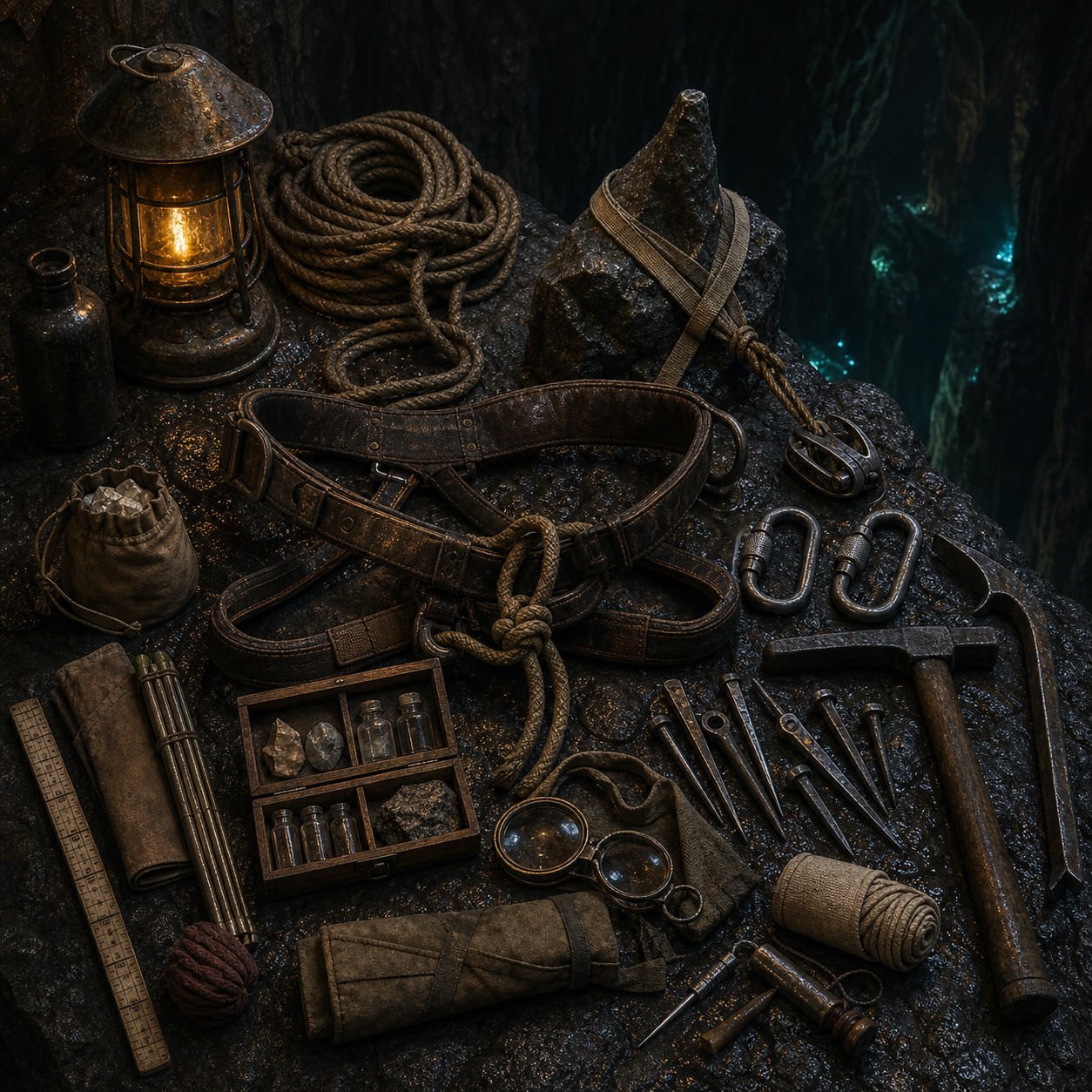
An object never hands a character Competency. It changes what the character may do.
#Enable
Equipment may make a method possible. A climbing harness permits a route bare hands cannot safely attempt. A delver's mask permits work in air that would otherwise be unbreathable.
#Ease
Equipment may change what the situation resists. A surgeon's kit makes delicate work less demanding. Sound rope changes a bad ledge. Deep-adapted lenses remove a visual obstacle.
#Change the method
Equipment may offer another approach to the same intent. An airship crosses in a day what a road takes a season. A listening cone replaces entering a room. A sealed case lets a volatile sample be carried rather than studied in place.
#Fail in its own way
Equipment introduces consequences. A generator overloads. A blade shatters. A rope frays. A lifting vessel loses the local Pulse and falls.
Gear is therefore recorded as affordance, condition, provenance, and history—not as a free-floating modifier.
#Quality, reliability, and reach
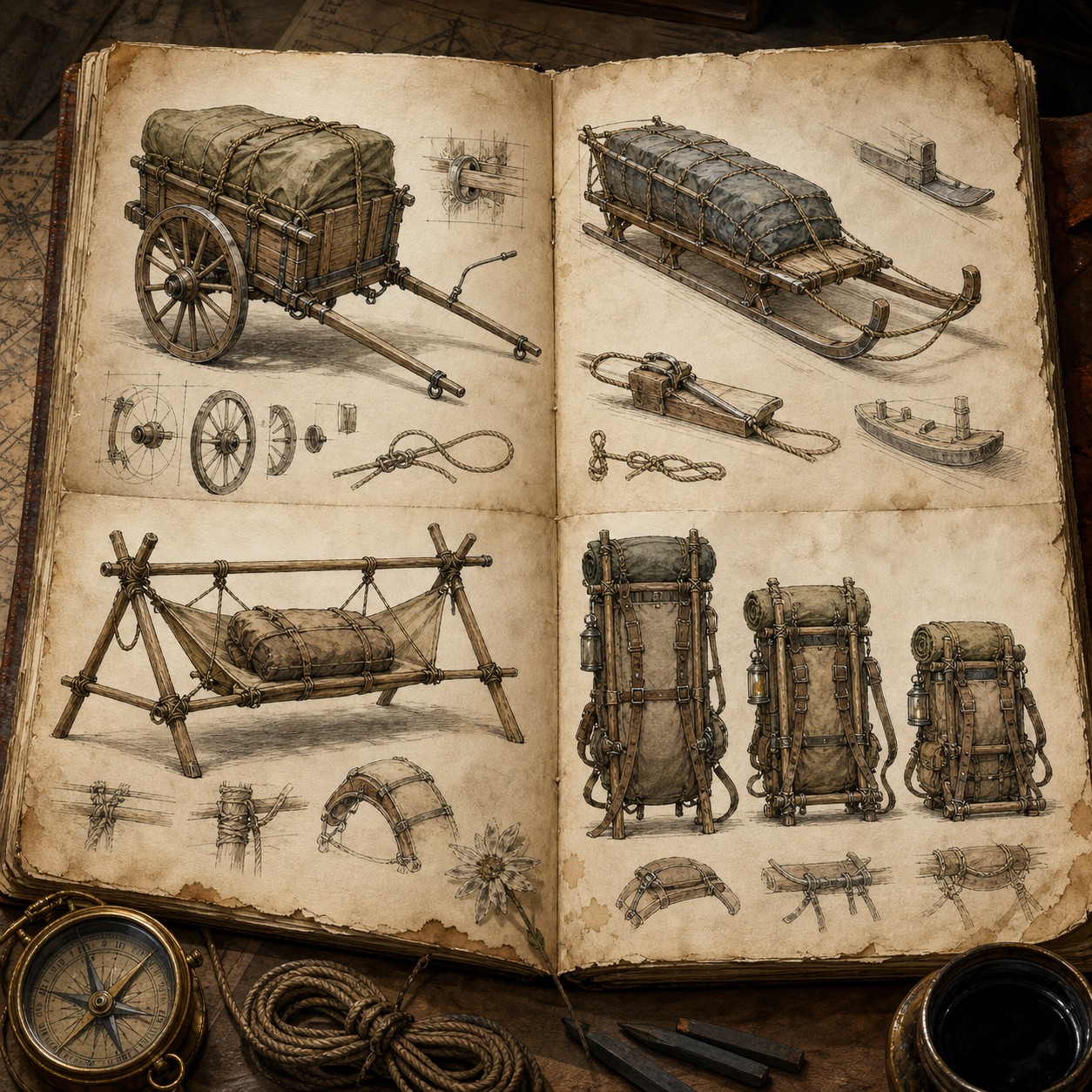
Craft may be described as improvised, serviceable, fine, exceptional, masterwork, or Pulse-worked. These descriptions are not a universal bonus ladder.
Quality changes what an object can withstand, what it enables, how reliably it performs, how far its affordance reaches, what failure looks like, and how the world values it. How well the character uses it remains Competency expressed as Performance.
#Arms, armor, and artifacts
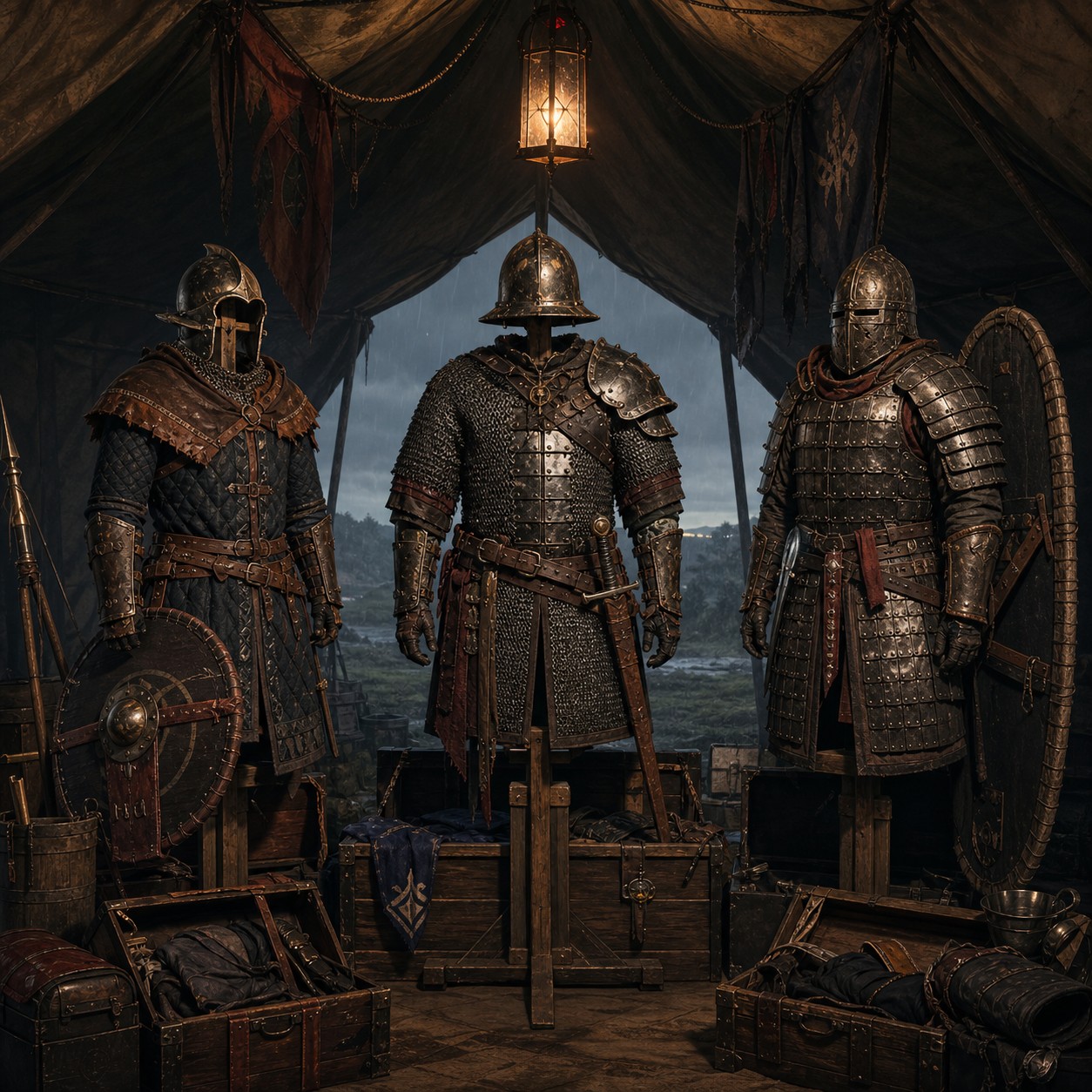
A weapon is known by its make, material, balance, condition, provenance, familiarity, and what it has survived. It does not carry one universal number that replaces the wielder's competence and the truth of the moment.
Armor changes what reaches the body, what movement costs, which environments can be survived, and how failure occurs. It does not make the wearer more skilled.
Artifacts emerge from the world. Their significance comes from origin, capability, history, access, relationship, and consequence—not a rarity color printed at the forge.
#The Pulse and its technology
Three things remain distinct:
- the Pulse—a Wanderer's living resonance or force;
- Pulse interaction—a locally valid person, relationship, collective, or place through which that force enters an interaction; and
- Pulse technology—what civilization builds to harness, channel, measure, contain, or survive it.
None automatically grants the others. A technician may operate a generator without personal attunement. A Pulsewalker may know a Wanderer's rhythm and understand nothing about the machinery. A Sagebound instrument and an industrial lifting chamber may touch the same source through different methods.
Bone-iron is a substrate, not a rarity tier. What it becomes depends on composition, craft, treatment, history, and local Pulse relationship.
An airship is likewise a system rather than a single item. Piloting, navigation, maintenance, weather reading, rigging, command, provisioning, and emergency response remain different work. The vessel is the affordance. The crew is the competence.
#Possession, ownership, and the common purse
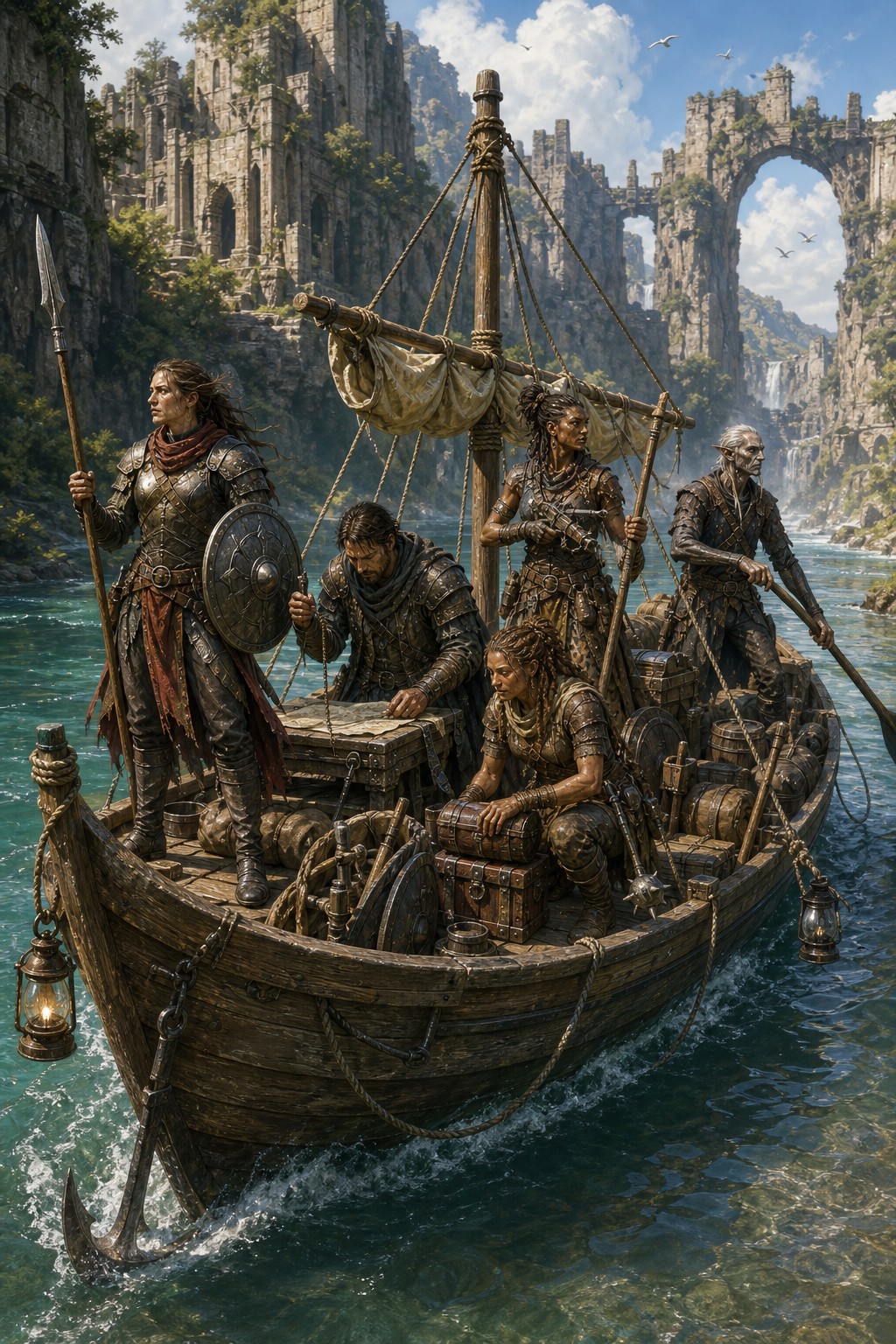
Holding a thing and owning it are not always the same. A record may distinguish carried, borrowed, entrusted, disputed, stolen, shared, personally owned, institutionally controlled, lost, broken, consumed, or surrendered property.
Picking something up establishes possession in the scene. Durable ownership, access, custody, and company allocation settle through what the Chronicle establishes afterward.
A company may keep a common purse, shared supplies, transport, camp equipment, salvage awaiting disposition, and goods nobody has claimed. The common store is not a frictionless inventory screen. Bulk, location, responsibility, access, and trust remain world facts.
#Objects change through play
Equipment has history too. It may acquire repairs, scars, modifications, reliability, relationships to particular users, reputation, institutional standing, symbolic weight, contested ownership, loss, and recovery.
Objects do not develop instead of the character. They develop alongside the character because the world remembers what both survived.