

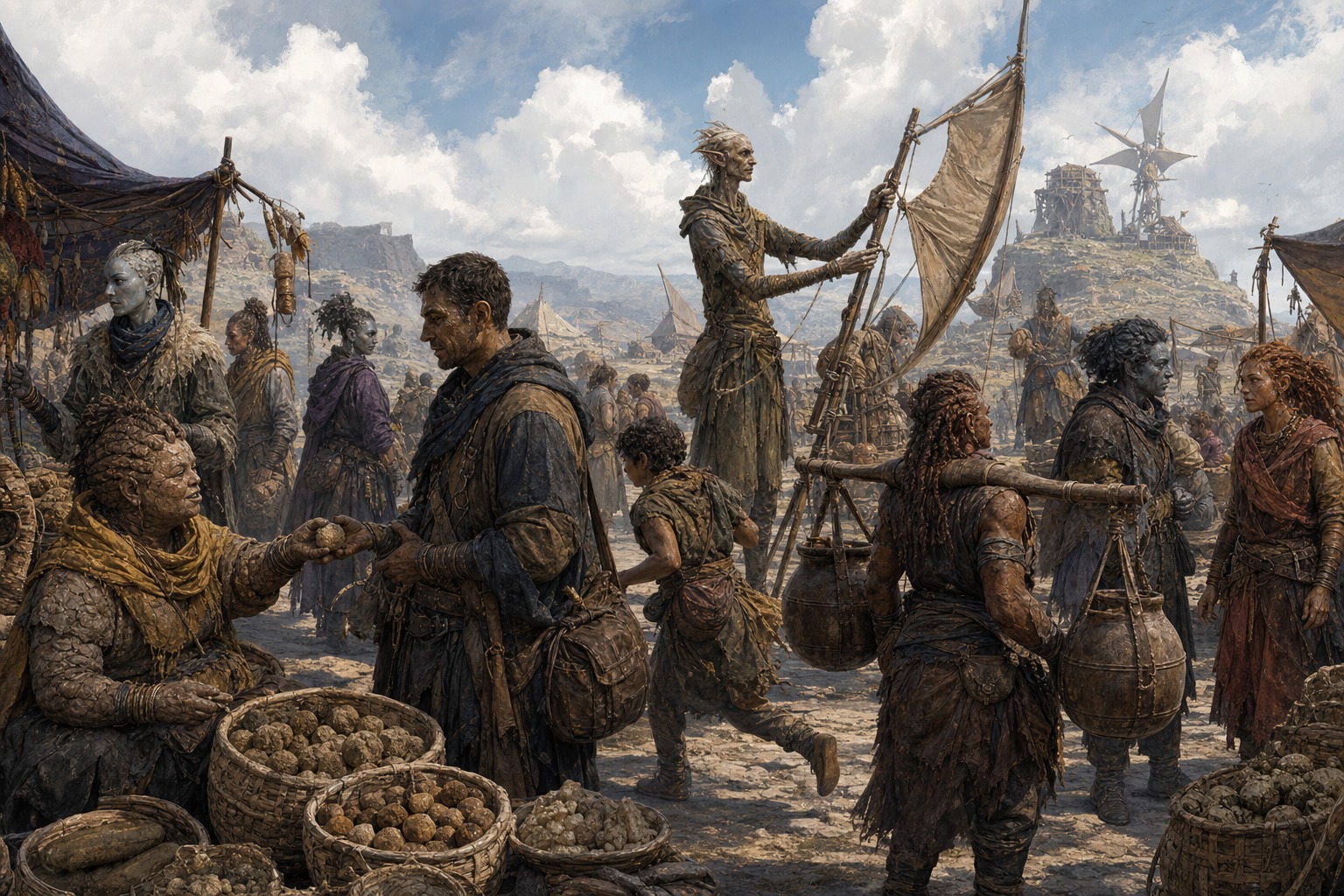
Body and possibility
The Seven Lineages
In this section
Lineage establishes a body and inherited possibility. It does not determine upbringing or character.
On this page 17 topics
#The question of creation — who made us?
Seven peoples follow. Before you meet them, two things about how they work — because it is not quite how these things usually work.
#Your lineage is your body. It is not your upbringing.
What you inherit is physical and it is real: a build, a lifespan, sometimes a sense other peoples do not have, sometimes a door standing open that most will never walk through. That much comes with you and cannot be given away.
Everything else in these pages is culture, and culture is learned. The guilds, the orchards, the old arguments, the rites, the way a people keeps its dead — none of that arrives in the blood. It arrives from whoever raised you.
So a child of any of these peoples, raised among another, is still what they were born as. They have the body, the years, and whatever their people inherit. What they do not have is the rest of it — the guild, the orchard, the calendar, the archive, the argument everyone else grew up inside. Nobody around them knew it either. They may not know there is anything to know.
That is an ordinary life on the Tread, not a twist. Every people here can be lived from the outside. Read each entry as a culture you might have been raised inside, beside, far from, or never heard of at all.
#They do not agree about where they came from.
Every people on the Tread carries an origin — and no two of them are the same kind of claim.
Some say they were made, and can tell you by whom. One says it was made to serve a purpose it never chose. One says nobody made it at all, and treats that as the most important fact about itself. One grew out of the ground. One remembers leaving somewhere rather than being made anywhere. And one has no story at all, which it has decided to find encouraging.
They cannot all be right. None of them can be proven, and the world has never offered to settle it. Where a people's own account contradicts what another people says about them, both are printed, because the disagreement is older than any of the peoples arguing about it and is not going to be resolved in a handbook.
You will find the whole argument laid side by side at the end of the chapter. It is worth reading after the seven, not before — the peoples are more interesting than the pattern they make.
#The Seven Lineages — I. The Wyldtouched
#The Companions
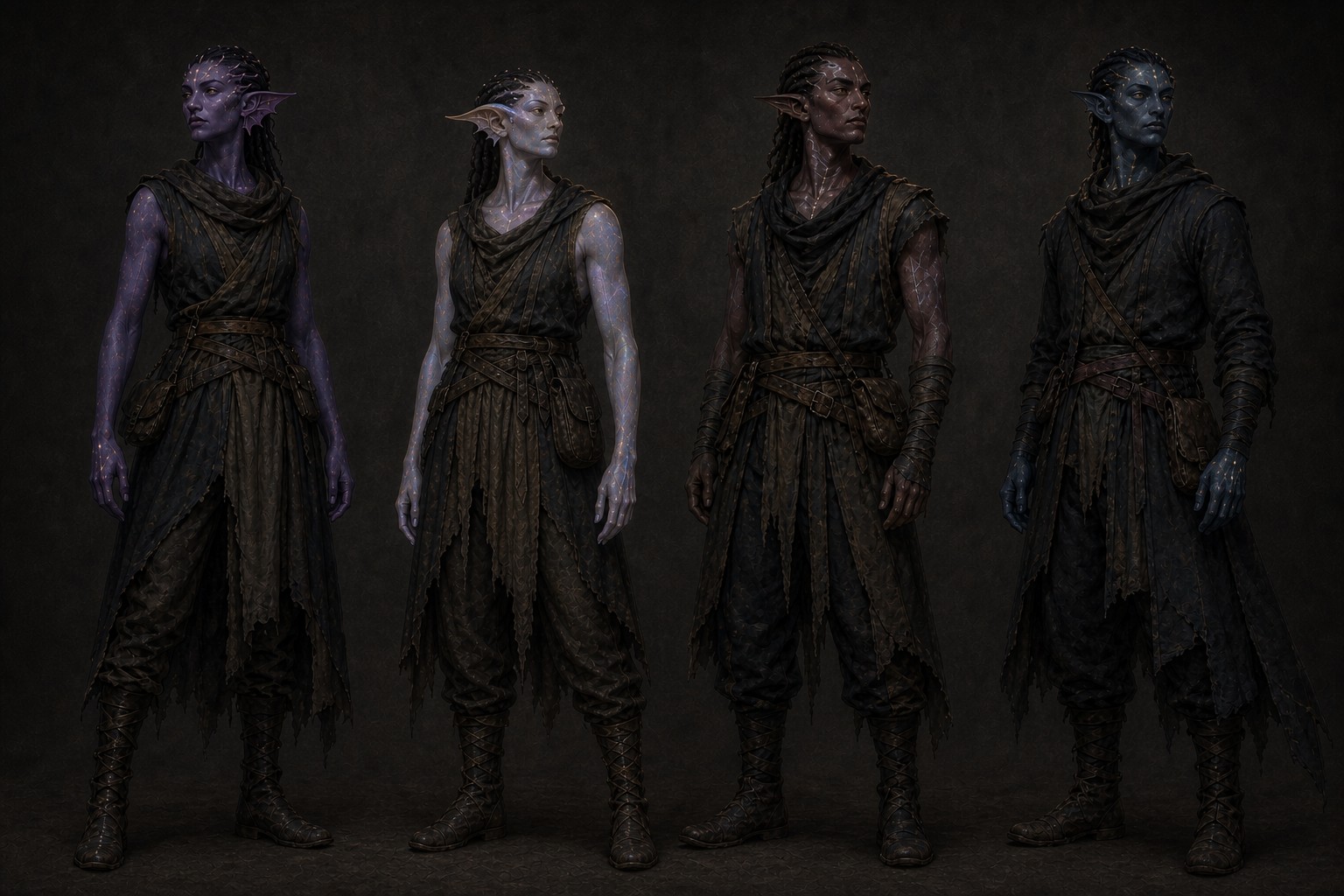
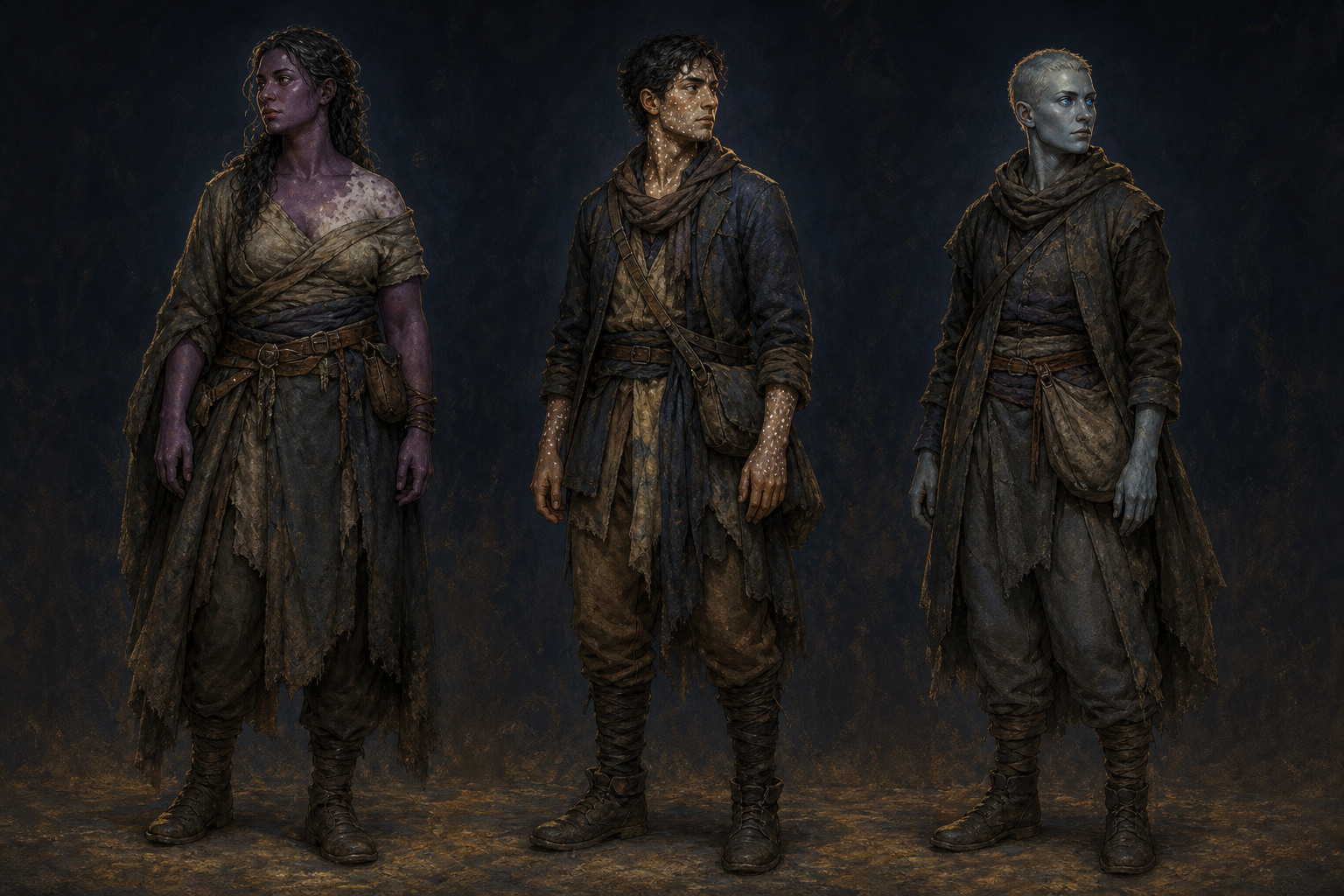
#The Companions
Among the oldest peoples still walking, and the one the eldest archives place closest to the Pulse itself.
What does it mean to have been made as a companion, when the one you accompany may never speak in words?
#Where they come from
They were made to walk beside the Wanderers. That much is old, settled history — and nobody now living knows how, or by whom, or why the Wanderers were thought to need company at all.
Their own archives say the Pulse made them. Another telling says the Wanderers did, for the long migrations, and the Wyldtouched see no reason those must be different answers. The same telling goes further: that the Wanderers later asked the Wyldtouched for protectors, and out of that came the Emberkin from Wanderer flesh, and then the Stonekin from bone to make the protectors' tools.
They are the first to tell you none of it can be proven. Their archives reach back into ages no other people kept any record of at all — which is either the best evidence anyone has, or exactly what you would expect from the people who wrote them. The Wyldtouched are aware of the problem. They have been aware of it for a very long time.
Neither the Emberkin nor the Stonekin much care for the story, for their own separate reasons.
Two of them came through the gallery inside an hour and I could not have told you they were kin. The first had a violet cast to her and a spill of light across the collarbone you could read by. The second I took for an ordinary woman until she set her hands on the table. Nothing alike. Both unmistakable, and both watched the whole way down. — P.
#How you would know one
By the marks, and by the fact that no two families carry them the same way.
Generations spent near the Depths left something in the blood, and it surfaces differently in every line. It shows in the skin — a color no one else quite has, or a scatter of pale points across the face and throat and backs of the hands, like a sky in the wrong place. It shows in the eyes, which are often too bright and too saturated to be mistaken for anyone else's. It shows in a voice that carries strangely, or in someone who runs warm to the touch in a cold season, or in how tall and how slowly they grew.
One family's marking will be a violet cast and a spill of light across the collarbone. Another's will be almost nothing until you notice their hands. A third's will be a thing you cannot name and will still recognize across a room.
A Wyldtouched can usually recognize another line's marking even when it looks nothing like their own. Strangers manage it too, which is the part that costs them.
A picture will not tell you the rest of it. They are ordinary to stand beside — a Wyldtouched is built like anyone, weighs what they look like they weigh, and takes up a person's worth of room. But they arrived there slowly. A Wyldtouched of thirty may have the face of someone half that and the patience of someone twice it, because five hundred years is a long enough road that nobody in the family is in any hurry about the first fifty.
And the marking runs in a line, not in a people. What you are looking at when you meet three of them is three families. The fourth will not resemble any of them, and will still be unmistakable.
#The Spark
They inherit something they call the Spark. It makes certain workings of the Pulse possible for a Wyldtouched that are simply not possible for other people.
It is a door, not a skill. Being born with it teaches nothing, guarantees nothing, and grants no technique. A Wyldtouched who never learns anything about it will go their whole life with a door open and never walk through it — and a great many do exactly that, especially those raised far from anyone who could have explained it.
What they can actually do is what they have learned to do, the same as everyone.
#Being read as an omen
When the Depths stir, people look at the Wyldtouched.
It is not accusation exactly, and it is rarely spoken outright. Shops stay open but conversations stop. A room adjusts. Old families in old settlements are treated with a caution that has nothing to do with anything the family has done, and everything to do with a mark on a face and a story about where that mark came from.
That fear belongs to the people holding it. It has never been shown to be about anything true. The Wyldtouched have been on the receiving end of it long enough to have developed a range of responses, from patience to scholarship to leaving.
#Five hundred years of remembering
A Wyldtouched may live around five centuries, and they grow into it slowly — a long childhood, a longer education, and an adulthood that arrives late by everyone else's reckoning.
What that does to a people is archives. They keep records nobody asked for, in more detail than anyone needs, going back further than other peoples' histories admit to going. A Wyldtouched scholar may be working from a source written by someone they met.
It also means they carry the oldest arguments personally. When a Wyldtouched says the Emberkin were raised at the Wanderers' asking, they may be repeating something their own grandmother was told by someone who claimed to have been there. That is not proof. They know it is not proof. It is, however, a very difficult thing to put down.
#What is inherited, and what is not
Upbringing near an old delving-site tends to seed early Pulse-sense, Depths-lore, or a scholar's habits before anyone has decided to teach them.
A Wyldtouched raised somewhere else carries none of that. They have the marks, the Spark, the long years — and no archive, no tradition, and no idea that the story about the Emberkin exists. They will still be treated as an omen by people who have never asked them anything.
For what a Wyldtouched is beyond playing one — origin accounts and what cannot be proven, how other peoples read them, and the range of lawful communities they live in — see Bestiary, §2 — Wyldtouched.
#The Seven Lineages — II. The Emberkin
#The Protectors
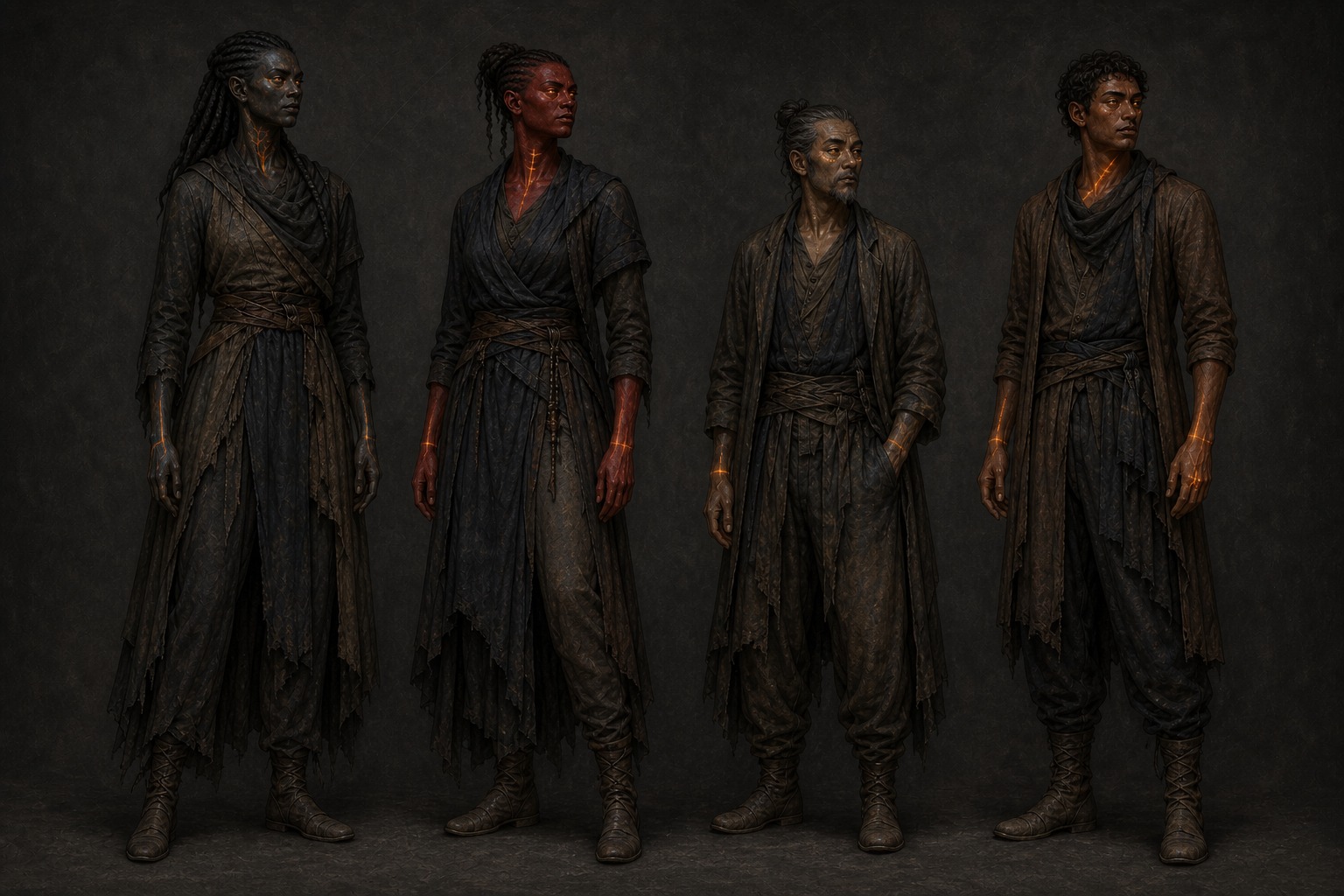
#The Protectors
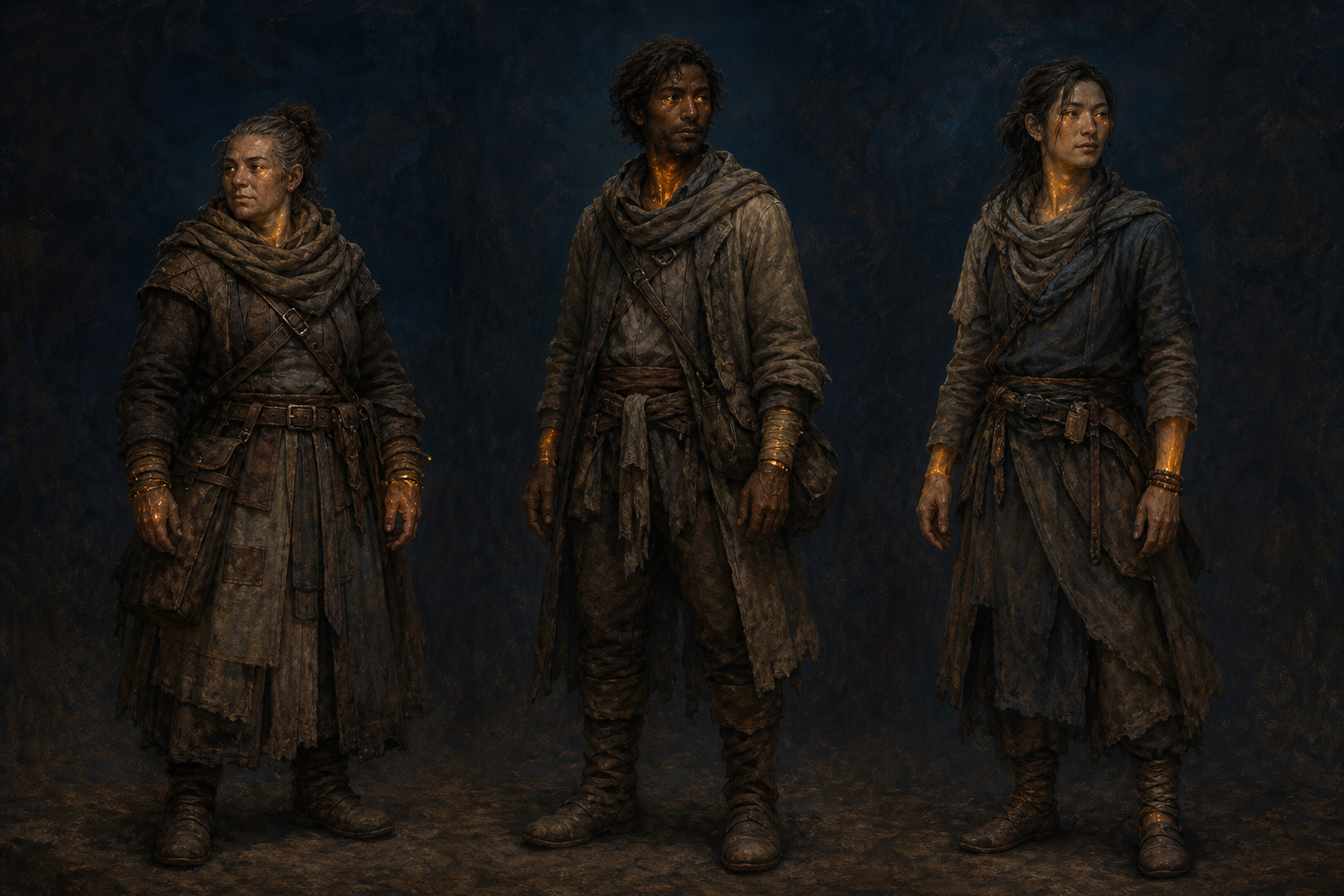
An ancient people who understand themselves as guardians, and who take every crisis on the Tread more personally than anyone else — because if the old bond is real, what does it mean when a Wanderer falters?
What does it mean to be called a protector when no one can prove why you were made?
#Where they come from
They say they were shaped from the flesh of a Wanderer.
Not raised by anyone, not commissioned — made from the living body of the thing they now guard. That would make them kin to it, and it is that claim, not the guarding, an Emberkin defends first.
The Wyldtouched tell it with one word changed. In their archives the Wanderers asked them for protectors, and the Emberkin came of it. Whether that word meant made, or only reared, has been argued for as long as anyone has been arguing. The Wyldtouched are not always careful about the difference. The Emberkin are extremely careful about it: a people can be brought up by someone without having been made by them, and being taught is not the same as being invented.
Underneath both versions sits a question neither answers — why. Protectors are made against something, nobody can say what, and the oldest guess is a people still here who insist they were never made at all.
So the Emberkin carry a purpose they did not choose and cannot confirm. If the story is true they were built for a job. If it is not, they have organized their whole existence around work nobody ever assigned them. Most decide it does not matter. Some decide it matters enormously.
You will know before he speaks. Take the hand — go on — and it is warm as a stone at the end of the day, in the cold, in the wet, in the deep of the year. My mother sat one at the head of the table and would not hear otherwise. Her sister crossed the lane rather than pass one. Same village. Same man. — an old wives' telling, told in many places
#How you would know one
They run warm.
Not feverish — warm the way a stone is warm hours after the sun has gone, so that a handshake in a cold season is a small surprise and children notice before adults will say anything. It holds through weather, through illness, through age.
There is light in them, too, and it is not a trick of a lamp. Something moves under the skin at the wrists and the throat and the hollow beneath the eyes, faint in most, unmistakable in a few, and brighter when an Emberkin is working or frightened or very old. Their own word for it is the Ember.
There is no one build or coloring among them, though they stand a head above a human and narrower with it, and their women a little taller again than their men. But nobody who has met one is in doubt afterward — and the resemblance between that light and the veins of warm gold under a Wanderer's hide is exactly the sort of thing that keeps an unprovable story alive.
Be clear about what the warmth and the light are not. An Emberkin does not scorch what they touch, cannot start a fire, and will not let you read by them in a dark room. Put one in a cold barn overnight and the barn is still cold; put your hands around theirs and yours are warmer than they were. Their skin is skin. It burns, and it scars, and it heals at the speed everyone else's does.
The rest is ordinary. They eat what anyone eats, tire when anyone tires, and want what anyone wants. The Ember is a small constant heat and a light under the skin, held for four hundred years, in a body otherwise built like yours.
#The Ember
Every Emberkin can press their own Pulse outward — push it past the boundary of the body, into a space, an object, or another person.
They call the Pulse the Ember, and have for longer than the surface has used the word Pulse at all. The two names are one force. And the Ember is kin to the Wyldtouched Spark: two peoples, two old names, the same thing surfacing through different blood. Whichever people you ask will tell you their word is the older one, and one of them is right.
What the Ember is not, despite a persistent old story, is fire. It is not carried in the throat, and there is nothing to breathe out.
Projection is a door and not a craft. What passes through it varies enormously between individuals and traditions, and none of it is inherited — an Emberkin who was never taught can push warmth into a room and nothing else, their whole life, and be entirely typical.
#Revered, or driven out
Wherever they go they are read as a sign, and the reading swings hard.
One settlement will seat an Emberkin at the front of a rite they have no part in and no wish to attend. The next will find reasons the room is full. It rarely stays neutral, and it almost never depends on the person: the same traveler is a blessing on one shoulder of a Wanderer and a bad omen on the other.
That is the world's reaction, and none of it is a fact about Emberkin. It is a fact about a story the world has heard.
#Long enough to see the job come round again
An Emberkin may live around five centuries, and that is what makes the crises personal.
An old Emberkin has been in a settlement that failed. They remember the winter, the names, and what was said in the room when the decision was made — not as history but as something they stood in. When a Wanderer slows or a road stops being safe, they are not reasoning from records. They have seen this shape before and they know what came next.
It also means they outlive what they set out to protect. Emberkin traditions are full of guardians still keeping a promise made to a village that no longer exists, to people whose grandchildren have died of old age. Nobody in those traditions treats that as a tragedy. They treat it as the job.
#Peoples, not a people
There is no single Emberkin culture, and describing one is a mistake outsiders make constantly.
Their communities are ancient and various — some far below the settled ridges, some threaded through them, some traveling and answering to nobody. They disagree about the Ember, about what the bond obliges, and about whether the guarding was ever a duty or only a habit that hardened.
An Emberkin raised outside all of it still runs warm, still carries the Ember, still gets read as an omen by strangers — and has never been told what any of it is supposed to mean.
For what a Emberkin is beyond playing one — origin accounts and what cannot be proven, how other peoples read them, and the range of lawful communities they live in — see Bestiary, §3 — Emberkin.
#The Seven Lineages — III. The Stonekin
#The Makers
#The Makers
Builders, quarriers, and keepers of deep places — the people who read the bones of a Wanderer the way others read weather.
What were we made to build, and who decided that making was our inheritance?
#Where they come from
Their oldest traditions say they were born from bone. That is the whole of it, and most Stonekin are content to leave it there.
The longer version is the Wyldtouched's, and it is less flattering: that the Stonekin were made third and made to order, shaped from Wanderer bone to supply tools to the Emberkin, who had been shaped from Wanderer flesh to stand guard. Sister peoples cut from the same body for different jobs — and one of the jobs was to equip the other.
A great many Stonekin decline that story. It is told about them by someone else, it makes them a means to another people's end, and nobody can prove a word of it.
It also leaves a question hanging that no one has closed. Guard against what? The old answer is the Tuskborn — the one people who claim no maker at all. Both peoples have lived alongside that story for a very long time. Neither has anything to settle it with.
Two of them on the crossing this morning and I have written the ferry down for repair. They do not look it. Shorter than my boy, the pair of them, and I put them at half again his weight and I was under. You learn to load them last and load them center. Nobody warns you. You find out with the water coming over the rail. — a ferry-master's note, entered in the margin of a toll book
#How you would know one
By the weight.
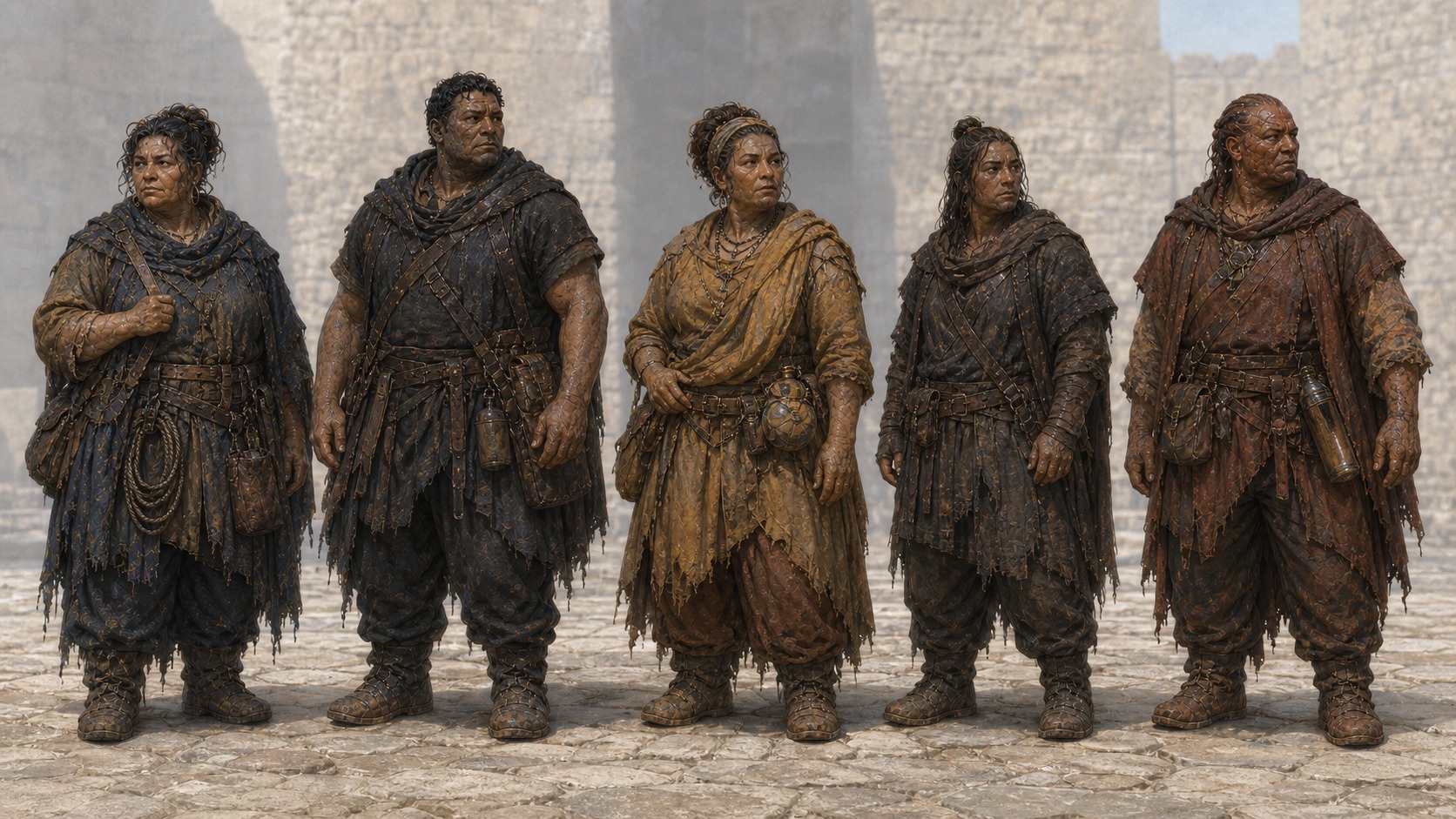
Stonekin are built low and solid and are heavier than they look. One a head shorter than you may be half again your weight, all of it packed into a frame that seems ordinary until they put a hand on something. They do not perch. They do not blow over. When a Stonekin sits down on a bench, the bench knows about it.
They stand shorter than a human and near half again as broad, and the difference is in the whole frame rather than the muscle: short thick limbs, a deep chest, hands that look wrong closing around an ordinary cup. The top of a Stonekin's head finds your shoulder, and the rest of them makes up the difference sideways. None of them are narrow.
Their skin carries mineral color, and this is the thing outsiders get wrong most often. It runs in families — warm sandstone, basalt and ironstone, honey limestone, dark slate, copper — and it lies in the skin the way a birthmark lies in skin. It is not armor. It does not turn a blade, does not strike sparks, and does not make them anything other than a person the same knife would open. They are not built out of the ridges they quarry. Say otherwise where they can hear you and find out how quickly a patient people stops being patient.
Their faces keep. A Stonekin of eighty looks to be in their prime and will still have most of that face at two hundred, so age arrives as wear rather than change — knuckles, scarring, a gray that turns up a century after you expected it. People who rarely meet Stonekin always guess low.
Many Deep Stonekin see in the dark, and you can spot it — larger eyes, and a squint on a bright ridge afternoon, like someone who has just come outside.
What holds across all of them is the density, and how long time takes to get to them. The rest — color, features, height within that envelope — varies as much as it does in anyone.
#The work
Nothing on the Tread is built on solid ground. The Stonekin are the people who decided that was an engineering problem.
They cut into the bone-rock — the pale ridges rising through the hide like the spine of something sleeping, which is exactly what they are. Out of it they take bone-iron. Into it they set the footings that keep a city from sliding off the shoulder of a moving animal. Walk any old settlement and the Stonekin work is the part nobody looks at: the retaining wall, the anchor, the stair cut into living rock a hundred and fifty years ago by someone who is still alive and still checks it.
They build for the ages and they mean it plainly. A Stonekin structure is meant to stand for generations without weakening — not propped, not patched, not apologized for. The world underneath it never stops moving. So they work slowly, build heavier than they need to, and have very little patience for anyone who wants it done by the season's end.
Where other peoples build shrines, the Stonekin keep survey records. Working out how the Wanderer is put together is the closest anyone gets to knowing what it is. Worship and measurement are the same feeling here, and it is very old.
#Long enough to answer for it
A Stonekin elder may live three and a half centuries — long enough to watch a building come of age.
That is what makes them careful rather than sentimental. Cut a joint badly at forty and you will still be alive when it is tested, and so will the people living above it. You sign your work because you will be there to answer for it. The mark cut into a footing is not boasting; it is a name attached to a promise, and the promise outlasts the person.
The worst thing you can say about a Stonekin's work is not that it fell. It is that someone had to come back to it early.
#Ridge and Deep
Two traditions, and a quiet tension between them that everyone feels and few will name.
Ridge Stonekin work in the light — masons, architects, surveyors, foremen, often the ones seated on a settlement's council because they are the only people present who know what the settlement is standing on. They are the sociable face of a private people.
Deep Stonekin work where the bone gives way, down at the boundary where the hard clean skeleton turns to something softer and stranger and the Depths begin. They are harder people, they keep to themselves, and their own kin are uneasy around them.
That uneasiness is not superstition. It is simpler and worse: Deep Stonekin have seen the place where the structure stops being structure and starts being flesh. They know something about what everyone is living on, and they do not discuss it at guild meetings.
For what a Stonekin is beyond playing one — origin accounts and what cannot be proven, how other peoples read them, and the range of lawful communities they live in — see Bestiary, §4 — Stonekin.
#The Seven Lineages — IV. The Tuskborn
#The People Who Were Never Made
#The People Who Were Never Made
Alone among the seven, the Tuskborn claim no maker at all.
Why must anyone have made us?
#Where they come from
Not shaped from flesh. Not cut from bone. Not grown out of the ground. The Tuskborn descend from the wildlife of the Wanderers — animal ancestors who, across spans of time nobody can hold in their head, became peoples.
Intelligence was not handed to them. It arrived on its own, the way they hold it might arrive anywhere, given enough time and nobody interfering.
"No one made us." It is not a boast, and Tuskborn say it flatly rather than proudly. It is the fact everything else about them rests on, and the part that matters is the second half: no one made us, and so no one decided what we were for. Every other people on the Tread carries somebody's intention, real or believed — a purpose, a commission, a job they were shaped to do. The Tuskborn carry the fact of having arrived by themselves. They hold that title somewhere between pride and relief.
There is an older story they have heard all their lives, and it is not theirs. In it, the made peoples were made as protectors — and the thing they were made against was the Tuskborn. Nobody has ever produced a scrap of evidence for it. It has never needed any: it explains, conveniently, why one people arrived without permission, and it has been useful to a great many settlements that wanted a reason.
Tuskborn responses to it range from patient argument to a refusal to dignify it. What almost none of them do is treat it as an open question about themselves.
Hired: four out of the flank country, three off the river-folds. Of the seven, two carried tusks I would call tusks. One hears in the dark better than my foreman sees in daylight. One is smaller than my daughter and shifted more stone than any two men on the books. Same people, they tell me. I have stopped writing the word build in this column; it means nothing here. — from an unfinished hiring ledger
#How you would know one
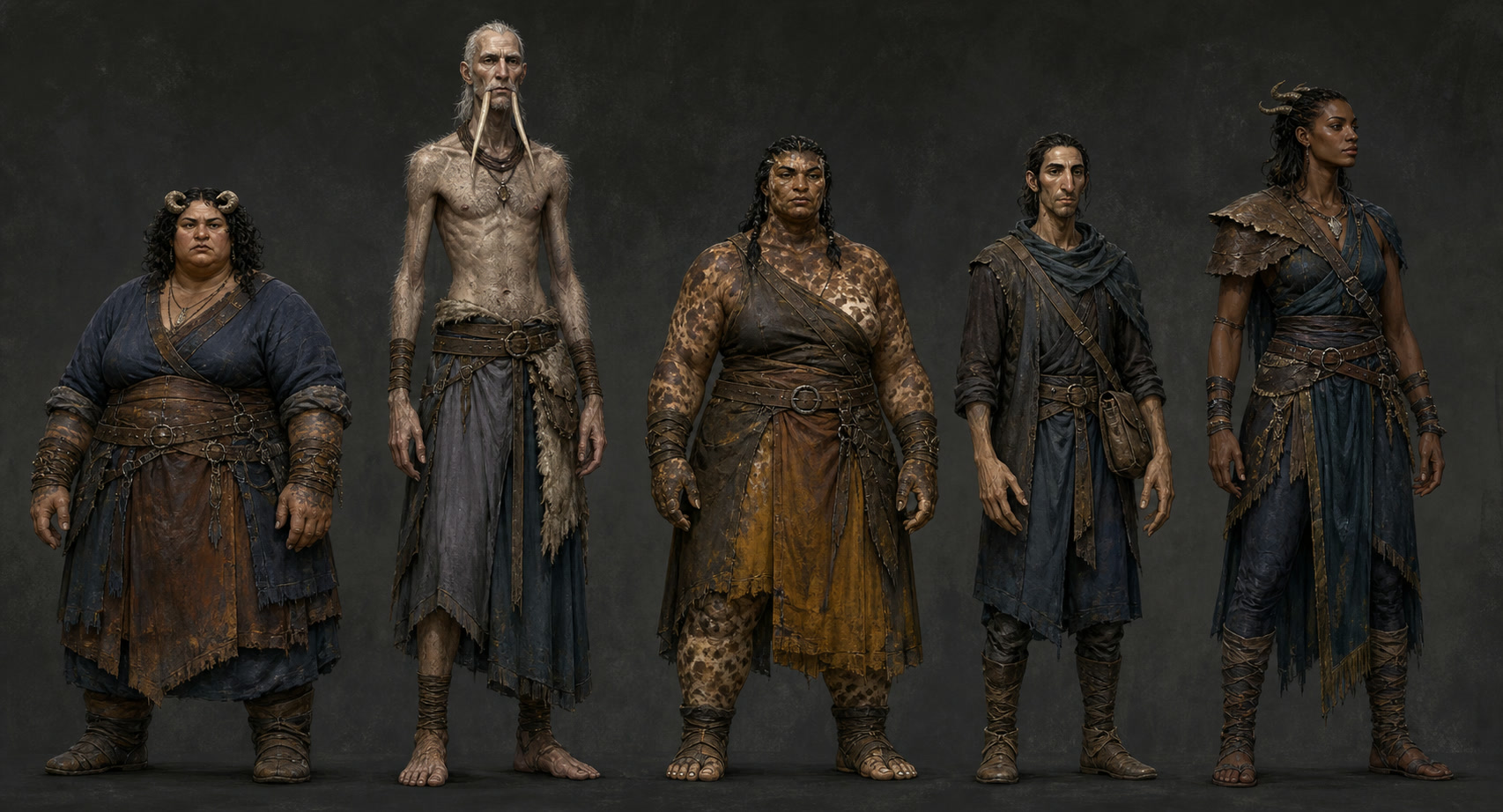
There is no Tuskborn build, because there was never one Tuskborn ancestry.
That difference matters. Their ancestors were many different animals living on many different parts of many different Wanderers, and every one of those lines handed something down. So Tuskborn bodies vary further from each other than any two other peoples do — in frame, in reach, in what their senses are good at, in what part of a Wanderer their family is built to survive.
Some carry the heavy shoulders and the tusks the name remembers, jaw-teeth grown long enough to show at rest. Some carry none of that and something else instead: hearing that works in the dark, a tolerance for cold that makes coats look decorative, a hide that turns a scrape, natural weaponry that has nothing to do with tusks at all. Skin runs every color a body can be.
What you are looking at is a heritage, not a template. A Tuskborn from a windward flank and one from a deep river-fold may share a name, a history of being treated badly, and almost nothing about their bodies.
The variation is not random, which is the part outsiders miss. It runs in families, and it breeds true. A river-fold line has produced the same broad flat hands and the same tolerance for cold water for as long as anyone has kept track, and a child born into it gets those and not the windward line's shoulders. Ask a Tuskborn what they can do and they will answer about their family. Ask what Tuskborn can do and you will get a look.
So no picture of three Tuskborn is a picture of the Tuskborn. Whatever range you have seen, the next one will fall outside it — and will be recognized on sight by any other Tuskborn in the room, who could not tell you how.
Set against that, the one thing they share is time, and it is the cruel one. Eighty years, ninety at the outside, in a world where the neighbors get three hundred. Everything about how a Tuskborn carries themselves is downstream of knowing they will finish first.
#Eighty years, and everybody else has three hundred
A Tuskborn lives about as long as a human — eighty years, a hundred and twenty at the outside, and hard living takes the top off that.
Everyone reading this chapter alongside them gets more. A Stonekin apprentice will still be working when the Tuskborn who trained them is a name over a door. A Wyldtouched scholar can take four Tuskborn lifetimes to finish an argument. Whole Tuskborn dynasties rise and end inside one Emberkin guardianship.
They arrived on their own and they got the least time, and they are entirely aware of both facts.
It shows in how they work. Tuskborn traditions tend to finish things. They write down what they know early and plainly, hand over tools before they are asked, and treat an unfinished promise as a serious kind of failure. A Tuskborn who says "not in my lifetime" is not being gloomy. They are doing arithmetic everyone else gets to skip.
#The work they were pushed into, and the work they do
For a long time the Tuskborn have been steered toward heavy labor and hired violence — not by inclination but by class, by prejudice, and by settlements that found a large people with short lives convenient to spend.
That history is real and it has not finished happening. It is also not what they are. Tuskborn are scholars, herders, guides, artisans, magistrates, hauliers, midwives, and everything else a settlement needs — and the ones who take up arms mostly do it for the reason anyone does, which is that the work is available and it pays.
Nothing in the blood points them anywhere. Upbringing deals the starting hand, the same as it does for everyone.
#What their ancestry does and does not give them
A Tuskborn may have a powerful frame, or sharp senses, or natural weaponry, or an adaptation to a brutal stretch of some Wanderer's flank. Which of those a given person carries is a question about their family, not about their people.
None of it is skill. A keen nose is not tracking, and a strong back is not a trade. What any Tuskborn can actually do is what they have gone and learned, the same as anyone.
The history does not travel with the body either. A Tuskborn raised among another people has whatever their ancestry gave them and none of what usually comes with it — nobody who explained the old accusation before a stranger used it, no tradition of finishing early, no particular reason to have thought about how much time they get.
They find out. Usually from somebody else.
For what a Tuskborn is beyond playing one — origin accounts and what cannot be proven, how other peoples read them, and the range of lawful communities they live in — see Bestiary, §5 — Tuskborn.
#The Seven Lineages — V. The Hearthborn
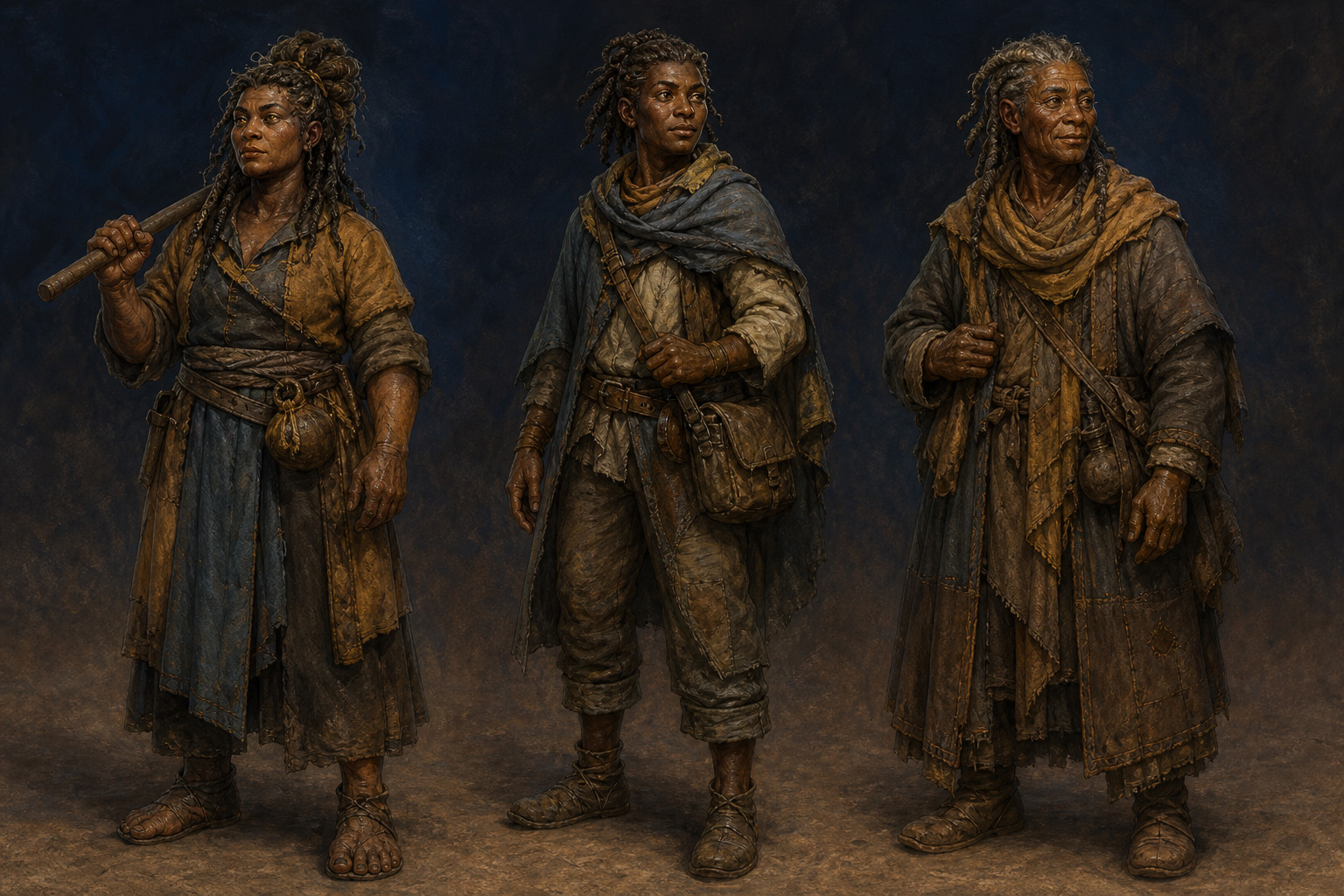
#The Rooted
#The Rooted
The people in whom the ground became people, and people became family.
Why did the world grow us, and what does it remember when we return?
#Where they come from
They grew out of the earth — the same fertile ground of a Wanderer's back that would later feed them. Not made by anyone. Not descended from any animal. Risen, in the oldest telling, straight from the living soil.
They hold the land to be their birthplace and their first ancestor, and they mean the second part literally. Their bond to the ground is not ecological. It is family.
They are careful about a distinction outsiders flatten constantly. The Tuskborn came from the life that lived on the Wanderers; the Hearthborn came from the Wanderers' living earth. Both peoples say nobody made them. Neither claims the same origin, and a Hearthborn will correct you.
And here they have something nobody else does. When a Hearthborn dies and is laid in living earth, no tree is planted; one grows from the grave. The burial groves formed this way are called orchards. Every tree is named for the person beneath it, and the family tends it afterward.
Other peoples argue their origins from archives, mythology, or a resemblance that half the people looking at it cannot see. A Hearthborn can walk you into an orchard and show you the same strange event happening again with every generation.
It proves less than outsiders assume. A tree growing from a Hearthborn grave does not establish that the first Hearthborn rose out of a field. It is still the most direct evidence any Lineage has for its own oldest story, which is why most Hearthborn stopped arguing about the story long ago even though everyone else did not.
I had talked to the woman most of an hour before it came up at all, and then only because she said my own face was from the terraces above the second bend and named the settlement, and she was right, and I have never lived there. That is the whole of it. Nothing to see. They know where you come from by looking at you, and they are polite about being right. — P.
#How you would know one
By what they appear to be made of.
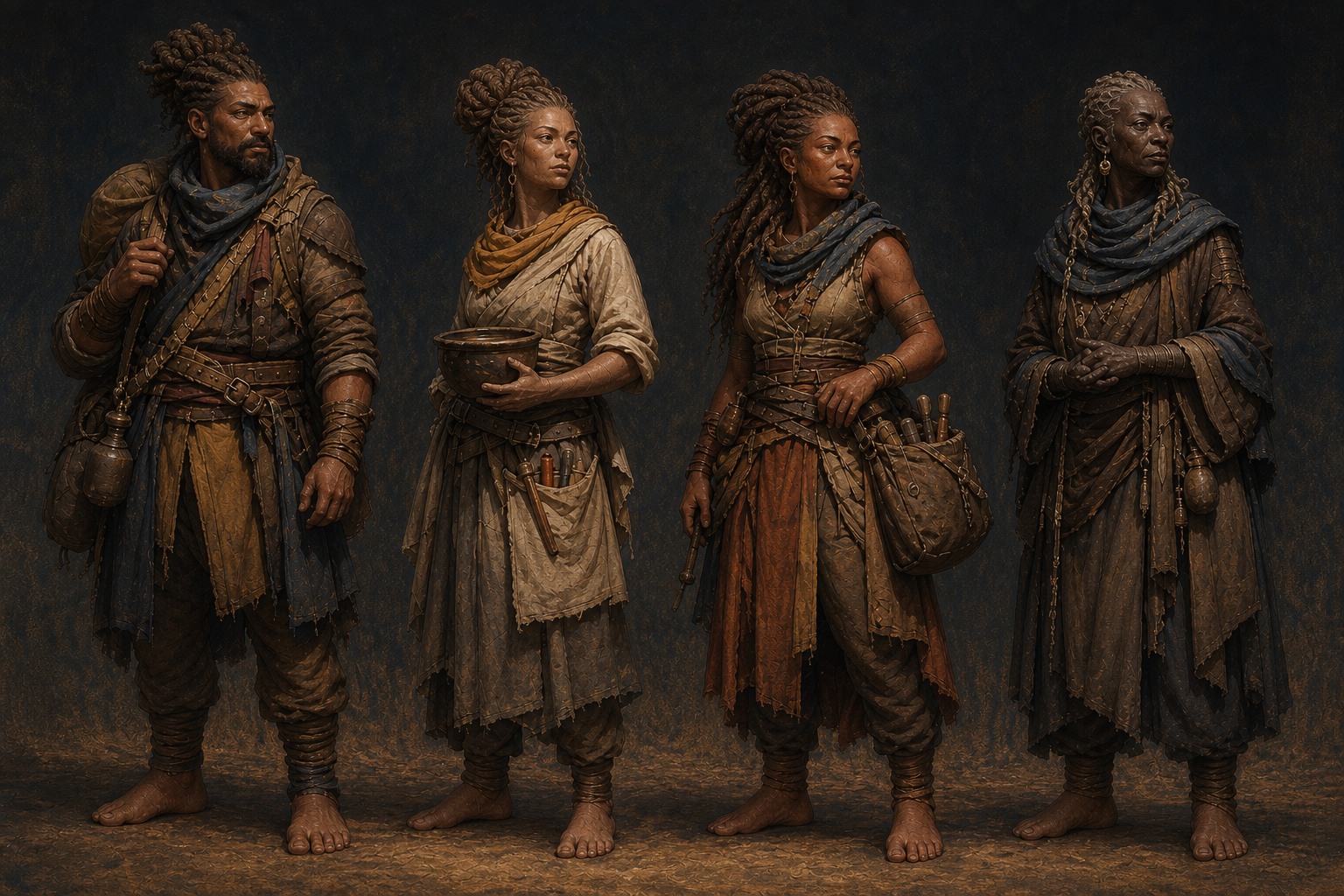
The Hearthborn carry no dramatic inheritance in the body — no light, no unusual weight, no tusks, nothing that changes the shape of them. A Hearthborn stands where a person stands and is built like one. The difference is the material.
Their coloring runs through soil rather than through skin: pale kaolin, red ochre, umber, ash, and a near-charcoal that looks black until the light finds the grain in it. It is matte, never glossy, and flecked with fine pale mineral the way sand sits in clay. Beneath it — on the forearms, the shoulders, the throat — run faint branching lines, root-traces or the crazing of clay as it dries, depending on who you ask and how much they like the Hearthborn. Their hair is coarse and fibrous and coils into ropes, nearer root fiber than anything that grows on a human head.
At the length of a market lane you would see a person. Close enough to take their hand you would not mistake them for anything else — and Hearthborn are entirely comfortable with that, having never regarded it as something to overcome.
The tell that runs deeper is a family resemblance that runs wider than a family. They have held the same valleys for generations beyond counting and married close to home, so a Hearthborn face tends to belong to a place — a jaw that turns up across four households, a coloring the next terrace over does not have. Somebody who knows the orchards can meet a stranger on the road and name the settlement they came from, and be right often enough to be annoying about it.
Old ones weather rather than shrink. A hundred and fifty years of the same wind and the same work produces a face like a fence post that has held.
Stand one beside a human of the same age and the body itself gives you nothing: the same height, the same weight, the same warmth, the same reach. They are not denser than a human, do not run warm, and carry no light. Everything that marks a Hearthborn is on the surface and none of it is an advantage. If a Hearthborn is stronger than you it is because they have lifted more than you have.
The one physical thing that is theirs is pace. A Hearthborn of ninety is not old, and does not behave old, and will still be doing the same work at a hundred and thirty with the same hands. That is not vigor so much as a longer middle — the part of a life where nothing much is changing simply runs on for decades. It is why they can hold a valley across generations that never quite hand over, and why a human neighbor can spend a whole working life dealing with the same Hearthborn and never see them alter.
#The Orchard
We do not plant them. We only put you down, and stand back, and wait — and the ground does the rest, as the ground has always done, and in the spring there is one more of us in the row. — from a burial refrain, Songweaver setting, collected in several forms
That burial fact shapes Hearthborn life. An orchard is four things at once: a cemetery, a family archive, a place of remembrance, and a genealogy you can walk through. Children learn who they came from by being led between trees and told. An old orchard is a written record that nobody wrote, and losing one is the worst thing that can happen to a Hearthborn community — worse than losing the houses, which can be rebuilt.
Nobody knows why it happens. Not the Hearthborn, not the scholars who have come to look, not anyone. It is the most closely observed unexplained thing on the Tread, and the people it happens to regard it roughly the way everyone else regards the weather.
It gives them nothing else. There is no Hearthborn plant-magic, no green thumb in the blood, no knack the orchard hands down. What grows in their fields grows because somebody who knew the work was out there doing it.
#The Hearth
Their other institution is the Hearth, which is a fire and is also not.
It stands for family, memory, protection, and continuity — the thing a household is organized around and the thing a household is for. To keep the Hearth is to keep people fed, remembered, and accounted for. Life comes from the ground and returns to it, and in between somebody has to cook.
#Stillfield and Roadwise
Stillfield Hearthborn keep the soil. They hold the ancestral ground and the ancestral houses, work the terraces their great-grandparents cut, and carry tradition forward without a break in it.
Roadwise Hearthborn carry the seed. Traveling families — traders, carriers, performers, bringers of news and oddities from the far side of a Wanderer. They did not leave the Hearth behind. They took it with them, and they are not one bit less rooted for it, whatever a Stillfield cousin may say after a drink.
#A hundred and eighty years of staying put
Hearthborn elders may reach around a hundred and eighty — long enough that the person who planted an orchard's newest edge is often still around to disapprove of how it is being pruned.
Their communities are close and slow to open, and tradition has never thought much of leaving. A Hearthborn who takes up the road is doing something their family will find difficult, and will usually be met on return with relief dressed as complaint.
That makes a Hearthborn adventurer unusual by culture, not by nature. Nothing about them is unsuited to it. Everything about how they were raised suggests they should have stayed.
And a Hearthborn raised away from any orchard has the same ordinary face and no tree waiting anywhere with their family's names on it. Some go looking. Some find the orchard their line came from and are welcomed, awkwardly, by people who have been tending their ancestors for a century and a half. Some never do, and are buried somewhere else, and something grows there.
For what a Hearthborn is beyond playing one — origin accounts and what cannot be proven, how other peoples read them, and the range of lawful communities they live in — see Bestiary, §6 — Hearthborn.
#The Seven Lineages — VI. The Fleethollow
#The People of the Long Road
#The People of the Long Road
Travelers, navigators, and keepers of routes, who understand better than anyone that the Wanderers are always moving.
What did we become when we left, and what did the road ask us to forget?
#Where they come from
Everyone else in this chapter has an origin. The Fleethollow have a departure.
They descend from the Pathreaders — travelers whose entire history is exploration and leaving, who went past the deepest reaches anyone had mapped and then went further, and passed out of the record altogether. Over generations the descendants they left behind became the Fleethollow.
Why the Pathreaders went, and what became of them, is not remembered. Not disputed, not sealed, not argued over by rival traditions — simply gone, along with whatever reason they had. The Fleethollow inherited the consequences of a decision nobody wrote down.
So their question runs backwards from everyone else's. They are not wondering who made them; nobody did, and they know exactly whose descendants they are. What they cannot answer is what those ancestors were before the road, and what the road turned them into instead.
There is one old suggestion, and the Fleethollow treat it more carefully than outsiders expect: that the Pathreaders were Wyldtouched once, and that leaving is what stopped them being it. Nothing supports this beyond a resemblance some people insist on and others cannot see at all. For a people missing an origin it is not an interesting theory. It is the possibility that they are a wound somebody else took, and it is not raised lightly in Fleethollow company.
Day nine at the shelf, waiting. He has not moved and does not intend to. I asked how long and he said until the wind turns, as though I had asked what color the sky was. Long-boned, lightly made, weathered about the eyes like a man of seventy — and he is not. I have stopped asking. He is not waiting the way I am waiting. — a margin note in a route-book, hand unknown
#How you would know one
By the way they are put together, and by the way they stand still.
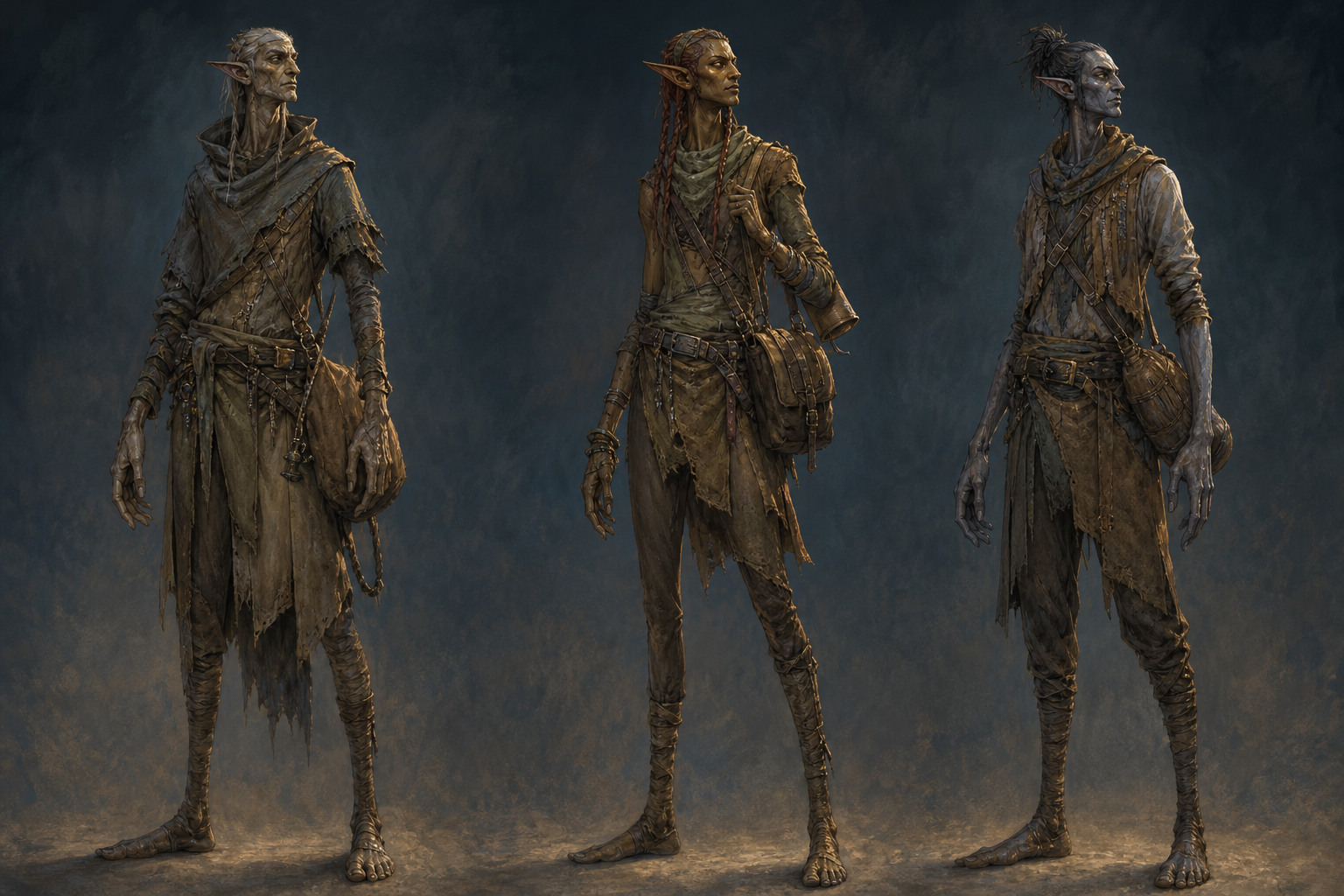
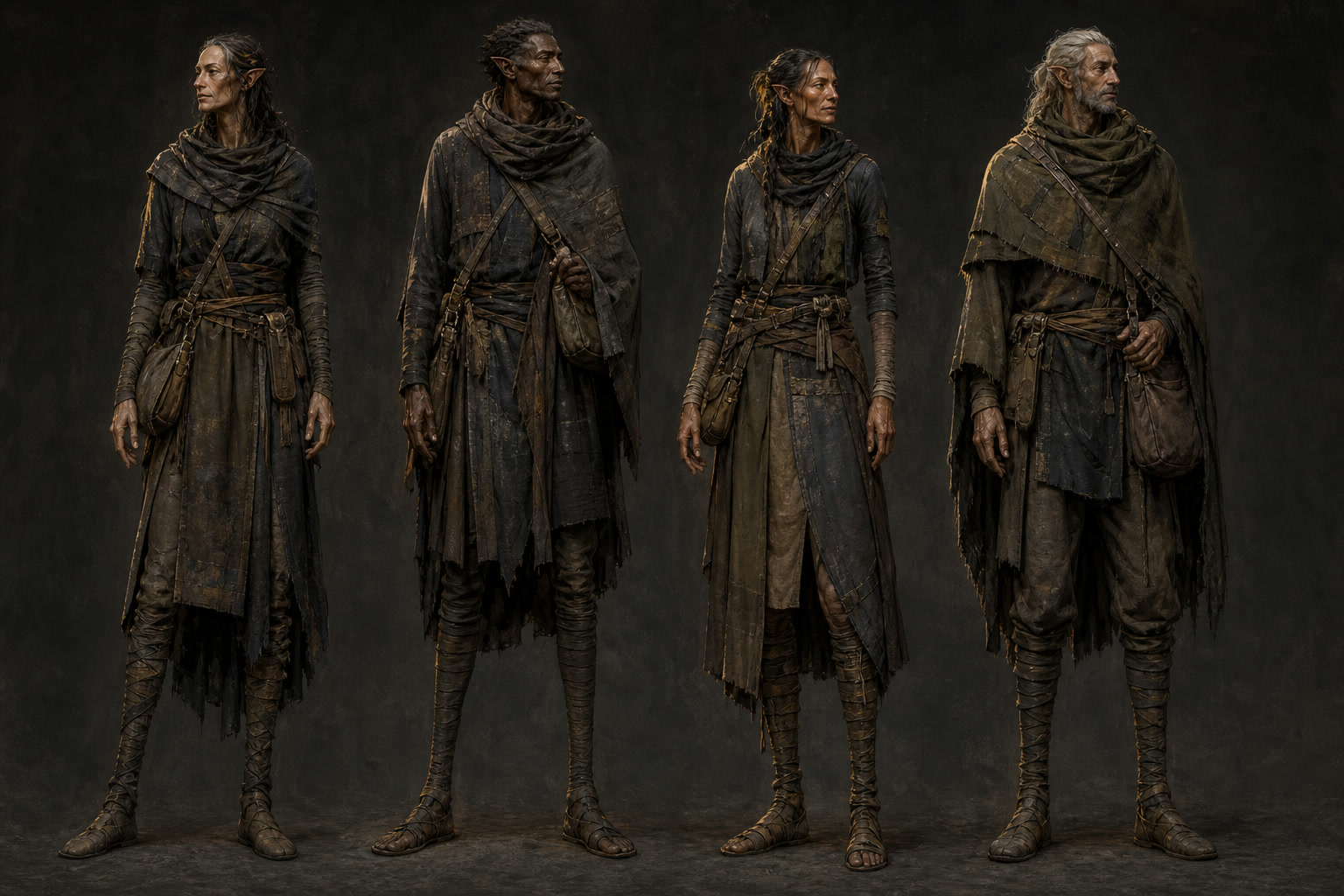
Fleethollow tend to be long-limbed and lightly built, made for distance rather than force, and the build reads as unfinished to peoples who are heavier — right up until it becomes obvious that they have not stopped walking and you have. Generations of long roads are visible in them the way generations of quarry work are visible in a Stonekin.
They are the tallest of the seven and among the lightest, which is a combination nobody expects until they have to take a Fleethollow's arm. One stands a head above a Wyldtouched and two above a human, and weighs less than either — long bones, little bulk, hands that close around your wrist and are stronger than they have any business being. Where a Stonekin arrives with weight, a Fleethollow arrives without it. A ferry does not notice them boarding. A rotten stair sometimes does not either.
That lightness has a cost people forget when they are hiring. A Fleethollow cannot hold a door against a Stonekin, cannot carry a casualty as far as a Tuskborn, and knows both of those things about themself without being told.
They weather early and then hold. A Fleethollow of sixty is already lined about the eyes from wind and glare, and at two hundred looks much the same as they did at eighty.
And they are difficult to hurry and difficult to startle. Watch one wait — for weather, for a Convergence, for the right hour to move — and the patience is unmistakable, because they are working on a timescale in which waiting a season is not a delay.
Some people say there is a faint echo of Wyldtouched marking about them, in the eyes or under the skin in certain light. Other people look at exactly the same face and see nothing at all. Both have been saying so for centuries.
#The calendars
The Fleethollow built the migration calendars. Not their own — everyone's.
Every settlement on every Wanderer runs on a reckoning of when the ground beneath it will turn, climb, slow, or bear left toward colder air, and that reckoning was worked out over generations by Fleethollow who walked it, recorded it, and handed it down. Harvests, Convergences, trade, whole ritual years are timed by their arithmetic.
Most people using a calendar have no idea whose it is. The Fleethollow are used to that.
#When a Wanderer stops
For most peoples a Stillness is a catastrophe. For the Fleethollow it is also a contradiction.
Their entire body of knowledge assumes movement — that a titan goes, that the going has a rhythm, and that the rhythm can be learned. A Wanderer that stops does not merely break a schedule. It makes a claim about the world that their scholarship was built to deny.
Reactions run the full range and none of them are calm. Some work the routes again and again, sure there is a pattern too long for anyone to have noticed. Some declare the calendars finished and say so with a kind of relief. Some go to look.
#High and Wild
The split is not about how they live. It is an argument about what knowing something is.
High Fleethollow hold that the world should be remembered. They keep the Pathreader records, the route-books, the Convergence tables, the ceremonies that go with them — and they hold that a thing observed and written down outlasts the person who saw it, which is the only way anybody knows anything at all.
Wild Fleethollow hold that no map can hold a living world. They live nearer the untamed edges and trust instinct, season, weather, and the movement of the titan underfoot, and they hold that a route written down thirty years ago is a description of a road that no longer exists.
Both are right often enough to keep the argument alive. It has been running for centuries and neither side expects to win it.
#Three hundred and fifty years of walking
A Fleethollow elder may reach around three and a half centuries, and they use it on distance.
A single Fleethollow may know a Wanderer's back the way a farmer knows a field — not from records but from having crossed it, personally, in every season, several times. They can pursue one question across a span that outlasts a human dynasty, and they will, and they will be annoyed at being asked to summarize.
None of that is inherited. Fleethollow are famous for direction and rhythm, and it is learned — taught early, reinforced constantly, and absent entirely in one raised somewhere else. There is no compass in the blood. There is a childhood spent being shown.
So one brought up off the road has the long build and the long years and no route-lore at all: no calendars, no Convergence tables, no instinct for when the ground is about to turn. They are frequently assumed to have all of it anyway, by people who are then confused when they get lost.
For what a Fleethollow is beyond playing one — origin accounts and what cannot be proven, how other peoples read them, and the range of lawful communities they live in — see Bestiary, §7 — Fleethollow.
#The Seven Lineages — VII. Humanity
#The People of Possibility
#The People of Possibility
One of the youngest known peoples and among the shortest-lived, who arrived into a world already ancient and, against every reasonable expectation, ended up nearly everywhere.
What can we become next, when no single origin tells us what we must remain?
#Where they come from
Nobody knows, including them.
No record names a beginning. Humans have filled the silence with theories and kept all of them: that they evolved somewhere unremarkable, that they were made and the making was lost, that they descend from several ancient peoples at once and carry a fragment of each. That last is the popular one, and it is popular partly because it is flattering.
None of it is proven. Where the other six carry answers, humanity carries the ache of not knowing — and has decided, in the absence of a past, that it may become anything.
That decision is the whole of them. It is also the thing other peoples find hardest to take seriously.
#Still proving themselves
A great many peoples regard humans as not yet having earned their place.
The reasoning is rarely stated outright and is perfectly clear anyway: they are new, they cannot say where they came from, they die almost immediately, and they are already in every settlement on every Wanderer, holding offices and running guilds. To a people three hundred years into a single lifetime, that reads less like achievement than like weather.
In remote settlements it is blunter. There are places well away from the crossings where a human is seated below the Bloomkin and the Underfolk and anyone else with a longer claim on the ground — where the question is not what you have done but how long your kind has been here, and the answer is not long.
Humans are aware of this. Some spend their lives disproving it, some find it funny, and some move somewhere it does not come up.
There is no use asking a human what they are. The answer arrives as a place — the windward flank, a river-city, three terraces up from a market I have never heard of — and the place does all the work the lineage does not. Two of them from opposite sides of the same back share a name and a span of years and, so far as I could find, nothing else whatever. — P.
#How you would know one
Mostly by where they are from, not by what they are.
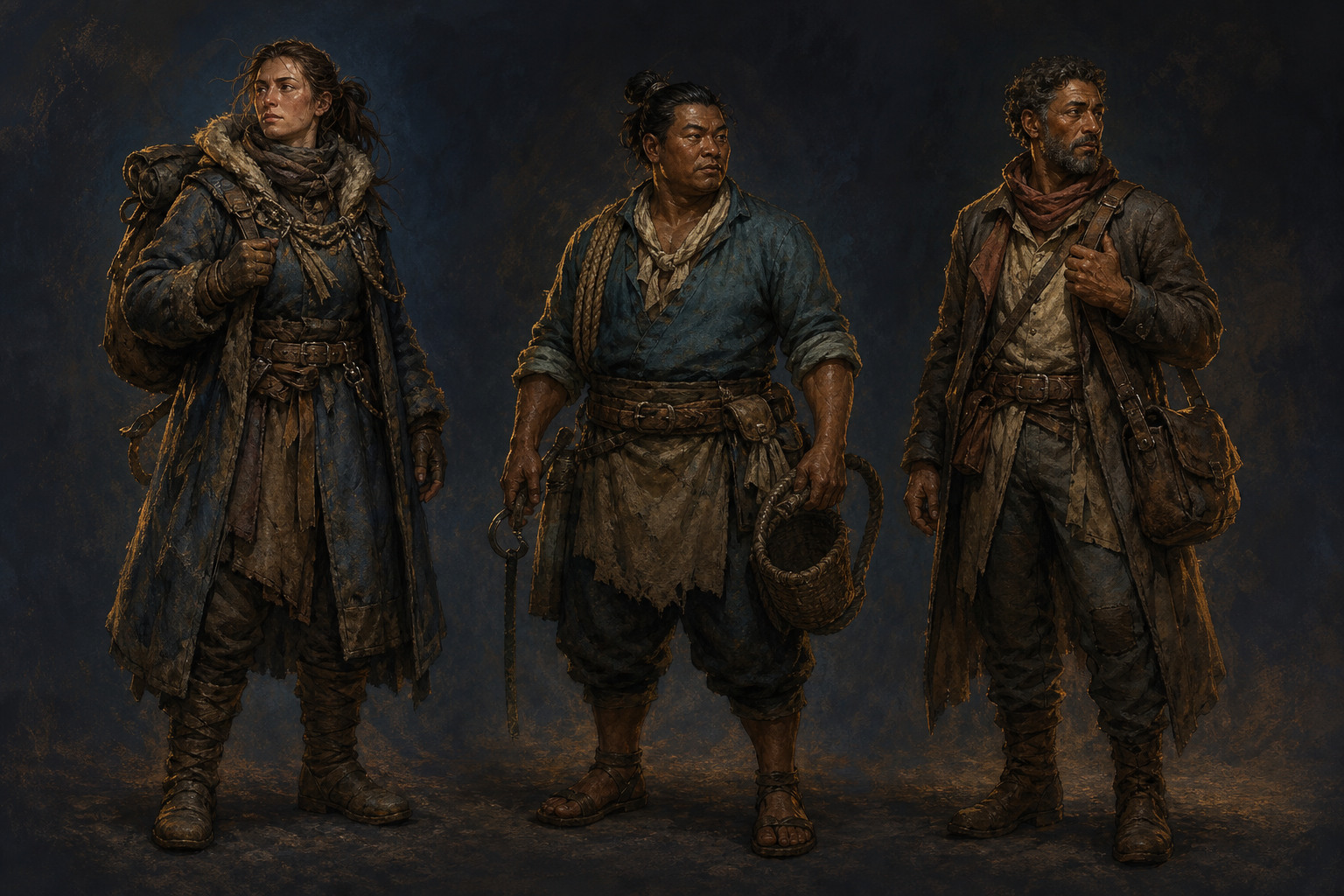
Humans carry no signature inheritance in the body — no marks, no ember, no density, no ancestral frame. What they have instead is region. A human raised on a windward flank and a human raised in a deep river-city may share a name and nothing else: not build, not coloring, not features, not bearing, not any of the small things that let people place a stranger.
So the useful question about a human is never what are you but where are you from, and humans ask it of each other constantly. Among the seven they are the people you cannot read at a glance, and the ones most likely to be mistaken for someone else's cousin.
They age fast and they show it. Gray at fifty, done at ninety if they are fortunate, and everyone around them watching it happen at what must feel like a run.
That is the fact a picture cannot hold, and it is the one that shapes them. A human is the ordinary measure of this world — ordinary height, ordinary weight, ordinary warmth, no mark, no light, no density, nothing under the skin — and they are also the only people besides the Tuskborn who will not be here in two hundred years. The Stonekin mason who signed the footing is still alive. The human who laid the road beside it is four generations gone, and the road is still called by their name.
Humans do their building inside a single lifetime because they have no other option. Everything a human means to finish, they mean to finish soon.
#Eighty years, and a hundred of them working at once
Humans hold no inherited grip on the Pulse to rival the Wyldtouched Spark or the Emberkin Ember. They have never needed one, because they do something else.
They learn. They borrow, combine, improve, write down, argue about, and above all accumulate — and the accumulating is the point. One human has a few decades, which is nothing. A hundred humans building on one another across a century is a different kind of force entirely.
A people that compounds does not need long lives to change the world quickly. Nobody has ever successfully explained this to a people who does not have to hurry.
It shows in how they work. Human traditions write things down early and badly, publish before they are finished, teach in crowds rather than in lineages, and take up somebody else's technique without embarrassment the moment it looks better than their own. Other peoples find this alternately impressive and appalling.
None of this is in the blood. Adaptability is a habit their cultures reward, not a property they inherit — and a human raised somewhere that punishes it will be no more adaptable than anyone else.
#Everywhere, and from nowhere in particular
They are the scattered majority: in every settlement, on every Wanderer, in every trade, and concentrated nowhere. There is no human homeland and there never was one to lose.
This is why a human is defined by region so completely. Without a shared origin, a shared body, or a shared inheritance, what a human has in common with another human is whatever the place they grew up in gave them — which is often less than they have in common with the Stonekin next door.
Human communities therefore tend to be places rather than peoples. Two of them a month apart may disagree about food, law, the dead, and what a human is for.
It also means a human raised among another people is barely displaced at all. They will have that people's language, manners, trades and quarrels, and no lineage of their own pulling against it — no marks to explain, no orchard, no calendar, no guild expecting them. They will also be reminded, gently or otherwise, that they are not going to be around very long.
#What they might become
The great human argument is whether being unfinished is a wound or an opening.
One side holds that a people with no origin has been robbed of something, and spends real effort looking — combing archives, chasing resemblances, funding expeditions to places that swallow them. The other holds that not being told what you are is the best position anyone on the Tread has ever been in, and that the rest can keep their makers.
Both sides are looking at the same blank page.
For what a Humanity is beyond playing one — origin accounts and what cannot be proven, how other peoples read them, and the range of lawful communities they live in — see Bestiary, §8 — Humanity.
#The Seven Lineages — An origin spectrum
#Read after the seven
#Origins side by side
Read down the table and the seven do not answer the same question in seven voices. They ask different questions, and some of their answers cannot both be true.
Made, grown, evolved, emerged, departed, unknown: the Lineages disagree about the nature of existence itself, and the world declines to settle the argument.
| Lineage | Origin (believed) | The question they carry |
|---|---|---|
| Wyldtouched | The Pulse, or the Wanderers' making | Creation — who made us? |
| Emberkin | Shaped, perhaps, from Wanderer flesh | Purpose — why were we made? |
| Stonekin | Shaped, perhaps, from Wanderer bone | Inheritance — what were we made to build? |
| Tuskborn | Evolved, unmade, from wildlife | Nature — why must anyone have made us? |
| Hearthborn | Grown from the fertile earth | Belonging — why did the world grow us? |
| Fleethollow | Descended from the vanished Pathreaders | Departure — what did we become when we left? |
| Humanity | Unknown — perhaps every people at once | Possibility — what can we become next? |
Not one of those beliefs has ever been proven. Several contradict each other outright. Every one of them is held sincerely by people who have thought about it for a very long time.
#A people is not a person
Everything in this chapter describes what a people is generally like — what the guilds are like, what the orchards are for, what a stranger expects when they see you coming.
None of it is a promise about your character.
Every one of these portraits is a stereotype, and most are stereotypes the peoples themselves would recognize and argue about. They are useful because they are broadly true and because the world believes them. A Stonekin who is careless, a Hearthborn who cannot wait to leave, a Tuskborn with no interest in a fight — all exist, and all will spend part of their lives being misread by strangers who have only ever met the general case.
That misreading is worth playing. It is also worth remembering that it is a misreading.
And the peoples are not opposites. They differ in body, in history, and in what they argue about — not in which virtues they are allowed. A Hearthborn and a Stonekin are built nothing alike and would not last a week at each other's work, but both come from peoples who respect long labor and patience, and each would say the other has the wrong idea about how to spend a life.
Do not read these seven as seven separate answers. They are seven peoples who overlap almost everywhere, and disagree about what the overlap means.
#And beyond the seven
The Tread also carries other peoples — the small, quick Underfolk of the bone-rock boundary; the fey-touched Bloomkin of the moss-forests; and rare giants and true dragons, known mostly through legend and singular danger rather than as common folk.
They are named here so that their absence from the seven reads as a choice and not an oversight.