

Inside a living world
The Depths
In this section
Old tunnels thread through bone and flesh, and the deeper Pulse refuses to behave.
On this page 8 topics
We went in on a Tuesday and the chart was forty years old and right. Two hundred yards past where the chart stopped being right, my grandmother's crew had left a mark on the wall. I am still not sure whether that was a comfort. — a Deep Stonekin crew-master
Cut into bone-rock and you find the Depths: old tunnels and chambers threading through bone and flesh, running through every Wanderer that has ever been surveyed.
It is not a cave system. It is an interior.
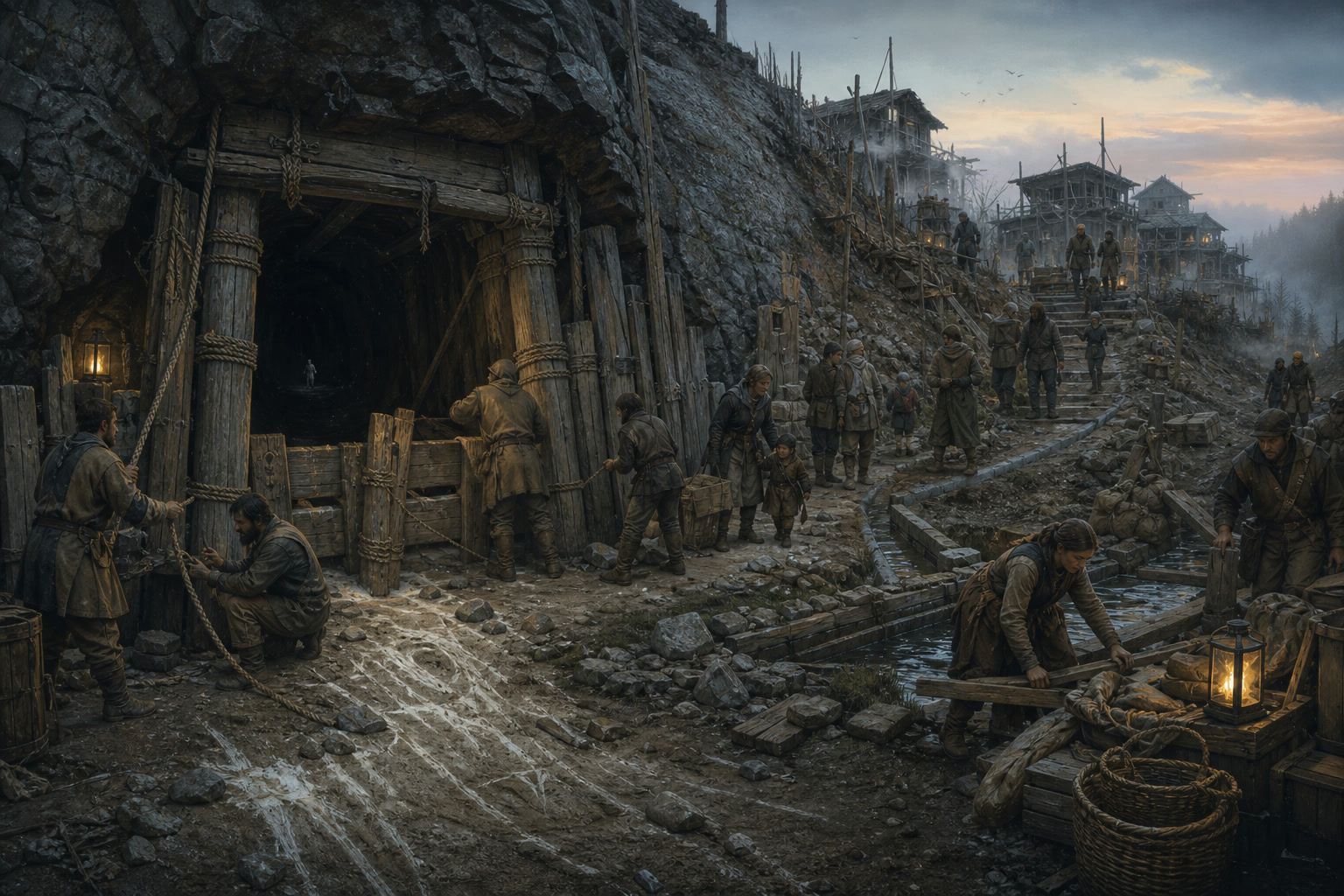
Some of the tunnels were cut and some were found, and most are older than whatever settlement now stands over the mouth. People go down for bone-iron, for growths that grow nowhere else, and for relics of wars nobody remembers being fought. The bone-iron that comes back out becomes tools, and then coin — which is why anybody goes at all.
They go on a schedule, in crews, on a shift pattern and a wage. That is the part visitors never quite absorb. The strangest place on the Tread is somebody's job, and has been for longer than most guilds have kept records.
#Two ways down, and they are not the same journey
Delving goes into a living thing. Expeditions to the low world go beneath it. Those come back rarer, and this chapter is not about them.
#The Pulse is stronger down there
This is the fact that governs everything else, and it is the one newcomers get wrong.
Depth is dangerous in its own right, before anything living has noticed you. The Pulse thickens as you descend, and concentrated Pulse is unstable Pulse (Chapter I). Instruments disagree. Practices work differently rather than failing cleanly, which is far worse for a crew that has planned around them. Prolonged exposure causes Pulse sickness, and generations of it mark a family.
A Pulsewalker is at more risk than anyone, for the reason you would least expect: their craft is reading a rhythm and committing to it, and where the rhythm is unstable they act on information that was true a moment ago. Deep crews have a saying that is not kind and is not wrong — the one who can hear it is the one who steps first.
#A tunnel is a wound
The Wanderer is alive, and living things close wounds.
Near the surface this happens too slowly to notice, and delvers hold the worked galleries open by ordinary maintenance without ever thinking of it as fighting a healing body. Deeper in it stops being slow, and it accelerates roughly as the Pulse thickens.
So the boundary between worked ground and deep workings is not a distance. It is the line past which maintenance stops keeping up. What does the closing does not distinguish between a wound and a passage, or between debris and a person standing in one.
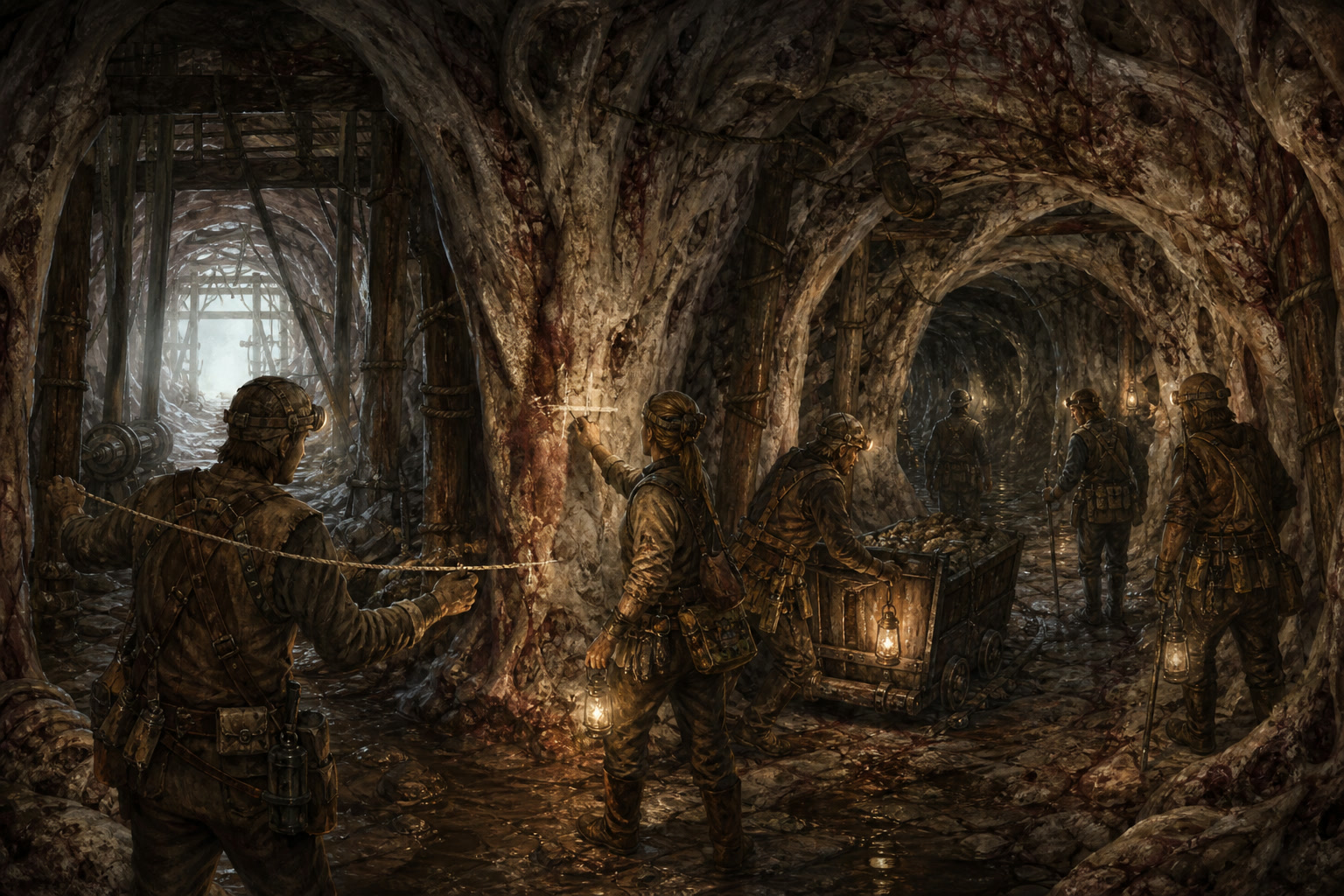
Deep crews measure on the way in — a knotted line, a marked stave, a scratch at a known height: something that will disagree with the gallery later. It is the single practice that most reliably separates crews that come back from crews that do not, and it is taught before anything else.
#The thing that actually kills people
It is not what lives down there.
You know the way you came and almost nothing else. The other openings off a chamber are openings — visible, and not destinations. In the dark they are not even visible. And having stood somewhere is not the same as recognizing it on the way back: a five-doored chamber you crossed an hour ago is a five-doored chamber, and this may or may not be that one. You have forgotten nothing. The knowledge simply does not attach to the place.
So you mark. Chalk, a scratch, a cairn, a knot in a line — whatever the rock will take. A mark stays where you put it. If one is gone, something took it, and it is worth a moment to think about what.
Deep enough in it is often a Mender, because a tunnel is a wound and living things close wounds without caring whose chalk was on the wall. Nearer the surface it is water, or an animal, or another crew. And it may be somebody who would rather you did not find your way out — in which case the dangerous version is not the mark that is missing but the one that has been moved.
And a way down is not a way back. A cut stair is. A hole you dropped through is not, and a chimney that took a rope going down may want rope, a free hand and a decision coming up. Ask which before you use it, not after.
Not every chamber leads on. The Depths as a whole go further than anyone has followed. Any particular room may simply stop at a wall — which means the way on exists and is not here, and that is the sentence to keep in mind when a company is certain it is heading out.
#How far down you are
The Depths are read in three broad strata — worked ground, the deep workings, and the undocumented — and knowledge falls off sharply between them. The Bestiary sets those out in full, along with what lives at each and what the record actually supports.
See the Bestiary, §12, for the strata and for everything that lives down there.
What is worth carrying into play from here is only this: the deep record is not merely thinner than the shallow one. It is thinner and less trustworthy, because the instruments a survey depends on grow less reliable exactly as the ground grows less known — and the people who made those charts knew it while they were making them.
#Not everything below is an enemy
A great deal of what lives down there is harmless, avoidable, or useful, and crews know the difference far better than the stories do. Being unfamiliar, hard to understand, or frightening in lamplight does not make a thing malevolent. The Depths are not a moral place, any more than weather is.
Some of it will still kill you. None of that is malevolent either, and being killed by something that had a reason is not materially better than the alternative.
#Things are coming up
Most of what lives below stays below. It is adapted to concentration, dark and pressure, and the surface offers it nothing.
So when something comes up, it came up for a reason, and the reason is underneath. A rising is a symptom. Companies get hired to fight the symptom, because the symptom is what is currently eating the settlement — and the people paying know perfectly well that is not the same as solving anything.
The risings are getting worse. That is the observation of every boundary crew on every Wanderer that keeps records. It is consistent with a Pulse growing less stable at depth. Nobody has established the connection well enough to say so in a document that matters.
This is the open door of the setting. If your Chronicle wants a reason for people to need dangerous work done, it is already standing there, and nobody has looked at what is behind it.
#What nobody can tell you
What the Depths ultimately are, and what a Wanderer ultimately is, are not answered here or anywhere. Several traditions are certain and none of them agree.
For the strata, the life, and the record, see the Bestiary, §12. For the Pulse itself, see Chapter I. For bone-iron as coin and as craft, see Chapter VII.