

Where you stand
The Tread
In this section
The low world is poisoned. Countries survive on the backs of continent-sized living Wanderers.
On this page 12 topics
#An introduction to the world, and to the book
Welcome to the Tread.
This is the book you open before play. It tells you where you stand, who lives here, and what the road expects of you. Read it the way you would read the first pages of an old traveler's account — not to memorize, but to get your bearings before the road begins.
Some of it is a traveler's account. Where a passage is set apart and signed, you are reading someone who was there — one hand among the gathered records of the Tread, and no more than one traveler's sight of it. Where such an account ends, the world does not.
#The ground does not hold cities
Nobody living remembers why. We know only what the low world is now — cracked and burning ground, toxic mist, poisoned marsh, and things down there grown larger than anything has a right to be. I have read that the titans themselves made it so, across ages, simply by breathing. I find I can believe it and still not picture it. — P.
That is the Low World: the true floor of the world, far below, and the reason nobody lives on it.
So the peoples of the world live where the ground still moves.
#On the backs of living gods
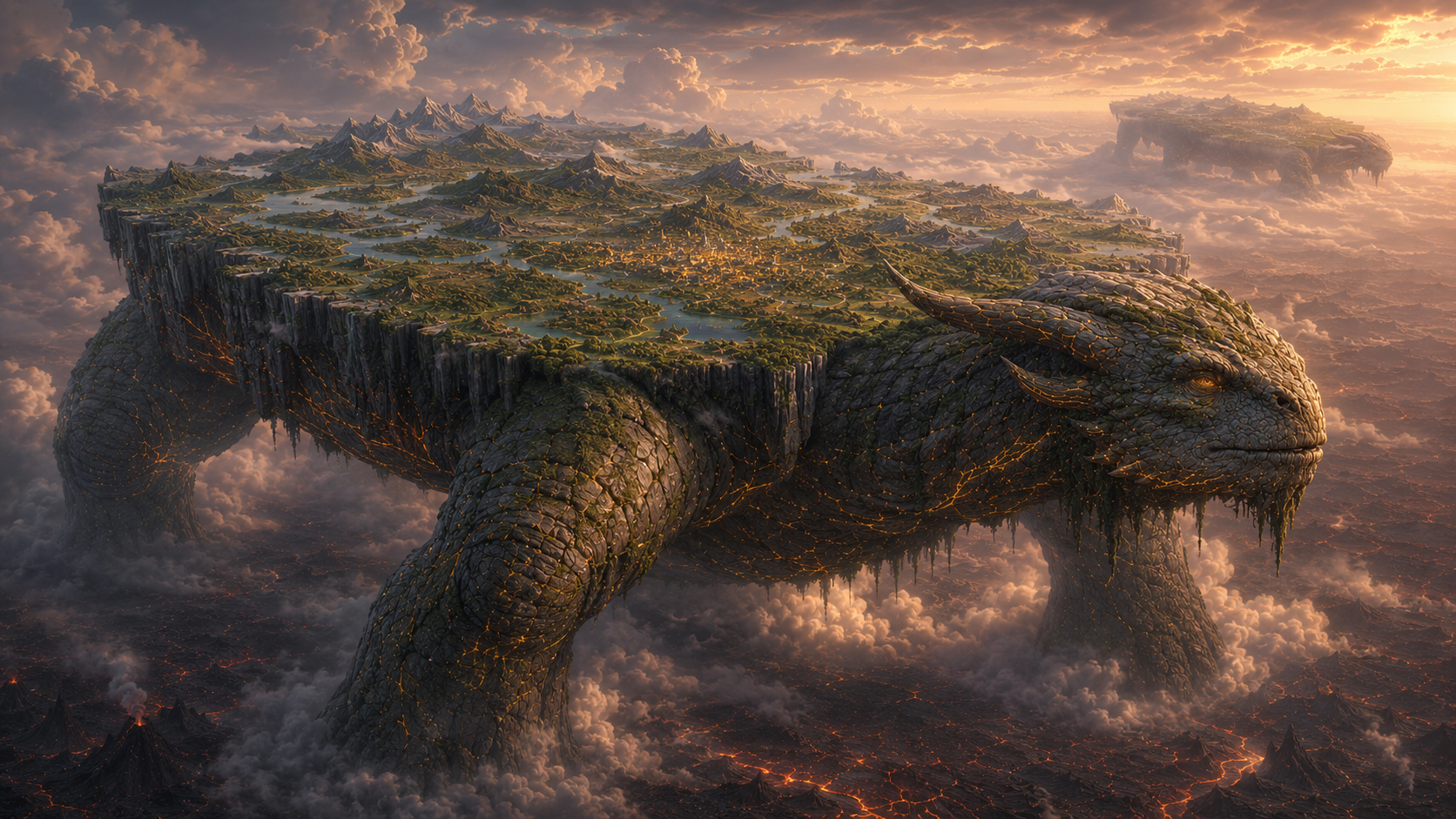
They are called the Wanderers, and they are the size of small continents.
A Wanderer is no beast of any earthly kind. Each one is an elder titan of dark living stone and mineral scale, veined with fine threads of warm ember-and-gold light — the slow fire of its life burning somewhere far beneath the hide. Great mossed horns sweep back from an ancient, weathered, gentle face. Its eyes are deep and slow and wise. Its legs are pillars the size of mountains, wreathed in cloud.
And across its broad back it carries a country.
Most are gentle, and it is worth saying plainly, because it is the thing people assume wrongly. The nations riding them do so in reverence and quiet gratitude, not in terror. No living witness remembers a battle between Wanderers. Older scars and bones say that this has not always been true.
#A continent that walks
The back of a Wanderer is a broad, almost level plateau — rivers, lakes, forests, whole mountain ranges — and its rim ends in sheer cliffs that fall away into cloud.
One back may hold many climates at once. Alpine snow at one shoulder, deep forest at the next, golden plain, warm coast. Regions of the same titan feel like separate nations, and walking from one side to the other is the work of a lifetime.
Settlement runs thickest at the sheltered heart of the back — cities, farmland, lantern-light — and thins outward toward the frontier near the cliffs. Beyond even that, the great neck and head are bare wilderness nobody has ever settled.
On the Tread, closer to the edge always means closer to danger. Everyone knows it. Nobody agrees on why.
#What is under your feet
Two days out the moss thinned mile by mile until it let go entirely, and there was only pale wind-bent trees and the old bone-rock breaking the surface like the titan's own ribs pushing up through too-little flesh. You do not forget that you are standing on something alive. But you can go years without being shown it. — P.
Bone-rock is a Wanderer's skeleton, surfacing where the soil runs thin.
Cut into it and you find the Depths: old tunnels and chambers threading through bone and flesh, where delvers go after bone-iron, strange growths, and relics of wars nobody remembers being fought. The Depths are badly mapped and dangerous, and they are home to things that do not come up under ordinary conditions.
The bone-iron that comes back out becomes tools, and then coin. That is why anyone goes down there at all.
There are two ways down on the Tread and they are not the same journey. Delving goes into a living thing. Expeditions to the Low World go beneath it, and those come back rarer.
#The rhythm everything runs on
Beneath the bone-rock runs a deep, slow resonance: a Wanderer's own living force. Folk call it the Pulse, and it is the nearest thing this world has to magic.
It is not a power source. It is a life.
It lifts airships over a continent-sized back. It is felt in ritual, in rhythm, in the turn of a season, and in the covenant rites that whole institutions exist to keep. Scholars of every tradition work through it or alongside it, and none of them own it. And when a living thing dies, its essence is said to return to the Pulse, while the body stays ordinary.
What that return actually means, no rite has ever proven, and the peoples of the Tread have been arguing about it for as long as there have been peoples.
The Pulse belongs to the titan, not to any bloodline. Magic here is a relationship with the Wanderer you live on. It is not something you are born owning, and no people has a monopoly on it.
It is also the reason there is anywhere to stand. The field a Wanderer generates is what holds the low world's poison off its own back, which is why the air thins to lethal out past the margin and why an airship that leaves one titan cannot reach another except at a Convergence.
That is as much as an introduction should carry. For what the Pulse does, how it is measured, what bone-iron, reagents and imbued work are for, and where it fails, see The Pulse.
#When two titans pass close
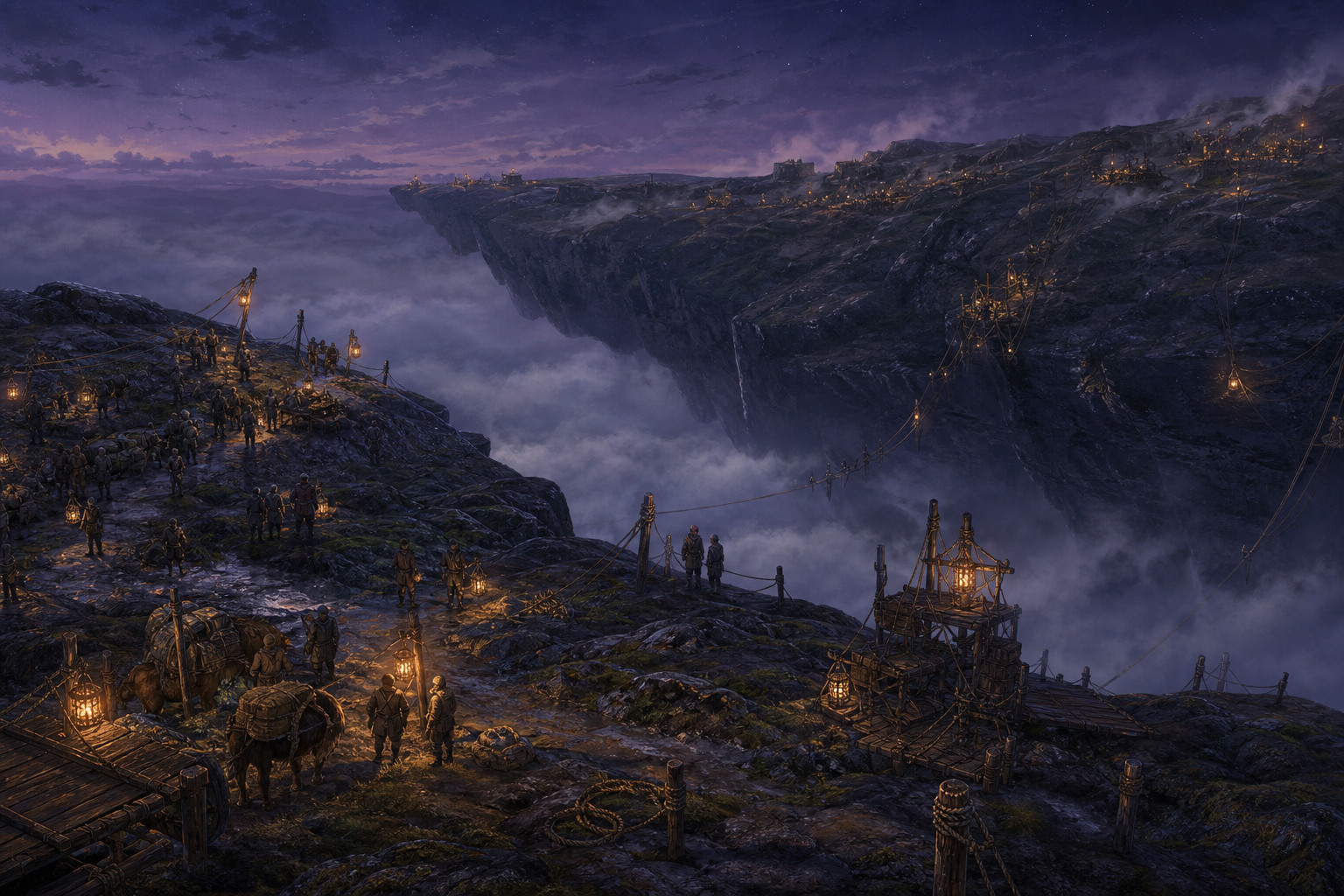
My grandmother saw one. My mother did not. They tell it here the way you tell a flood or a good year — the causeways going up in eleven days, whole guilds who had never met shouting at each other across a gap that was not there the week before and would not be there the month after. Marry from it if you can. You will not get another. — a saying of the terrace settlements
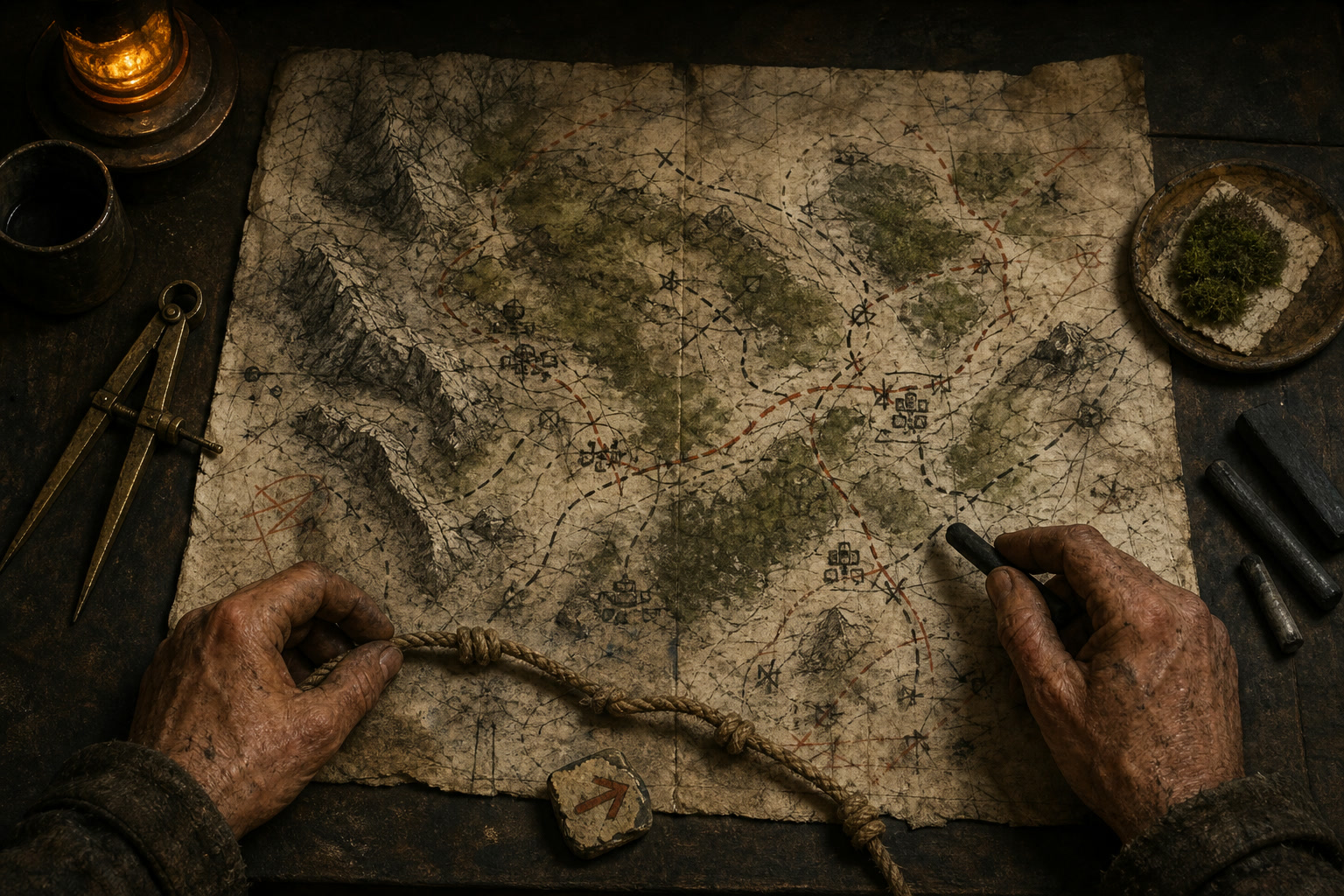
When two Wanderers' migration paths run near enough, their peoples build.
Temporary causeways and bridge-convoys go up between the backs, and for a while there is trade, diplomacy, intermarriage, and occasionally war. A Convergence is the main way separate titan-nations ever meet, the only time coin crosses between them, and the one moment a reckless airship pilot can attempt the short lethal hop through open air from one titan to another.
They are rare enough that a person may live a whole life between two of them, and they are where an enormous amount of the world's history has happened. Calendars are built around them. So are fortunes, feuds, and a great many marriages.
#When one stops
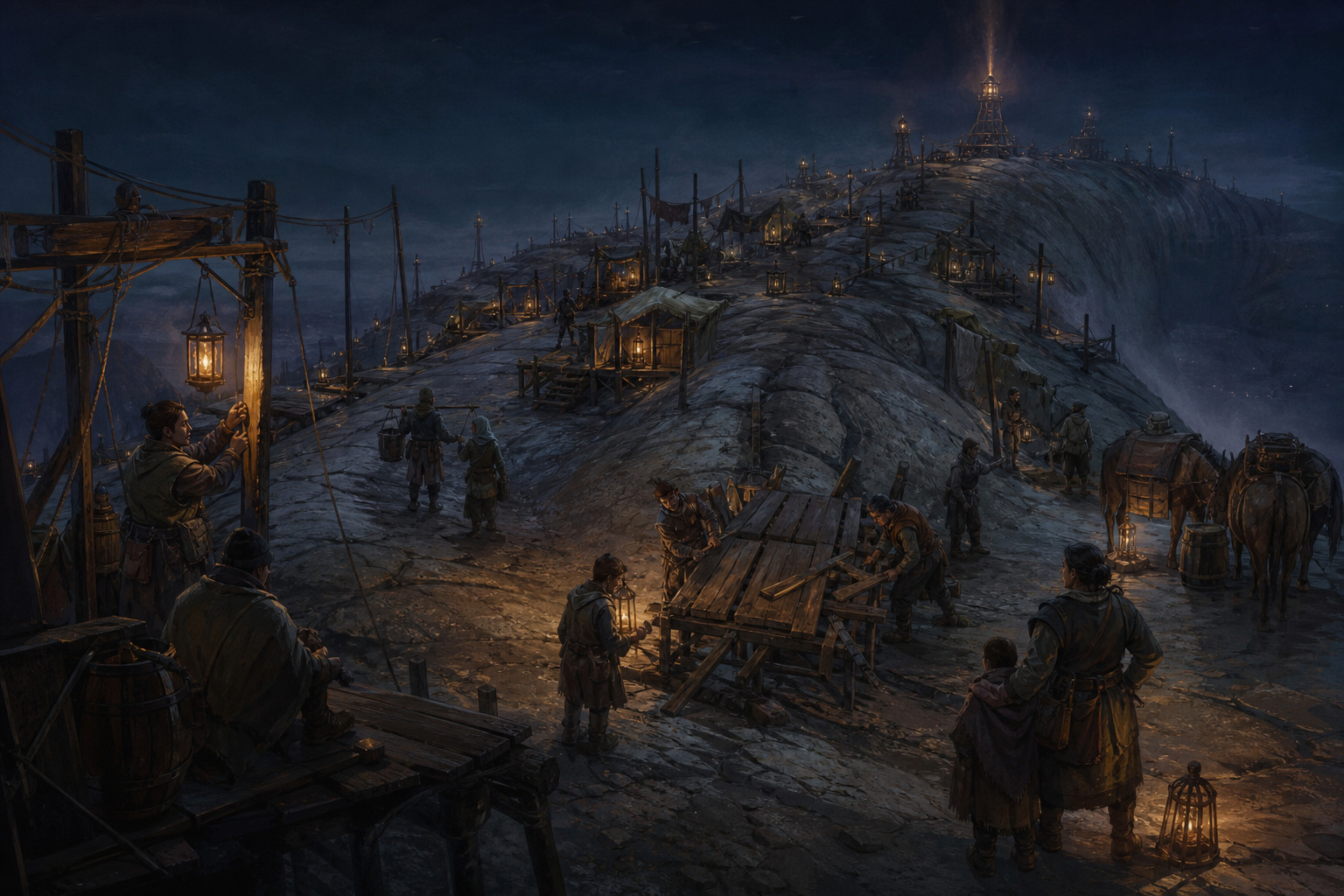
A Stillness is the word for a Wanderer falling dormant, or simply ceasing the movement it has kept up for longer than anyone can name.
It describes a condition, not a cause. Different Stillnesses have had different reasons, and some have had none that anyone ever found.
What it does is worse than the silence. A titan that stops is a titan whose Pulse has thinned — and the Pulse is what the skies run on. Airships go unreliable and then go nowhere. Rites that have been performed the same way for centuries stop feeling like they land. Calendars built on a gait that no longer happens become guesses.
For peoples whose harvests, holy days and covenants all assume the titan will keep walking, a Stillness is not just a crisis. It is a hole in the order of the world.
#Grim, but not joyless
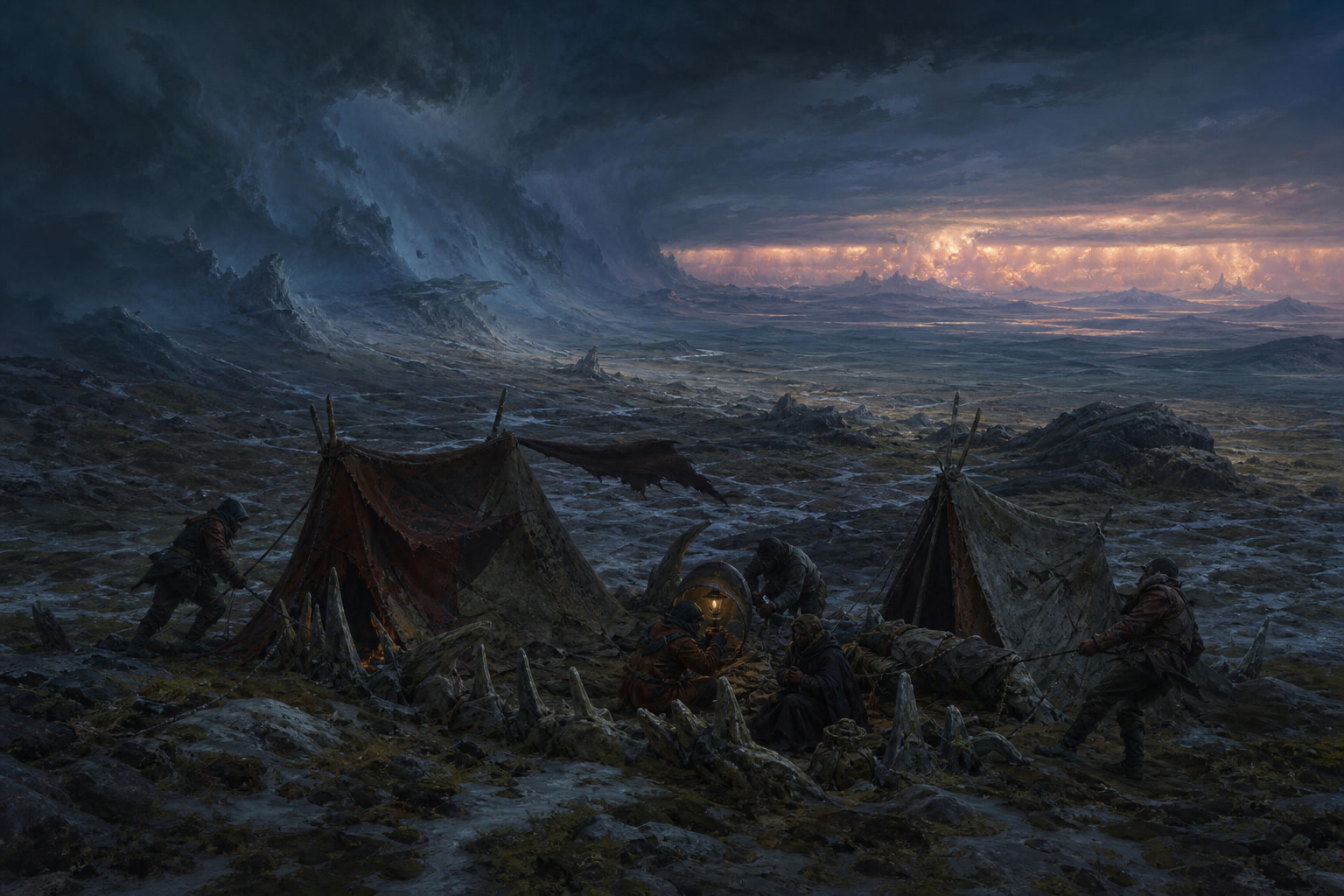
This world is hard, and the book will not pretend otherwise. Failure costs something. Danger is real. People die of ordinary things.
And then there is a moss-forest at dusk that lights itself from underneath, and an airship coming in over the cliffs with the last sun on it, and something small and strange and delighted that decides, for no reason at all, to talk to you.
Both are true at once, and neither one is the joke. The wonder is not a break from the grimness. It is what makes the grimness worth surviving.
#Who you will be
There is no array of scores to assign here, no experience to collect, and no levels to climb. A person on the Tread is made of five layers, and only one of them ever becomes a number.
- Lineage — what you are. Your people, and the body you were born with.
- Culture — what shaped you. What an upbringing put in your hands before you chose anything.
- Practice — what you chose to learn. Your discipline. Any lineage may take any Practice.
- Competency — what you have demonstrated. Earned in play, never granted at birth. The only layer that is ever a number.
- Mystery — the question your people have never answered, and never will.
That last one is not about you. Every people on the Tread carries a question about its own origin that nobody has ever closed, and you will meet all seven of them in Chapter III.
#How this goes at the table
You say what your character is doing — in the fiction, not in the machinery. You are never asked to name a rule or call a number.
The world is run and voiced by the Tread Master, who knows far more than you will be told and narrates only what you could actually perceive. When something is genuinely uncertain and the stakes are real, they weigh what you can do against what the moment demands, and let the answer stand, whichever way it falls. When an action is routine, or failing costs nothing, it simply happens.
Risk is honest here. Danger is telegraphed in the fiction — a ledge that shifts, a hand that will not stop shaking — rather than hidden inside numbers, so that when you decide to act, you are deciding with your eyes open.
#What this book will never tell you
Some of the oldest questions in this world are meant to stay questions. You will see them sealed as you read, and they are sealed on purpose.
The largest is the simplest. What a Wanderer ultimately is — divine, biological, or something with no name yet — is the one thing this world will never answer.
That they are living, ancient, gentle and aware is certain. Their deepest nature is not, and no story told on the Tread may prove a final answer, even at its ending.
Hold the wonder. Do not solve it.